1711 First Mastricht Edition With Provenance
HE KAINE DIATHEKE. NOVUM TESTAMENTUM
By Gerhard von Mastricht
KEY DETAILS
Condition: Good
Format: Hardcover, Octavo (Standard) (8vo 6 × 9 in 152 × 229 mm )
Note: Binding/size selection follows standard bibliographic conventions and is approximate; exact measurements may vary.
Published By: Ex Officina Wetsteniana, Amstelaedami [Amsterdam], 1711
Language: Ancient Greek and Latin
Illustrated By: Willem de Broen (frontispiece engraver)
Provenance: Sir Charles Grave Hudson, 1st Baronet (1730–1813)
Collation: [2], 88, 255, [3], 255–560, 37, [1] pp.; engraved frontispiece and four folding engraved maps/plans.
Dust Jacket: None, as issued
SKU: BTETM0001848
Shipping Info: Approximate Package Dimensions H: 12.5, L: 30, W: 25 (Units: cm), W: 2Kg
Tracked Shipping, Insurance Coverage as per Customer Request
DESCRIPTION
HE KAINE DIATHEKE. NOVUM TESTAMENTUM
[THE GREEK NEW TESTAMENT]
Edited by Gerhard von Mastricht, drawing upon the earlier work of Étienne de Courcelles, John Fell and the Oxford textual tradition
An important and attractive early eighteenth-century Greek New Testament, printed at Amsterdam by the Wetstein press in 1711: the first edition of Gerhard von Mastricht’s recension and a notable witness to the development of New Testament textual criticism in the generation immediately following John Mill.
Rather than presenting the biblical text alone, Mastricht assembled a compact scholarly apparatus around the Greek New Testament. Building particularly upon the editions of Étienne de Courcelles and John Fell, he supplied extensive parallel passages and variant readings drawn, as the title itself announces, from more than one hundred manuscripts and ancient versions. He further incorporated variants from a manuscript in the Imperial Library at Vienna and attempted to assess competing readings systematically through his celebrated forty-three critical canons — the XLIII Canones — accompanied by substantial prolegomena and terminal critical notes.
The result belongs to an important transitional period in biblical scholarship. The traditional printed Greek text remained dominant, but scholars were increasingly confronting it with manuscript evidence, early versions and the accumulated work of earlier editors. Mastricht’s edition therefore stands between the seventeenth-century tradition represented by Courcelles and Fell and the increasingly sophisticated textual criticism of Mill, Wettstein and their eighteenth-century successors.
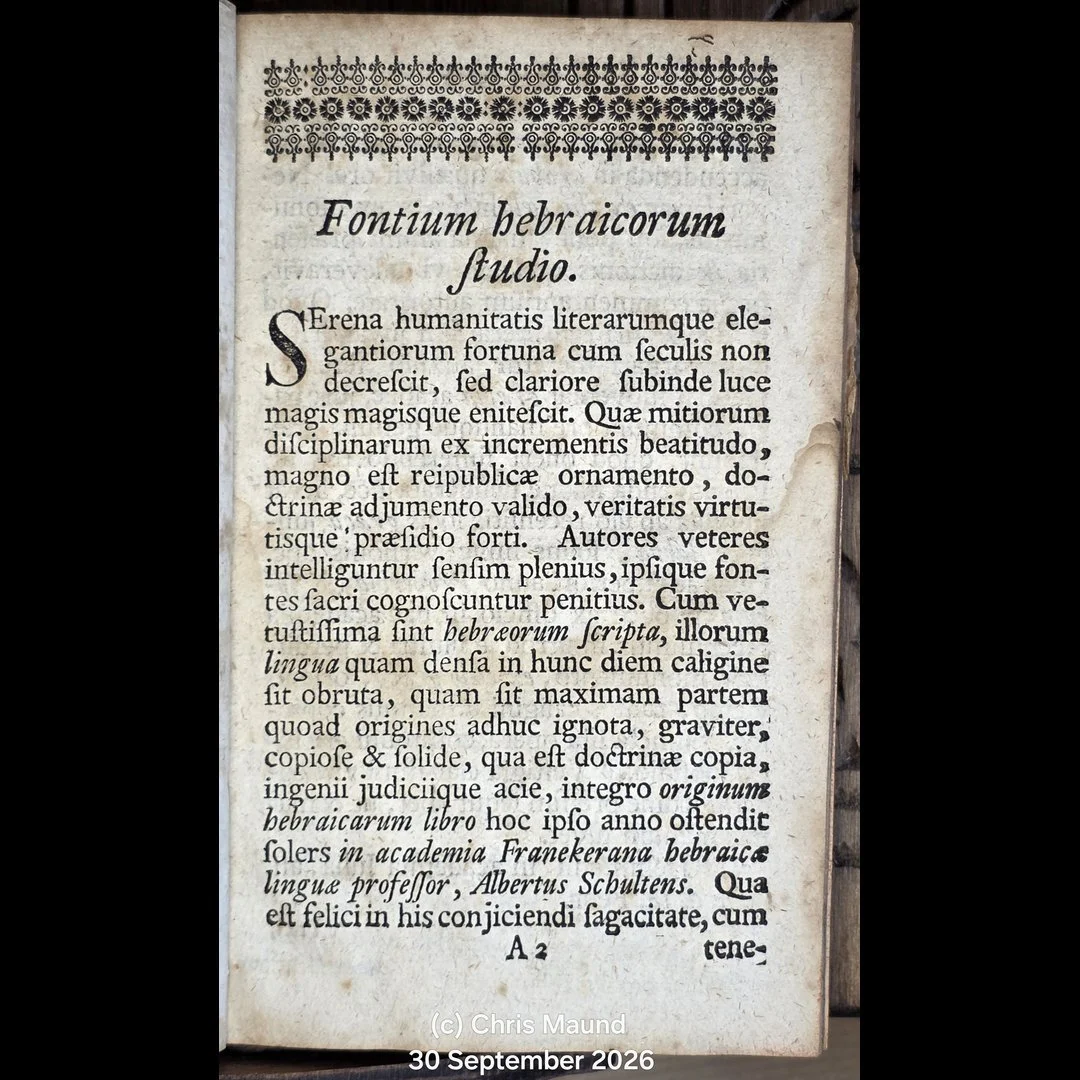
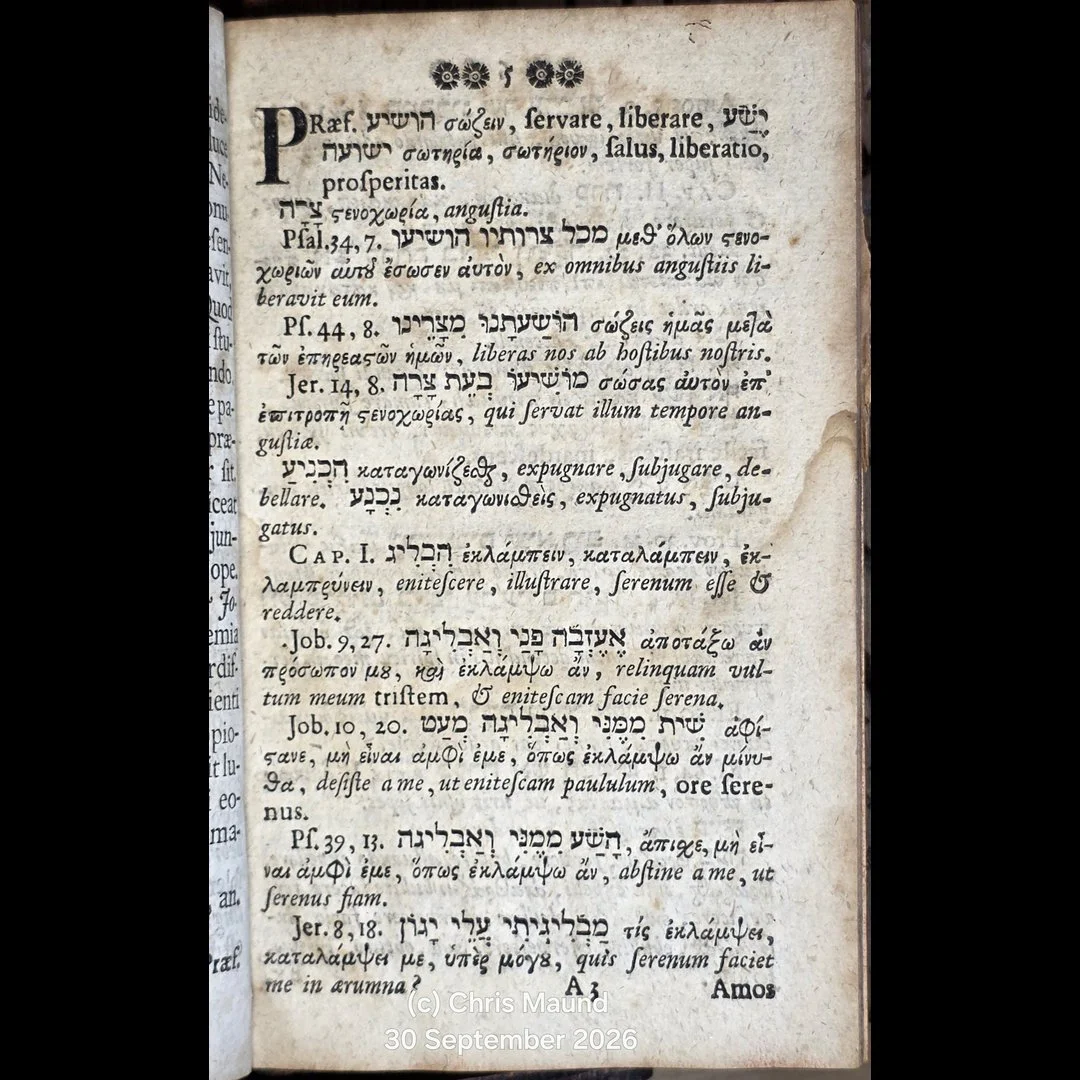
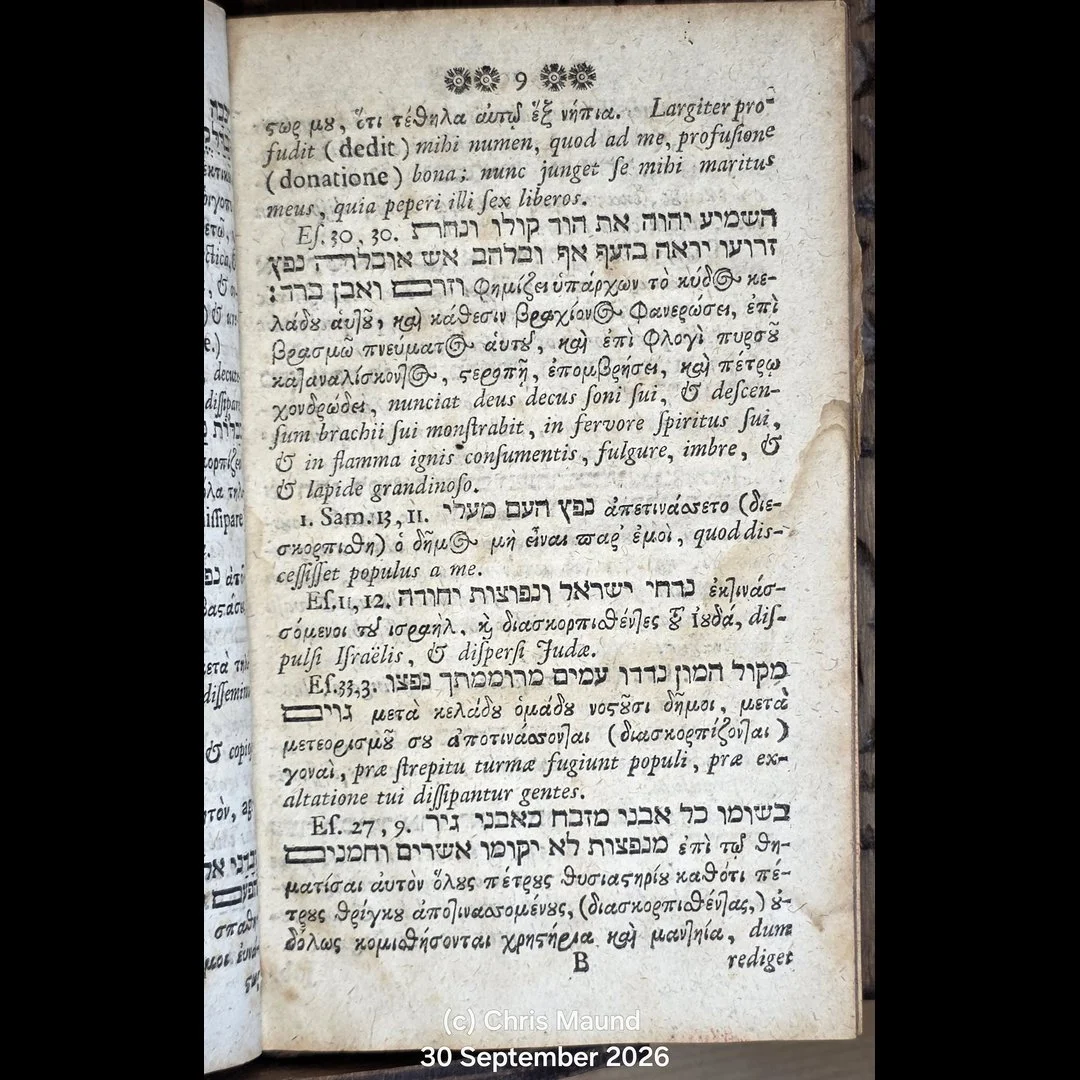
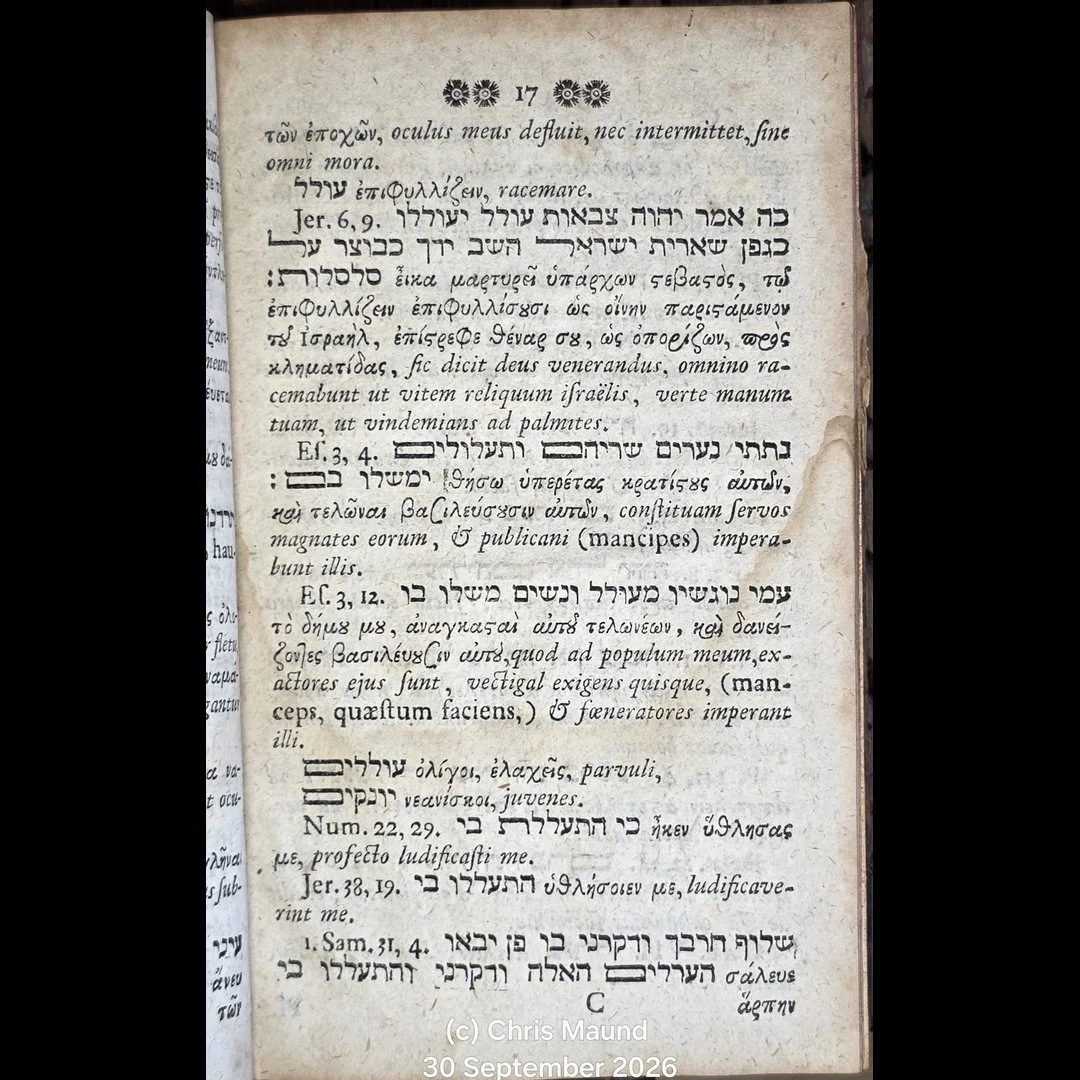
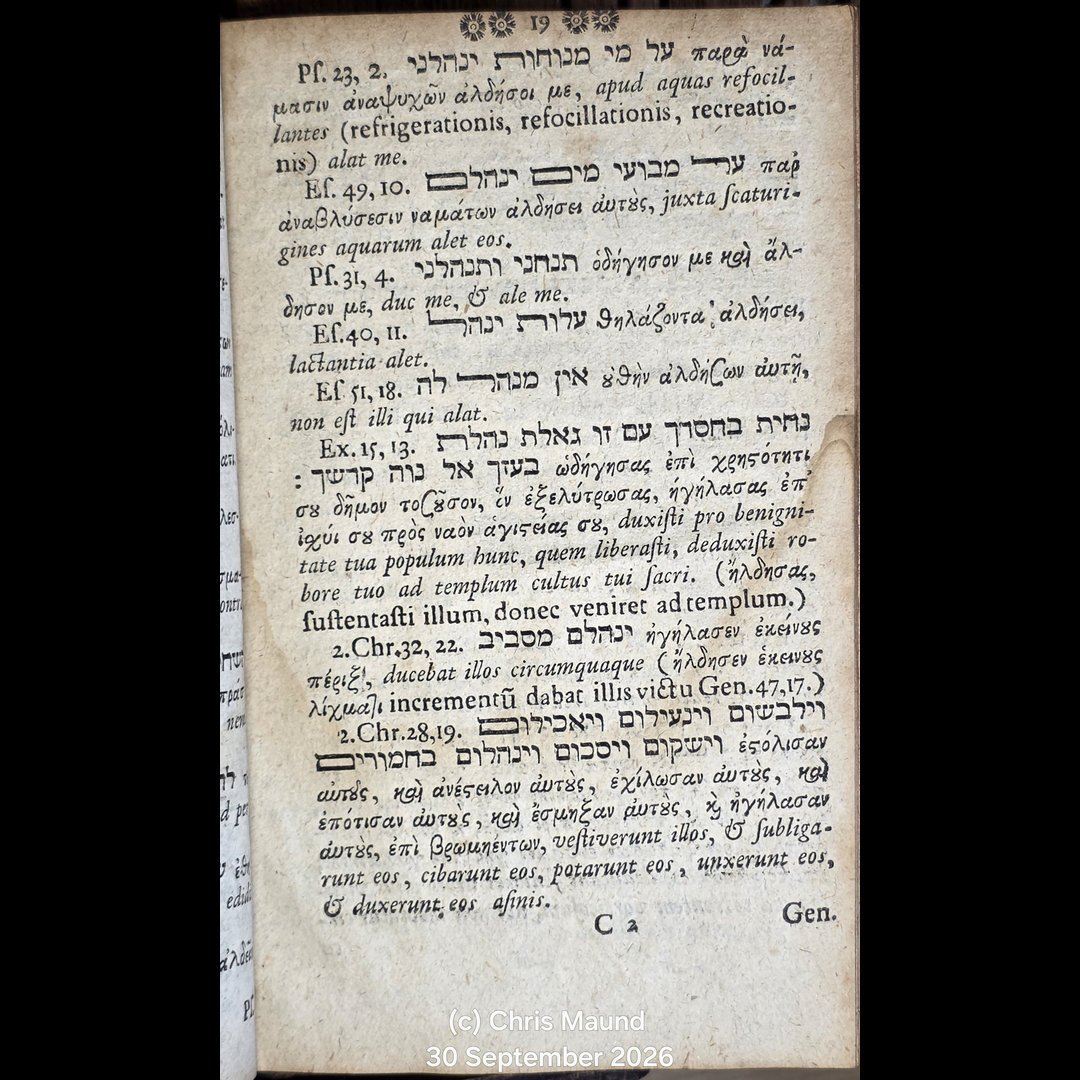
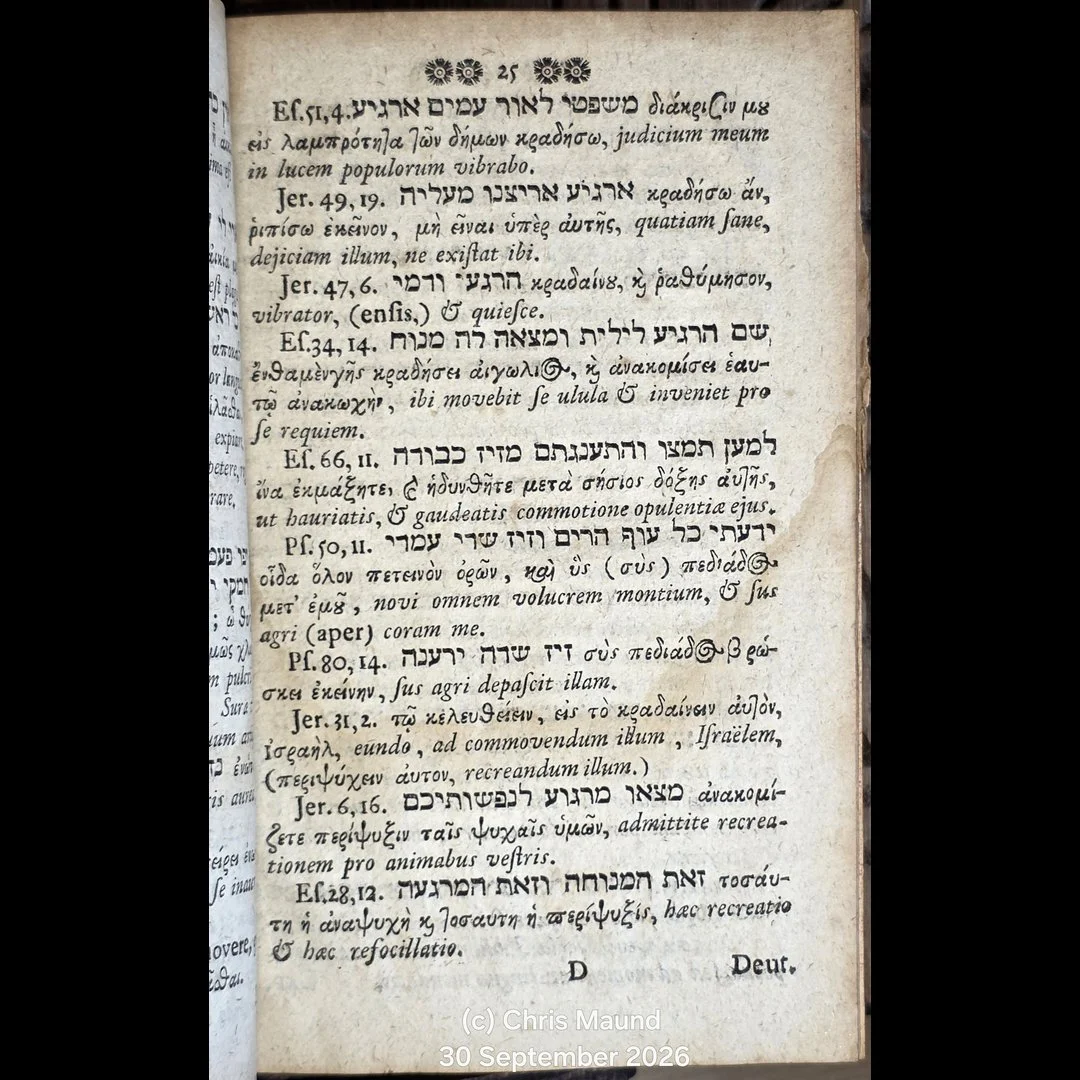
The Greek New Testament is handsomely printed in two columns, divided into verses, with parallel references and critical material placed conveniently at the foot of the pages. The preliminary matter includes Mastricht’s extensive Latin prolegomena, tables of manuscript sigla and the Canones Critici, while a separately paginated section of Latin critical notes follows the biblical text.
The volume is additionally illustrated with an engraved frontispiece and the complete suite of four engraved folding maps and plans, comprising views/plans associated with Jerusalem and the Temple together with maps of the Holy Land and the Mediterranean. The red-and-black typographical title page is particularly attractive.
This copy also has distinguished eighteenth-century English provenance, retaining the large armorial bookplate of Charles Grave Hudson, Esq. (1730–1813), later Sir Charles Grave Hudson, 1st Baronet, of Wanlip Hall, Leicestershire. Hudson served as High Sheriff of Leicestershire and was a director of the South Sea Company. Institutional collections, including Cambridge University Library and Eton College, record other books carrying the same Charles Grave Hudson armorial bookplate.
A complete and appealing example of an important scholarly Greek New Testament, combining early textual criticism, biblical cartography and identifiable eighteenth-century provenance.
Editorial Tradition: Étienne de Courcelles; John Fell; the Oxford Greek New Testament tradition; with reference to the critical work of John Mill
PROVENANCE
Sir Charles Grave Hudson, 1st Baronet (1730–1813)
Armorial bookplate to the front pastedown reading “Charles Grave Hudson, Esq.”
Charles Grave Hudson became owner of Wanlip Hall in Leicestershire and served as High Sheriff of the county. He was also a director of the South Sea Company and was created a baronet in 1791.
The use of the style “Esq.” on the bookplate is consistent with a plate designed or used before his elevation to the baronetcy, although it does not in itself establish the date at which this particular volume entered his library.
Other surviving books bearing the same armorial bookplate are recorded in major institutional collections, including Cambridge University Library and Eton College, establishing Hudson as an identifiable eighteenth-century bibliophile and providing this copy with attractive and documented provenance.
CONDITION, COLLATION & COPY NOTES
COLLATION
[2], 88, 255, [3], 255–560, 37, [1] pp.; engraved frontispiece and four folding engraved maps/plans.
The unusual pagination around p.255 is a feature recorded in bibliographical descriptions of the edition and does not indicate loss.
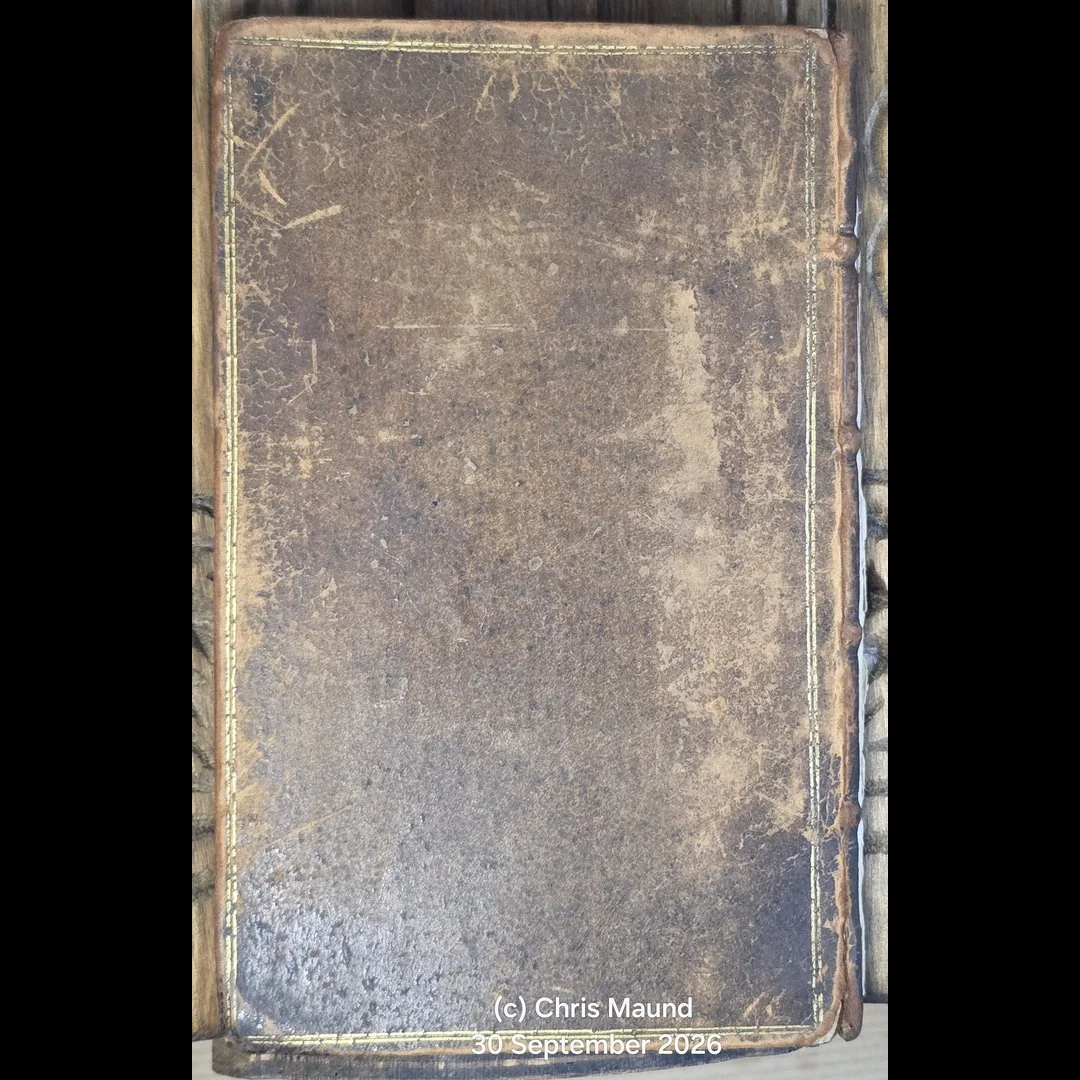
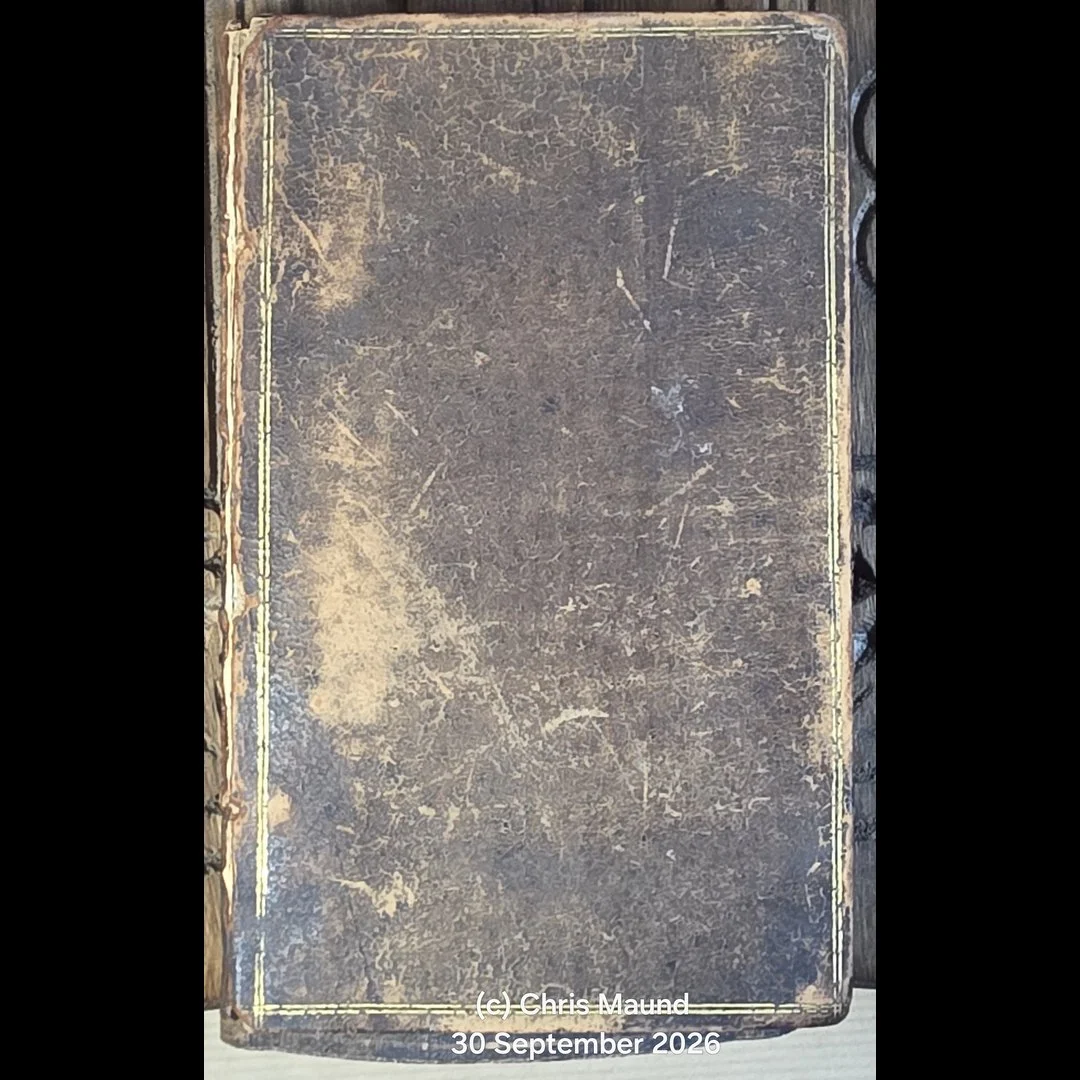
A complete and bibliographically attractive copy, internally very well preserved overall, in contemporary or early calf boards which have been sympathetically rebacked in later calf.
The retained original boards show substantial age-related rubbing, staining, abrasion and areas of surface loss, particularly towards the spine edges and extremities. The later reback is executed in brown calf with raised bands, gilt rules and black gilt-lettered labels, retaining the historical character of the original boards while presenting attractively on the shelf.
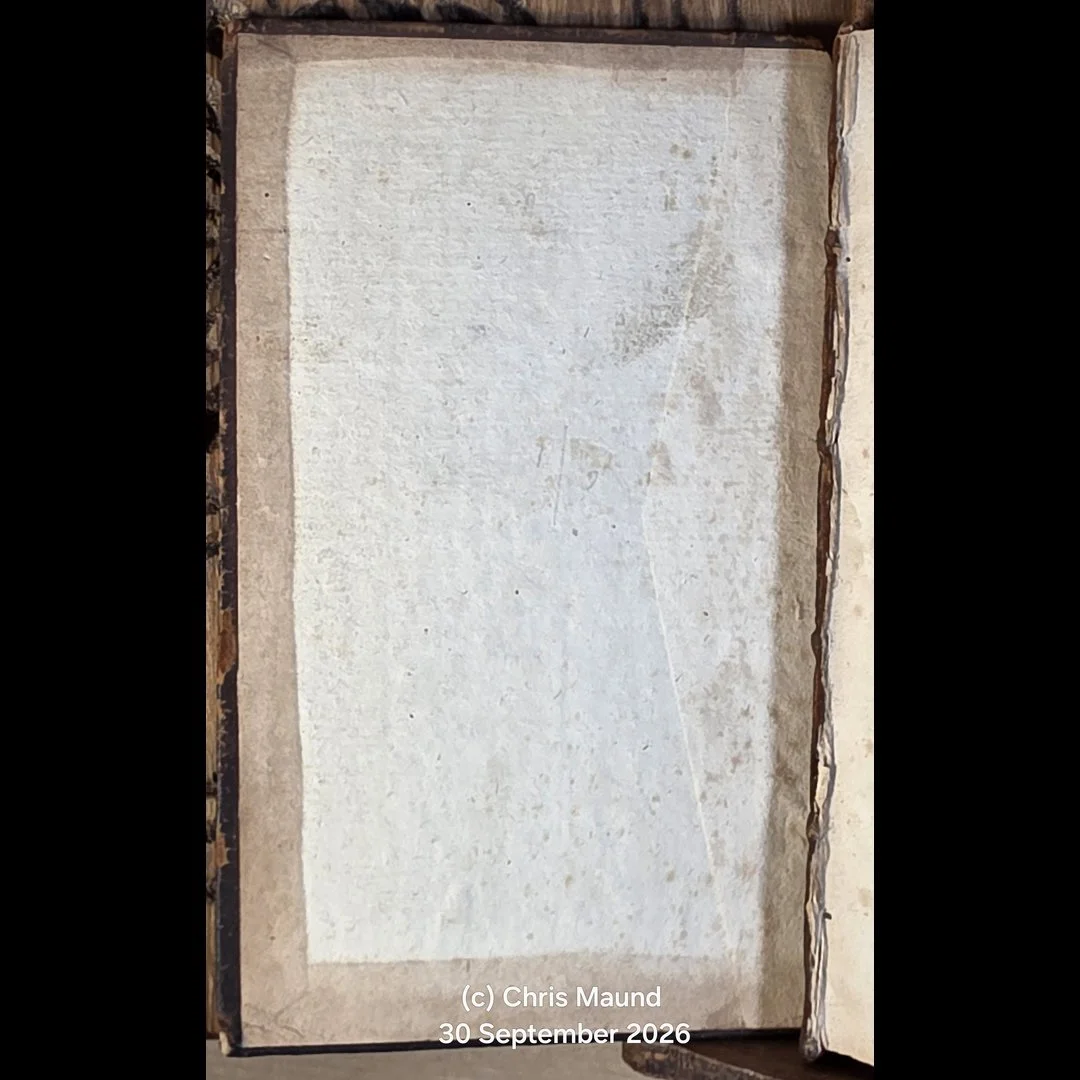
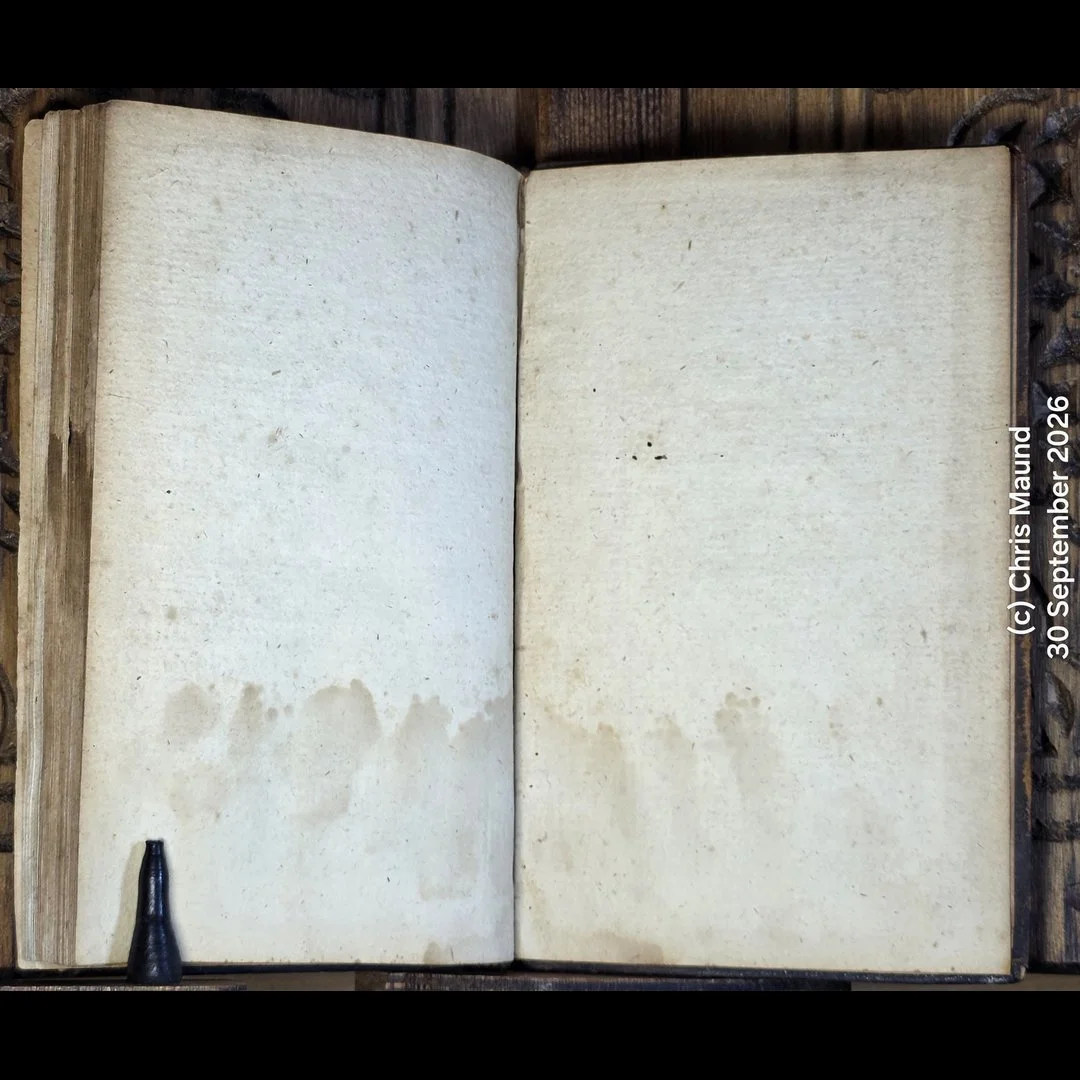
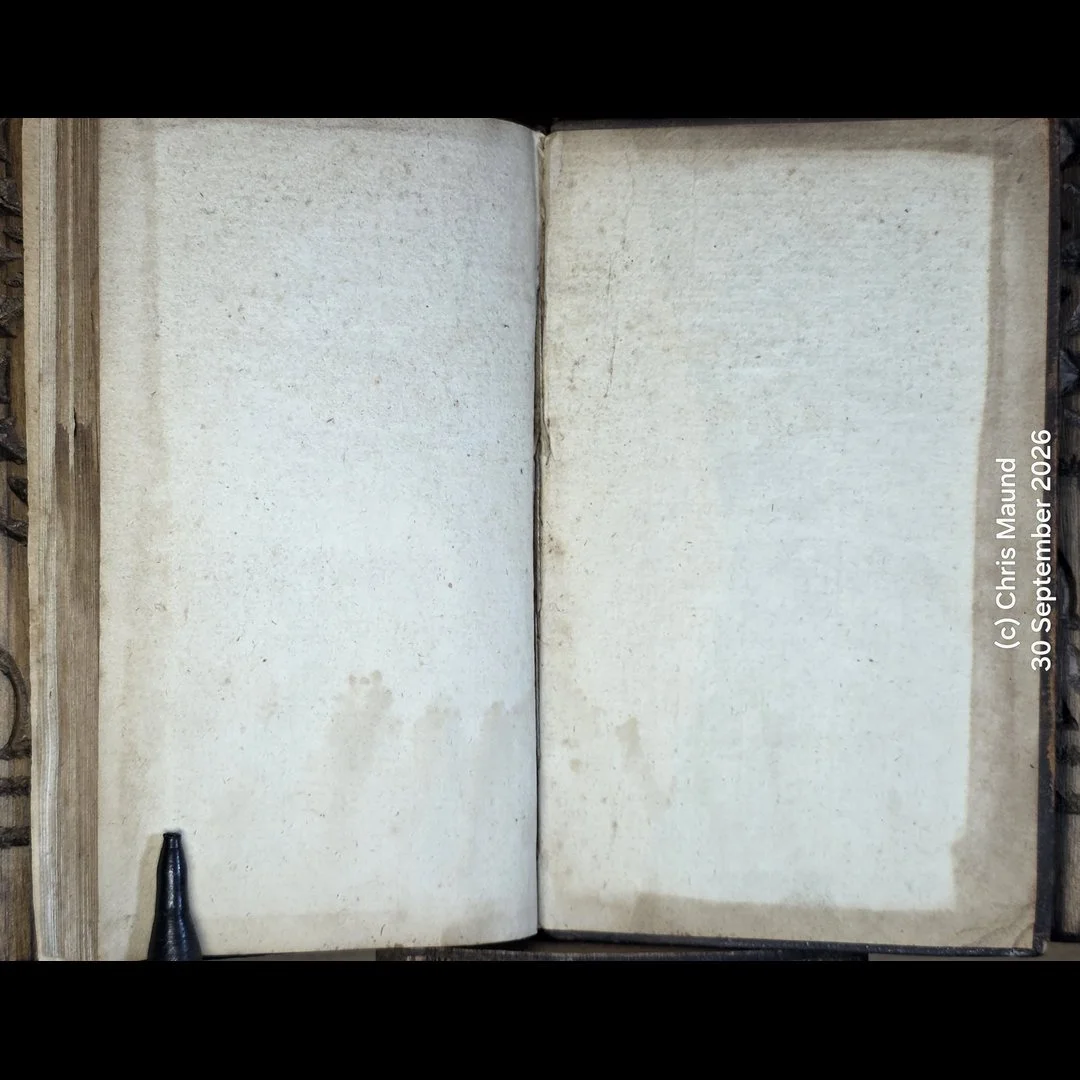
Armorial bookplate of Charles Grave Hudson, Esq., later Sir Charles Grave Hudson, 1st Baronet, to the front pastedown. Front and rear endpapers with age-related staining and marking.
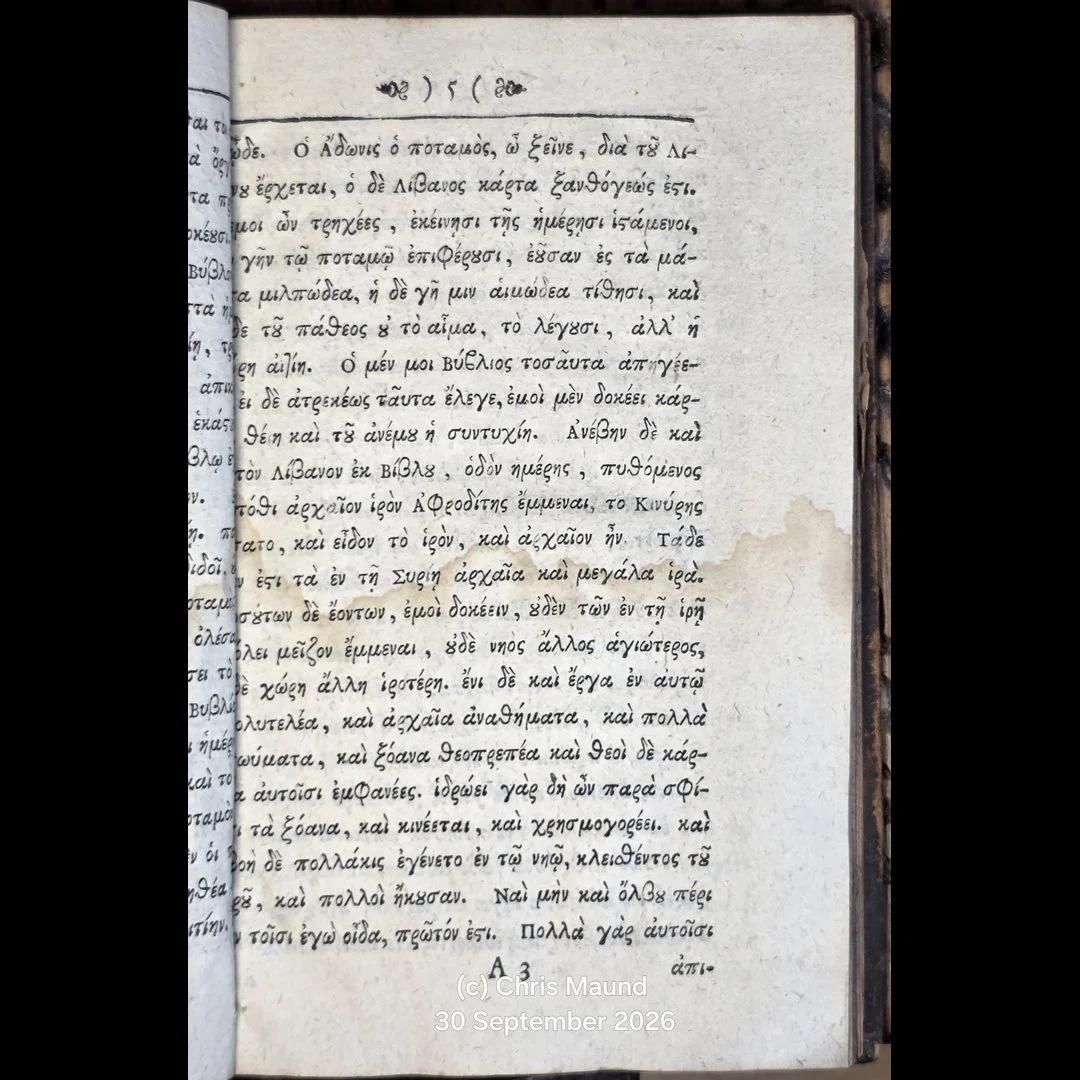
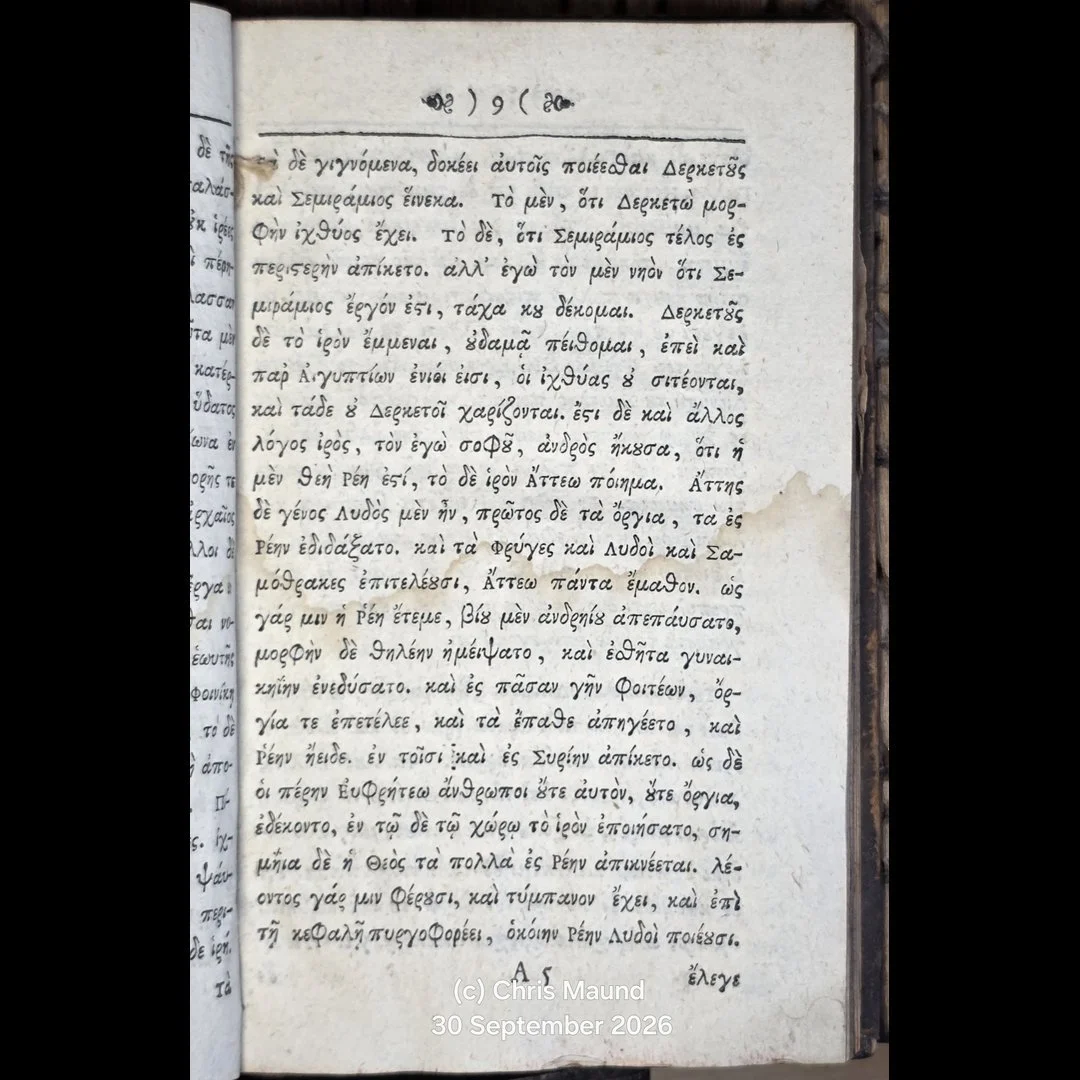
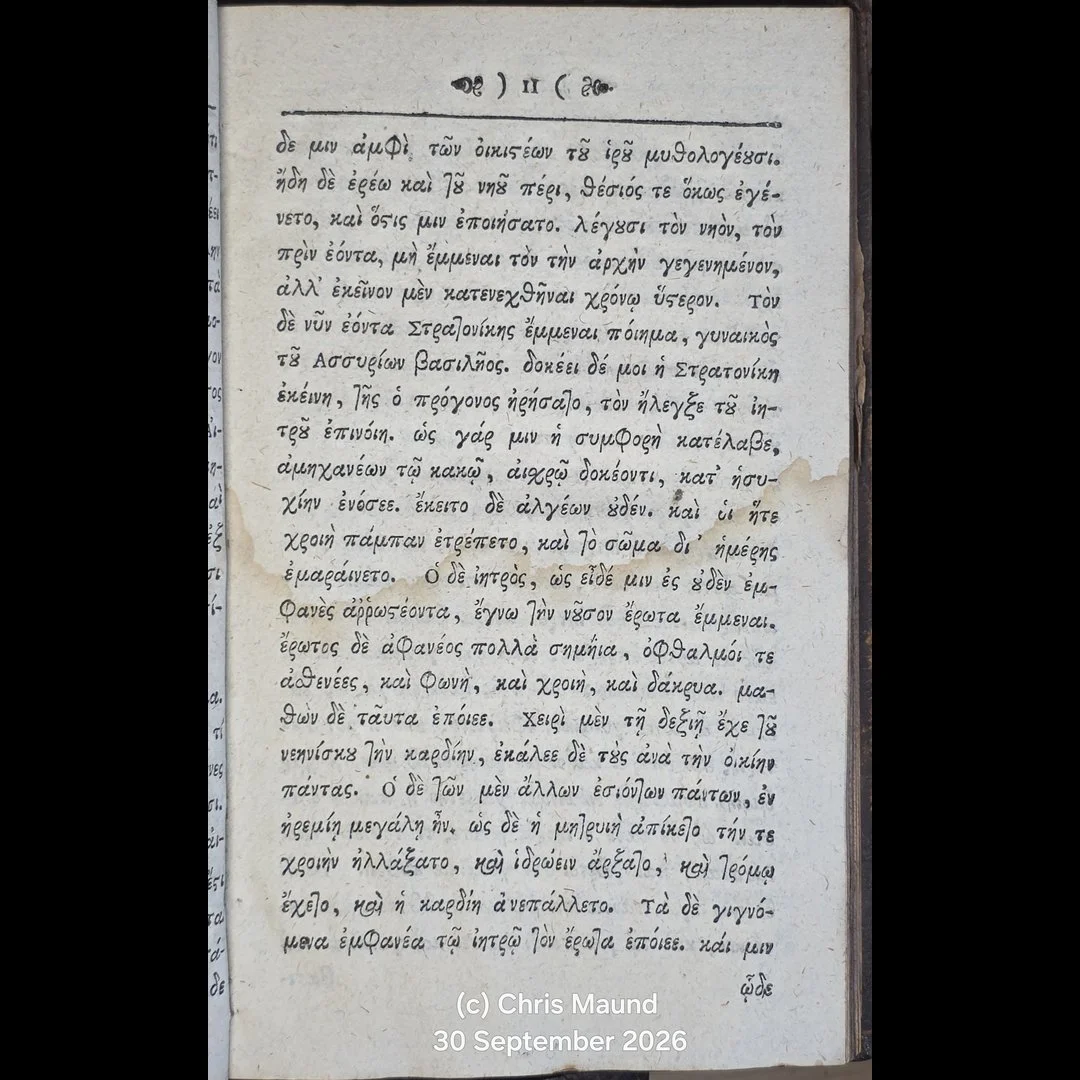
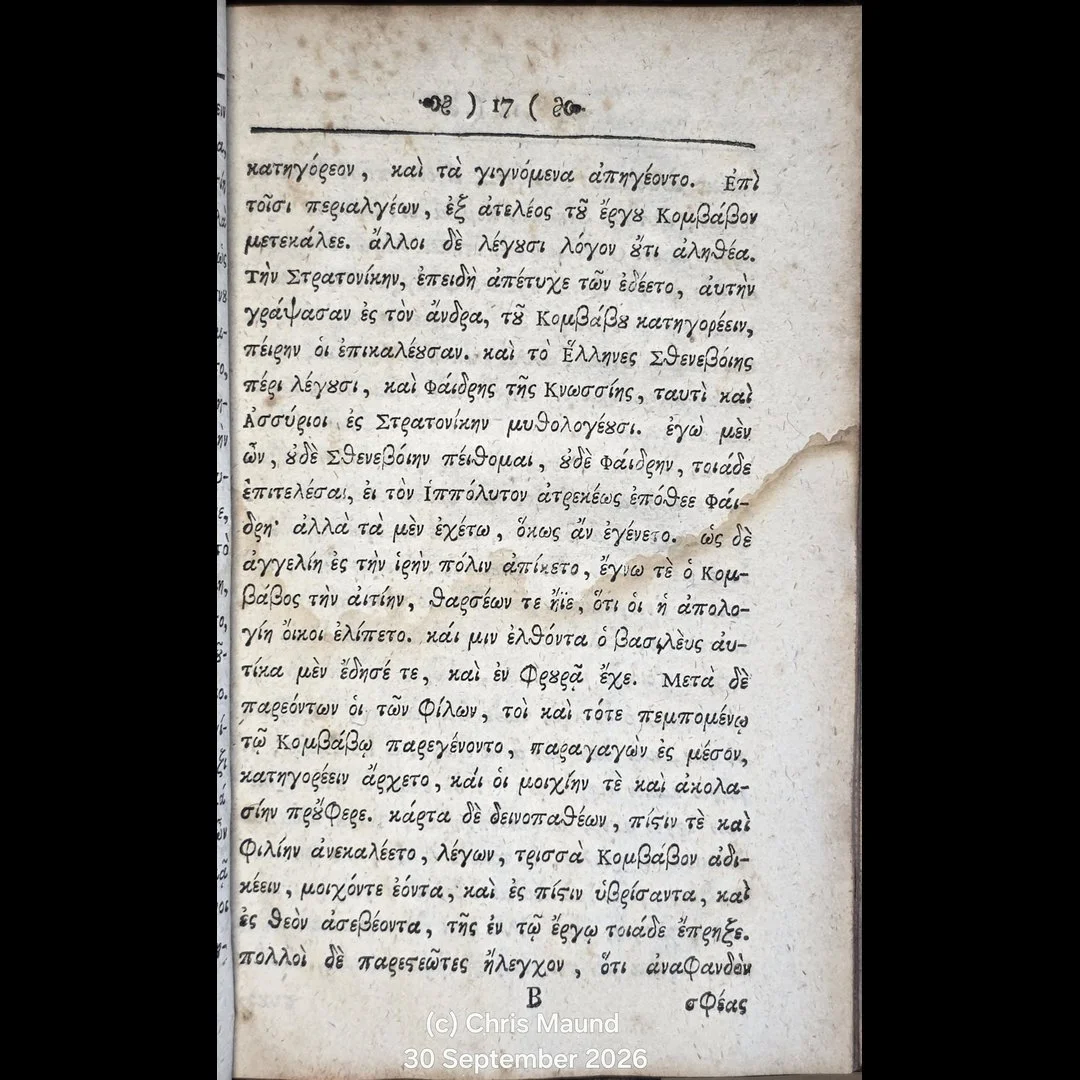
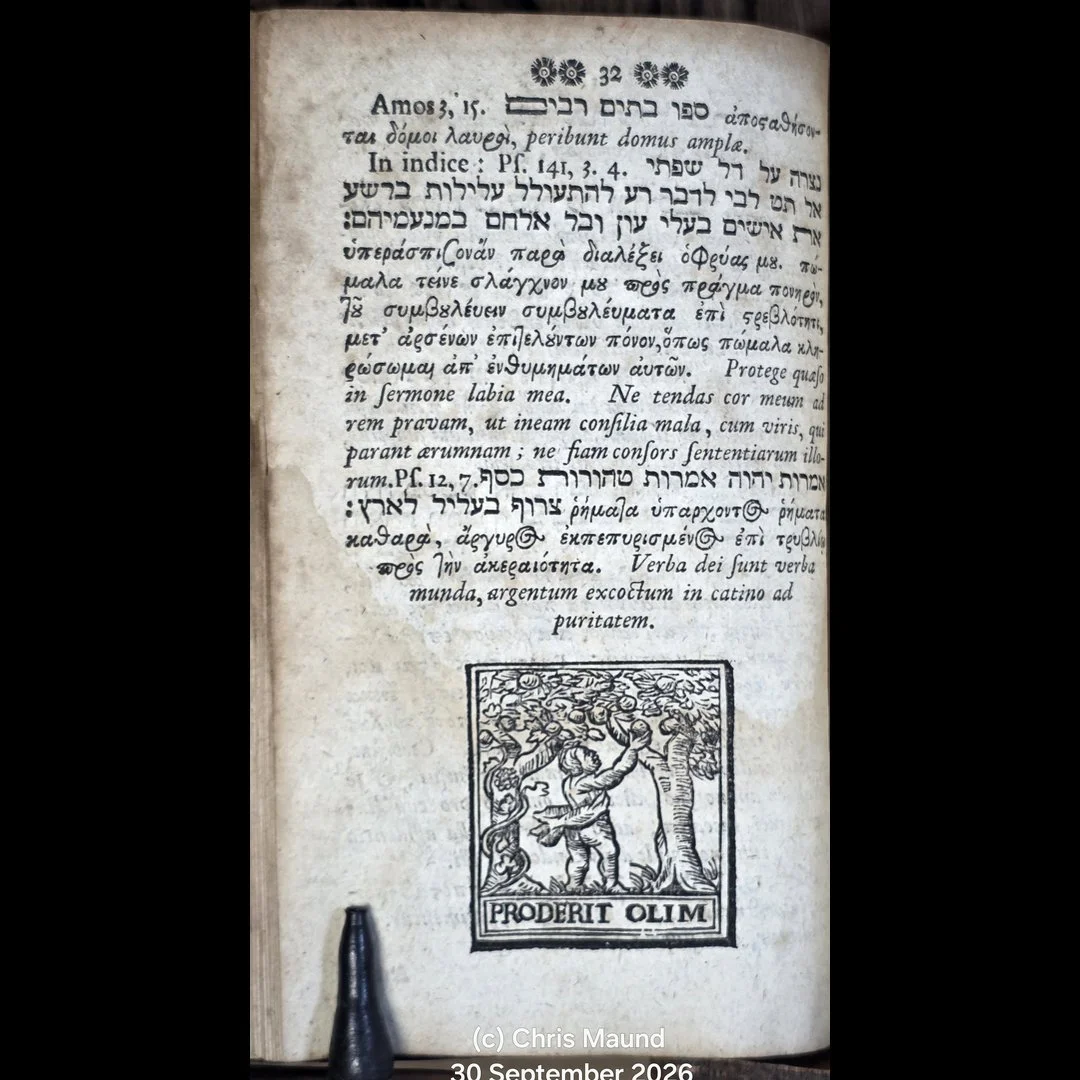
Internally substantially cleaner and better preserved than the exterior. Engraved frontispiece present. Title page printed in red and black and remaining crisp and attractive. Greek text generally clean and strongly printed, with good margins and comparatively modest age-toning and spotting for a volume of this date.
Some small marginal pinholes/old worming are visible through portions of the preliminary matter, without significant loss of text. Occasional minor handling marks and age-toning, with some staining towards the inner margin at the rear and expected darkening/soiling to the exposed text-block edges.
Complete with the engraved frontispiece and all four engraved folding maps and plans, including the plan of Jerusalem, plan of the Temple, map of the Holy Land and Mediterranean map. The folding material remains an especially attractive feature of the volume.
The preliminary scholarly material includes manuscript sigla and Mastricht’s XLIII Canones Critici. The main Greek text is printed in two columns, with parallel references and critical material at the foot of the page. The terminal Latin section, Notae Criticae, is separately paginated.
Please see Photos as part of condition report.
REFERENCES
Darlow & Moule 4728
STCN 245597530
National Trust Collections, NT 3087323
WorldCat / OCLC 9331612
Scrivener, A Plain Introduction to the Criticism of the New Testament, discussion of Mastricht’s 1711 Amsterdam edition
SYNOPSIS
This 1711 Amsterdam Greek New Testament represents an important stage in the development of modern biblical textual criticism.
Edited by Gerhard von Mastricht, it builds upon the seventeenth-century Greek New Testament tradition associated particularly with Étienne de Courcelles and John Fell, while responding to the enormous body of manuscript evidence assembled by John Mill in his landmark Oxford New Testament of 1707.
Rather than simply reproducing a received Greek text, Mastricht sought to place the reader directly before the textual evidence. The New Testament is printed in Greek in two columns, accompanied by parallel scriptural passages and an extensive apparatus of variant readings drawn, as the title page announces, from more than one hundred manuscripts and ancient versions. Additional readings were taken from a manuscript preserved in the Imperial Library at Vienna.
Most distinctive is Mastricht’s attempt to evaluate these competing readings according to a systematic series of forty-three critical canons — the XLIII Canones Critici. These principles were intended to help determine the relative authority, origin and likelihood of variant readings rather than merely recording their existence.
Extensive Latin prolegomena explain the manuscripts, sources and critical methodology employed, while separately paginated critical notes follow the New Testament. The volume therefore provides a particularly tangible illustration of the transition from the traditional printed Greek New Testament towards the increasingly manuscript-based and methodical textual scholarship of the eighteenth century.
The edition is also visually appealing. It includes an engraved frontispiece together with the complete suite of four folding engraved maps and plans: a plan of Jerusalem, a plan of the Temple, a map of the Holy Land and a map of the Mediterranean world associated with the New Testament narrative.
Published only four years after Mill’s monumental 1707 edition, Mastricht’s compact and accessible New Testament placed much of this developing critical scholarship into a form usable by theologians, ministers and learned readers. The revised 1735 Editio altera demonstrates the continuing significance of the project.
For collectors today, the 1711 edition consequently has interest on several levels: as an early eighteenth-century Greek Bible, as an artefact in the history of New Testament textual criticism, as an illustrated work of biblical cartography, and — in this copy — as a book with identifiable eighteenth-century English provenance.
AUTHOR BIO
Editor Bio: Gerhard von Mastricht (1639–1721)
Gerhard von Mastricht was a jurist, theologian, scholar and civic official whose career combined academic work with public service. After studying law and receiving his doctorate at Basel, he taught at Duisburg before later serving as syndic of Bremen.
His scholarly interests ranged across canon law, ecclesiastical history and theology. In the history of biblical scholarship, however, he is remembered particularly for this compact but ambitious 1711 Greek New Testament.
Publishing under the initials G.D.T.M.D., expanded as Gerhardus de Trajectu Mosae Doctor, Mastricht brought together the work of earlier seventeenth-century editors with additional manuscript evidence and his own system of forty-three critical canons. His attempt to classify and assess variant readings places the edition within the gradual emergence of a more systematic discipline of New Testament textual criticism.
A revised and enlarged second edition appeared at Amsterdam in 1735.
Editorial Context:
Étienne de Courcelles (1586–1659) was a French Protestant theologian whose Greek New Testament became influential for its presentation of textual variants and supplied an important foundation for subsequent seventeenth-century editors.
John Fell (1625–1686), Bishop of Oxford and Dean of Christ Church, produced the important Oxford Greek New Testament of 1675. Mastricht drew particularly heavily upon Fell’s text and critical material.
John Mill (1645–1707) brought seventeenth-century textual scholarship to a new level with his monumental Oxford Greek New Testament of 1707, whose enormous apparatus assembled variant readings accumulated over decades of manuscript study. Mastricht’s much more compact 1711 edition appeared only four years later and belongs directly to this rapidly developing scholarly environment.
ILLUSTRATOR
Willem de Broen (frontispiece engraver)
Willem de Broen was an Amsterdam engraver active during the late seventeenth and early eighteenth centuries and particularly associated with portrait engraving, reproductive prints and book illustration.
Dutch biographical sources describe him as a skilled plaatsnijder — copperplate engraver — working in Amsterdam. Among his known works were engraved series after the celebrated Dutch genre painter Adriaen van Ostade, including rustic and peasant scenes, together with religious subjects such as the story of the Prodigal Son and the Works of Mercy. He was also involved in the production of engraved biblical illustrations.
De Broen produced portraits of prominent seventeenth- and early eighteenth-century intellectual, religious and political figures, including the theologians Johannes Coccejus and Gisbertus Voetius, and in 1707 engraved a portrait of Prince Eugene of Savoy. His surviving work places him firmly within Amsterdam’s flourishing culture of printmaking and illustrated publishing at the beginning of the eighteenth century.
The engraved frontispiece to this 1711 Greek New Testament is by Willem de Broen. It forms part of the visual programme accompanying Mastricht’s scholarly edition, alongside the four folding biblical maps and plans.
De Broen’s wider connection with biblical illustration is well established. Nineteenth- and twentieth-century Dutch biographical dictionaries record his participation in engraved Bible plates, while the Rijksmuseum preserves biblical engravings associated with Willem de Broen from approximately the same period.
His contribution to the present volume therefore places the book not only within the history of biblical textual scholarship but also within the exceptionally productive world of early eighteenth-century Amsterdam engraving and religious publishing.
1711 First Mastricht Edition With Provenance
HE KAINE DIATHEKE. NOVUM TESTAMENTUM
By Gerhard von Mastricht
KEY DETAILS
Condition: Good
Format: Hardcover, Octavo (Standard) (8vo 6 × 9 in 152 × 229 mm )
Note: Binding/size selection follows standard bibliographic conventions and is approximate; exact measurements may vary.
Published By: Ex Officina Wetsteniana, Amstelaedami [Amsterdam], 1711
Language: Ancient Greek and Latin
Illustrated By: Willem de Broen (frontispiece engraver)
Provenance: Sir Charles Grave Hudson, 1st Baronet (1730–1813)
Collation: [2], 88, 255, [3], 255–560, 37, [1] pp.; engraved frontispiece and four folding engraved maps/plans.
Dust Jacket: None, as issued
SKU: BTETM0001848
Shipping Info: Approximate Package Dimensions H: 12.5, L: 30, W: 25 (Units: cm), W: 2Kg
Tracked Shipping, Insurance Coverage as per Customer Request
DESCRIPTION
HE KAINE DIATHEKE. NOVUM TESTAMENTUM
[THE GREEK NEW TESTAMENT]
Edited by Gerhard von Mastricht, drawing upon the earlier work of Étienne de Courcelles, John Fell and the Oxford textual tradition
An important and attractive early eighteenth-century Greek New Testament, printed at Amsterdam by the Wetstein press in 1711: the first edition of Gerhard von Mastricht’s recension and a notable witness to the development of New Testament textual criticism in the generation immediately following John Mill.
Rather than presenting the biblical text alone, Mastricht assembled a compact scholarly apparatus around the Greek New Testament. Building particularly upon the editions of Étienne de Courcelles and John Fell, he supplied extensive parallel passages and variant readings drawn, as the title itself announces, from more than one hundred manuscripts and ancient versions. He further incorporated variants from a manuscript in the Imperial Library at Vienna and attempted to assess competing readings systematically through his celebrated forty-three critical canons — the XLIII Canones — accompanied by substantial prolegomena and terminal critical notes.
The result belongs to an important transitional period in biblical scholarship. The traditional printed Greek text remained dominant, but scholars were increasingly confronting it with manuscript evidence, early versions and the accumulated work of earlier editors. Mastricht’s edition therefore stands between the seventeenth-century tradition represented by Courcelles and Fell and the increasingly sophisticated textual criticism of Mill, Wettstein and their eighteenth-century successors.
The Greek New Testament is handsomely printed in two columns, divided into verses, with parallel references and critical material placed conveniently at the foot of the pages. The preliminary matter includes Mastricht’s extensive Latin prolegomena, tables of manuscript sigla and the Canones Critici, while a separately paginated section of Latin critical notes follows the biblical text.
The volume is additionally illustrated with an engraved frontispiece and the complete suite of four engraved folding maps and plans, comprising views/plans associated with Jerusalem and the Temple together with maps of the Holy Land and the Mediterranean. The red-and-black typographical title page is particularly attractive.
This copy also has distinguished eighteenth-century English provenance, retaining the large armorial bookplate of Charles Grave Hudson, Esq. (1730–1813), later Sir Charles Grave Hudson, 1st Baronet, of Wanlip Hall, Leicestershire. Hudson served as High Sheriff of Leicestershire and was a director of the South Sea Company. Institutional collections, including Cambridge University Library and Eton College, record other books carrying the same Charles Grave Hudson armorial bookplate.
A complete and appealing example of an important scholarly Greek New Testament, combining early textual criticism, biblical cartography and identifiable eighteenth-century provenance.
Editorial Tradition: Étienne de Courcelles; John Fell; the Oxford Greek New Testament tradition; with reference to the critical work of John Mill
PROVENANCE
Sir Charles Grave Hudson, 1st Baronet (1730–1813)
Armorial bookplate to the front pastedown reading “Charles Grave Hudson, Esq.”
Charles Grave Hudson became owner of Wanlip Hall in Leicestershire and served as High Sheriff of the county. He was also a director of the South Sea Company and was created a baronet in 1791.
The use of the style “Esq.” on the bookplate is consistent with a plate designed or used before his elevation to the baronetcy, although it does not in itself establish the date at which this particular volume entered his library.
Other surviving books bearing the same armorial bookplate are recorded in major institutional collections, including Cambridge University Library and Eton College, establishing Hudson as an identifiable eighteenth-century bibliophile and providing this copy with attractive and documented provenance.
CONDITION, COLLATION & COPY NOTES
COLLATION
[2], 88, 255, [3], 255–560, 37, [1] pp.; engraved frontispiece and four folding engraved maps/plans.
The unusual pagination around p.255 is a feature recorded in bibliographical descriptions of the edition and does not indicate loss.
A complete and bibliographically attractive copy, internally very well preserved overall, in contemporary or early calf boards which have been sympathetically rebacked in later calf.
The retained original boards show substantial age-related rubbing, staining, abrasion and areas of surface loss, particularly towards the spine edges and extremities. The later reback is executed in brown calf with raised bands, gilt rules and black gilt-lettered labels, retaining the historical character of the original boards while presenting attractively on the shelf.
Armorial bookplate of Charles Grave Hudson, Esq., later Sir Charles Grave Hudson, 1st Baronet, to the front pastedown. Front and rear endpapers with age-related staining and marking.
Internally substantially cleaner and better preserved than the exterior. Engraved frontispiece present. Title page printed in red and black and remaining crisp and attractive. Greek text generally clean and strongly printed, with good margins and comparatively modest age-toning and spotting for a volume of this date.
Some small marginal pinholes/old worming are visible through portions of the preliminary matter, without significant loss of text. Occasional minor handling marks and age-toning, with some staining towards the inner margin at the rear and expected darkening/soiling to the exposed text-block edges.
Complete with the engraved frontispiece and all four engraved folding maps and plans, including the plan of Jerusalem, plan of the Temple, map of the Holy Land and Mediterranean map. The folding material remains an especially attractive feature of the volume.
The preliminary scholarly material includes manuscript sigla and Mastricht’s XLIII Canones Critici. The main Greek text is printed in two columns, with parallel references and critical material at the foot of the page. The terminal Latin section, Notae Criticae, is separately paginated.
Please see Photos as part of condition report.
REFERENCES
Darlow & Moule 4728
STCN 245597530
National Trust Collections, NT 3087323
WorldCat / OCLC 9331612
Scrivener, A Plain Introduction to the Criticism of the New Testament, discussion of Mastricht’s 1711 Amsterdam edition
SYNOPSIS
This 1711 Amsterdam Greek New Testament represents an important stage in the development of modern biblical textual criticism.
Edited by Gerhard von Mastricht, it builds upon the seventeenth-century Greek New Testament tradition associated particularly with Étienne de Courcelles and John Fell, while responding to the enormous body of manuscript evidence assembled by John Mill in his landmark Oxford New Testament of 1707.
Rather than simply reproducing a received Greek text, Mastricht sought to place the reader directly before the textual evidence. The New Testament is printed in Greek in two columns, accompanied by parallel scriptural passages and an extensive apparatus of variant readings drawn, as the title page announces, from more than one hundred manuscripts and ancient versions. Additional readings were taken from a manuscript preserved in the Imperial Library at Vienna.
Most distinctive is Mastricht’s attempt to evaluate these competing readings according to a systematic series of forty-three critical canons — the XLIII Canones Critici. These principles were intended to help determine the relative authority, origin and likelihood of variant readings rather than merely recording their existence.
Extensive Latin prolegomena explain the manuscripts, sources and critical methodology employed, while separately paginated critical notes follow the New Testament. The volume therefore provides a particularly tangible illustration of the transition from the traditional printed Greek New Testament towards the increasingly manuscript-based and methodical textual scholarship of the eighteenth century.
The edition is also visually appealing. It includes an engraved frontispiece together with the complete suite of four folding engraved maps and plans: a plan of Jerusalem, a plan of the Temple, a map of the Holy Land and a map of the Mediterranean world associated with the New Testament narrative.
Published only four years after Mill’s monumental 1707 edition, Mastricht’s compact and accessible New Testament placed much of this developing critical scholarship into a form usable by theologians, ministers and learned readers. The revised 1735 Editio altera demonstrates the continuing significance of the project.
For collectors today, the 1711 edition consequently has interest on several levels: as an early eighteenth-century Greek Bible, as an artefact in the history of New Testament textual criticism, as an illustrated work of biblical cartography, and — in this copy — as a book with identifiable eighteenth-century English provenance.
AUTHOR BIO
Editor Bio: Gerhard von Mastricht (1639–1721)
Gerhard von Mastricht was a jurist, theologian, scholar and civic official whose career combined academic work with public service. After studying law and receiving his doctorate at Basel, he taught at Duisburg before later serving as syndic of Bremen.
His scholarly interests ranged across canon law, ecclesiastical history and theology. In the history of biblical scholarship, however, he is remembered particularly for this compact but ambitious 1711 Greek New Testament.
Publishing under the initials G.D.T.M.D., expanded as Gerhardus de Trajectu Mosae Doctor, Mastricht brought together the work of earlier seventeenth-century editors with additional manuscript evidence and his own system of forty-three critical canons. His attempt to classify and assess variant readings places the edition within the gradual emergence of a more systematic discipline of New Testament textual criticism.
A revised and enlarged second edition appeared at Amsterdam in 1735.
Editorial Context:
Étienne de Courcelles (1586–1659) was a French Protestant theologian whose Greek New Testament became influential for its presentation of textual variants and supplied an important foundation for subsequent seventeenth-century editors.
John Fell (1625–1686), Bishop of Oxford and Dean of Christ Church, produced the important Oxford Greek New Testament of 1675. Mastricht drew particularly heavily upon Fell’s text and critical material.
John Mill (1645–1707) brought seventeenth-century textual scholarship to a new level with his monumental Oxford Greek New Testament of 1707, whose enormous apparatus assembled variant readings accumulated over decades of manuscript study. Mastricht’s much more compact 1711 edition appeared only four years later and belongs directly to this rapidly developing scholarly environment.
ILLUSTRATOR
Willem de Broen (frontispiece engraver)
Willem de Broen was an Amsterdam engraver active during the late seventeenth and early eighteenth centuries and particularly associated with portrait engraving, reproductive prints and book illustration.
Dutch biographical sources describe him as a skilled plaatsnijder — copperplate engraver — working in Amsterdam. Among his known works were engraved series after the celebrated Dutch genre painter Adriaen van Ostade, including rustic and peasant scenes, together with religious subjects such as the story of the Prodigal Son and the Works of Mercy. He was also involved in the production of engraved biblical illustrations.
De Broen produced portraits of prominent seventeenth- and early eighteenth-century intellectual, religious and political figures, including the theologians Johannes Coccejus and Gisbertus Voetius, and in 1707 engraved a portrait of Prince Eugene of Savoy. His surviving work places him firmly within Amsterdam’s flourishing culture of printmaking and illustrated publishing at the beginning of the eighteenth century.
The engraved frontispiece to this 1711 Greek New Testament is by Willem de Broen. It forms part of the visual programme accompanying Mastricht’s scholarly edition, alongside the four folding biblical maps and plans.
De Broen’s wider connection with biblical illustration is well established. Nineteenth- and twentieth-century Dutch biographical dictionaries record his participation in engraved Bible plates, while the Rijksmuseum preserves biblical engravings associated with Willem de Broen from approximately the same period.
His contribution to the present volume therefore places the book not only within the history of biblical textual scholarship but also within the exceptionally productive world of early eighteenth-century Amsterdam engraving and religious publishing.

 Image 1 of 24
 Image 2 of 24
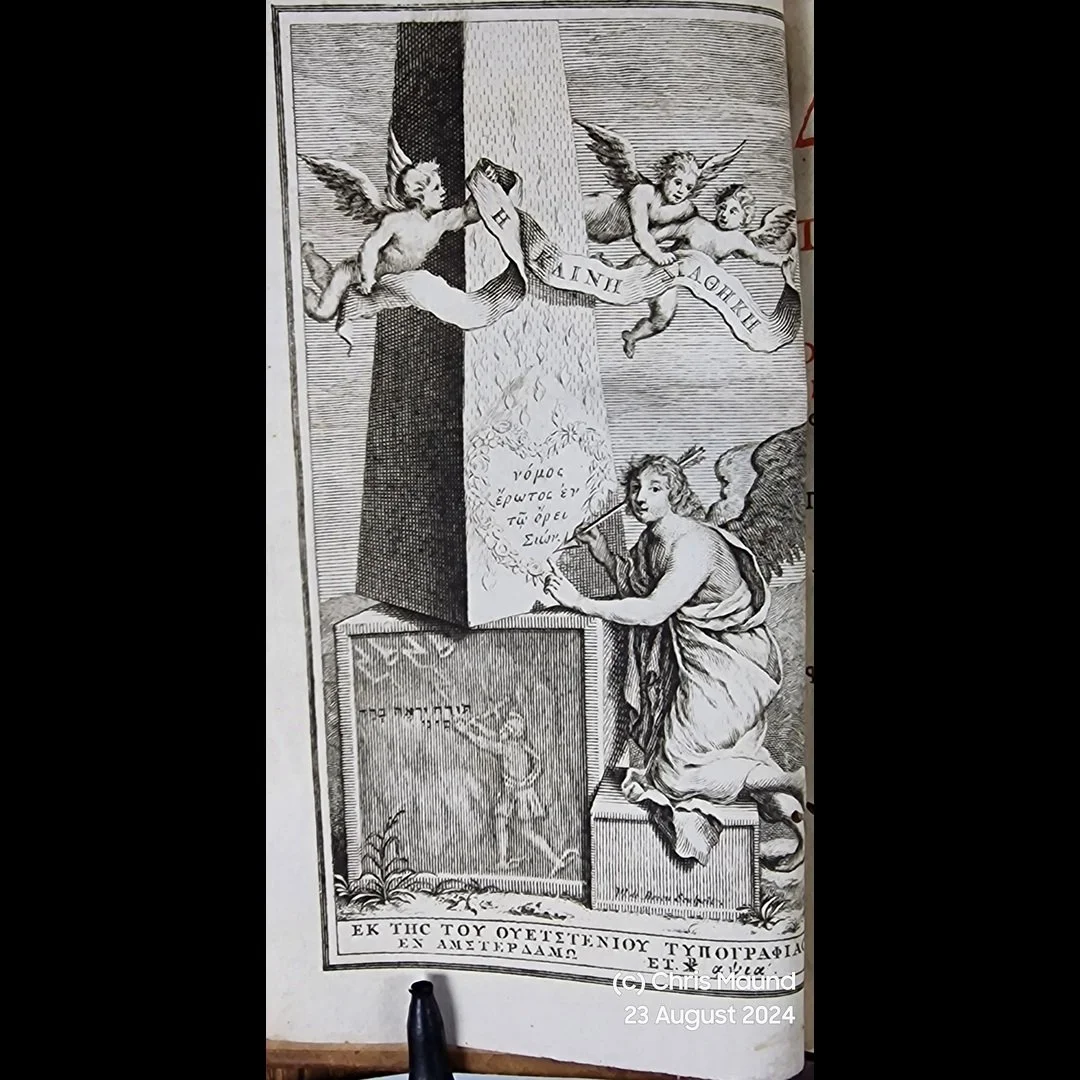 Image 3 of 24
 Image 4 of 24
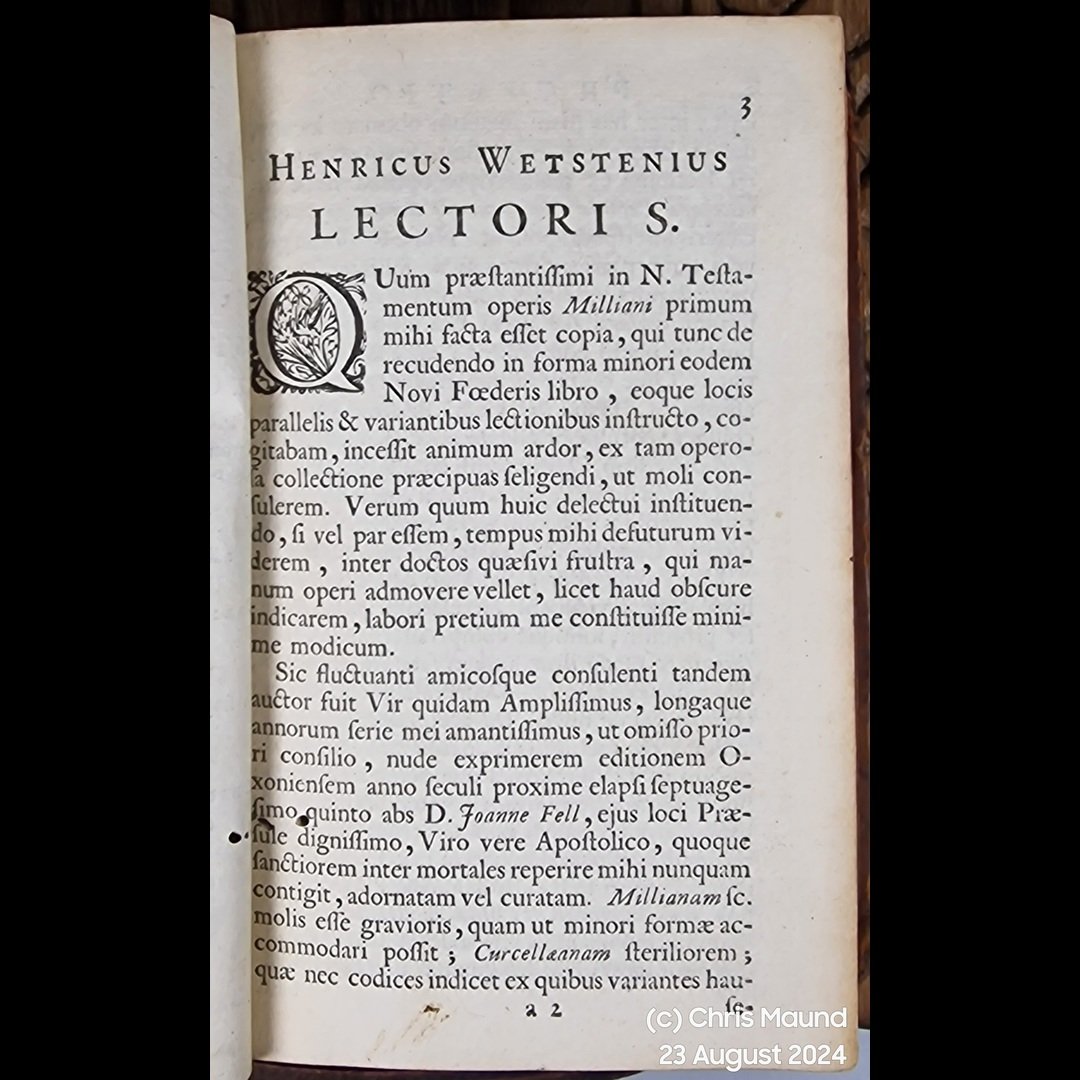 Image 5 of 24
 Image 6 of 24
 Image 7 of 24
 Image 8 of 24
 Image 9 of 24
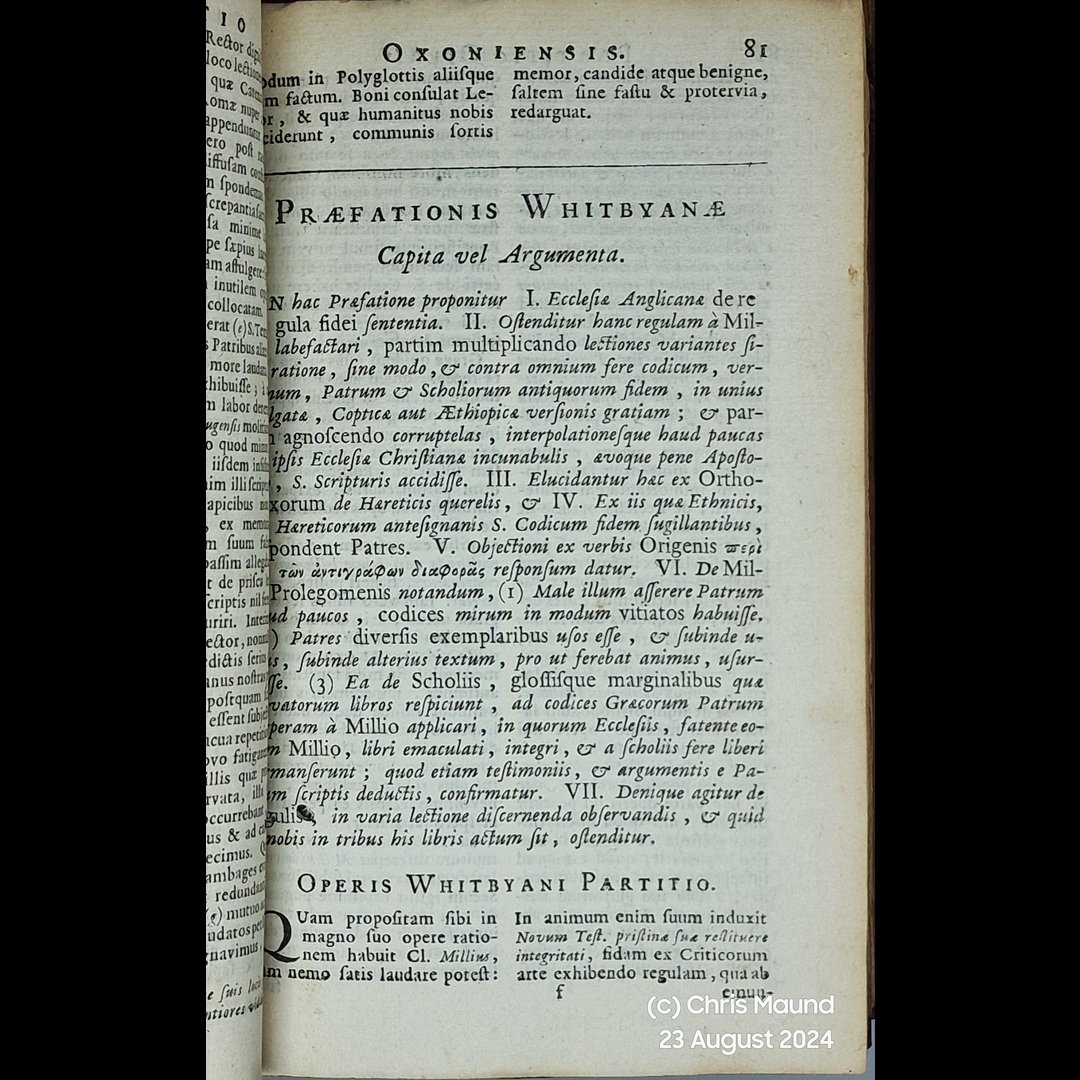 Image 10 of 24
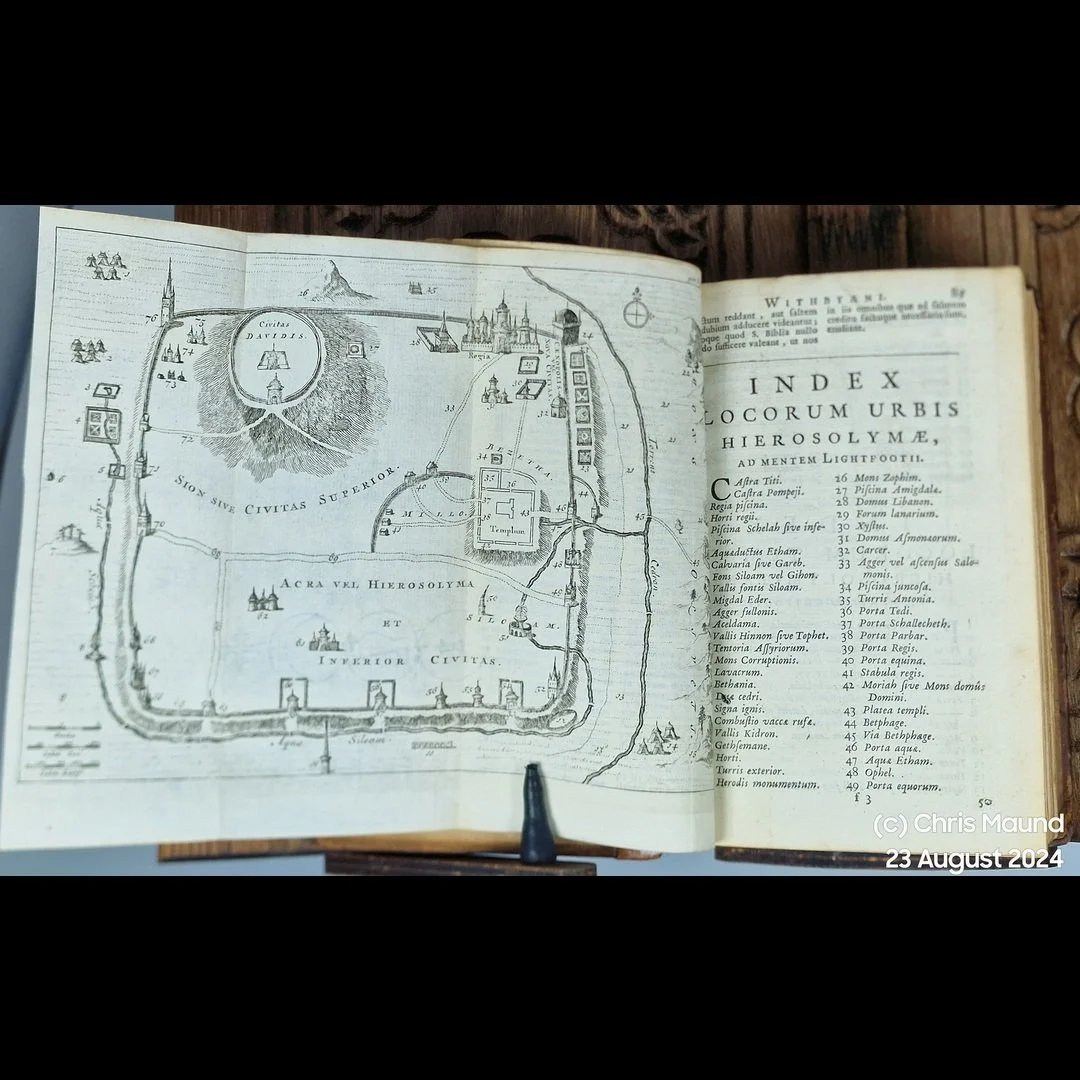 Image 11 of 24
 Image 12 of 24
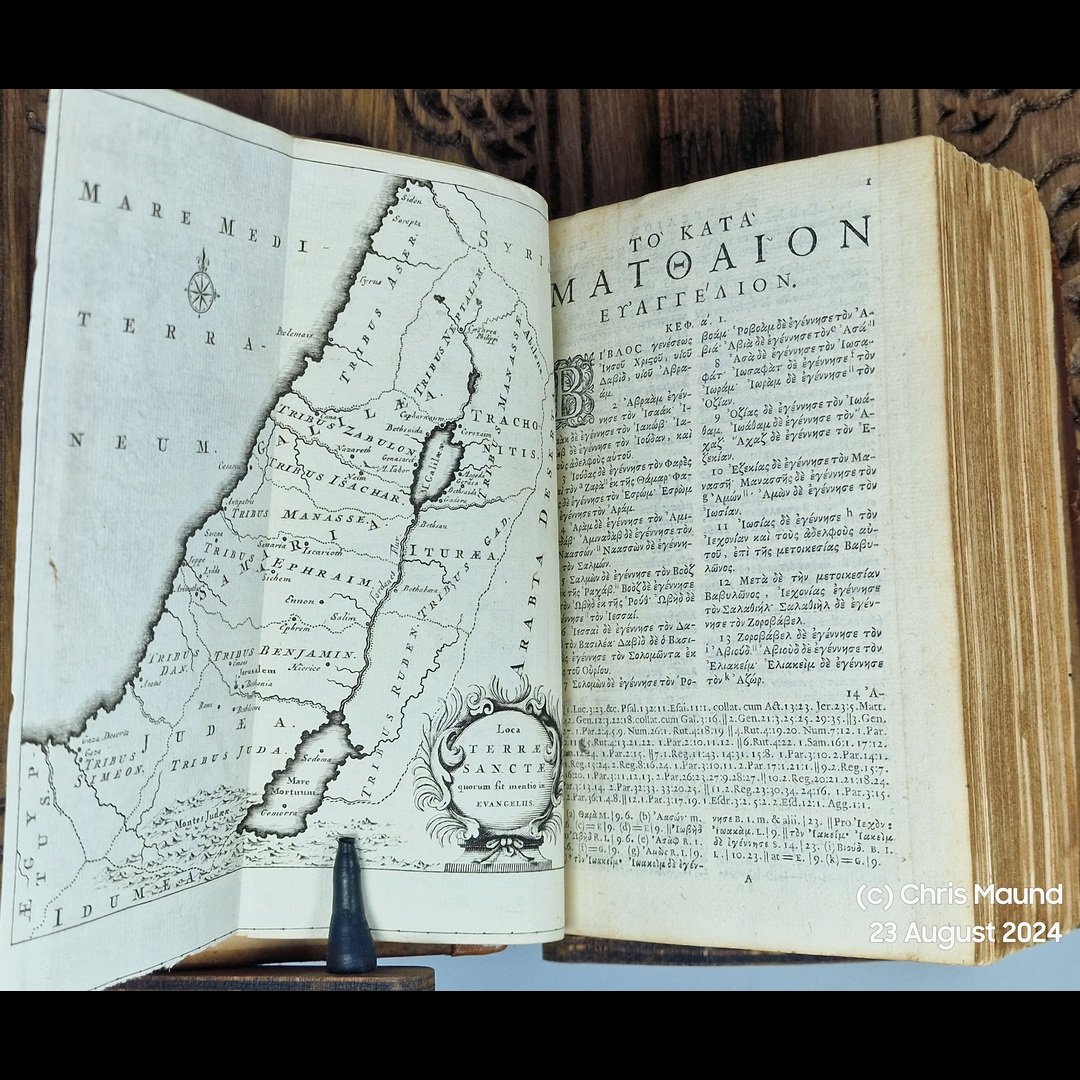 Image 13 of 24
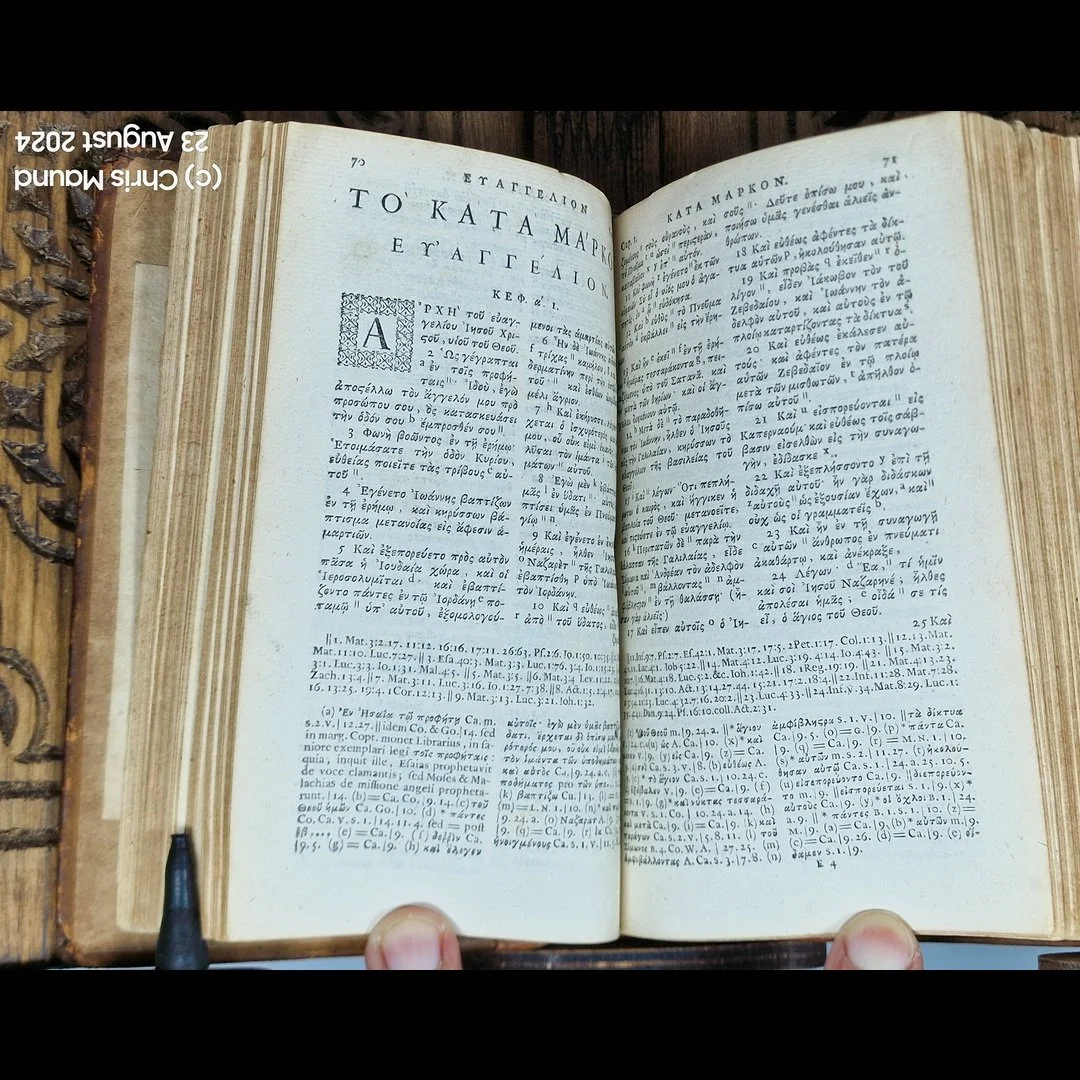 Image 14 of 24
 Image 15 of 24
 Image 16 of 24
 Image 17 of 24
 Image 18 of 24
 Image 19 of 24
 Image 20 of 24
 Image 21 of 24
 Image 22 of 24
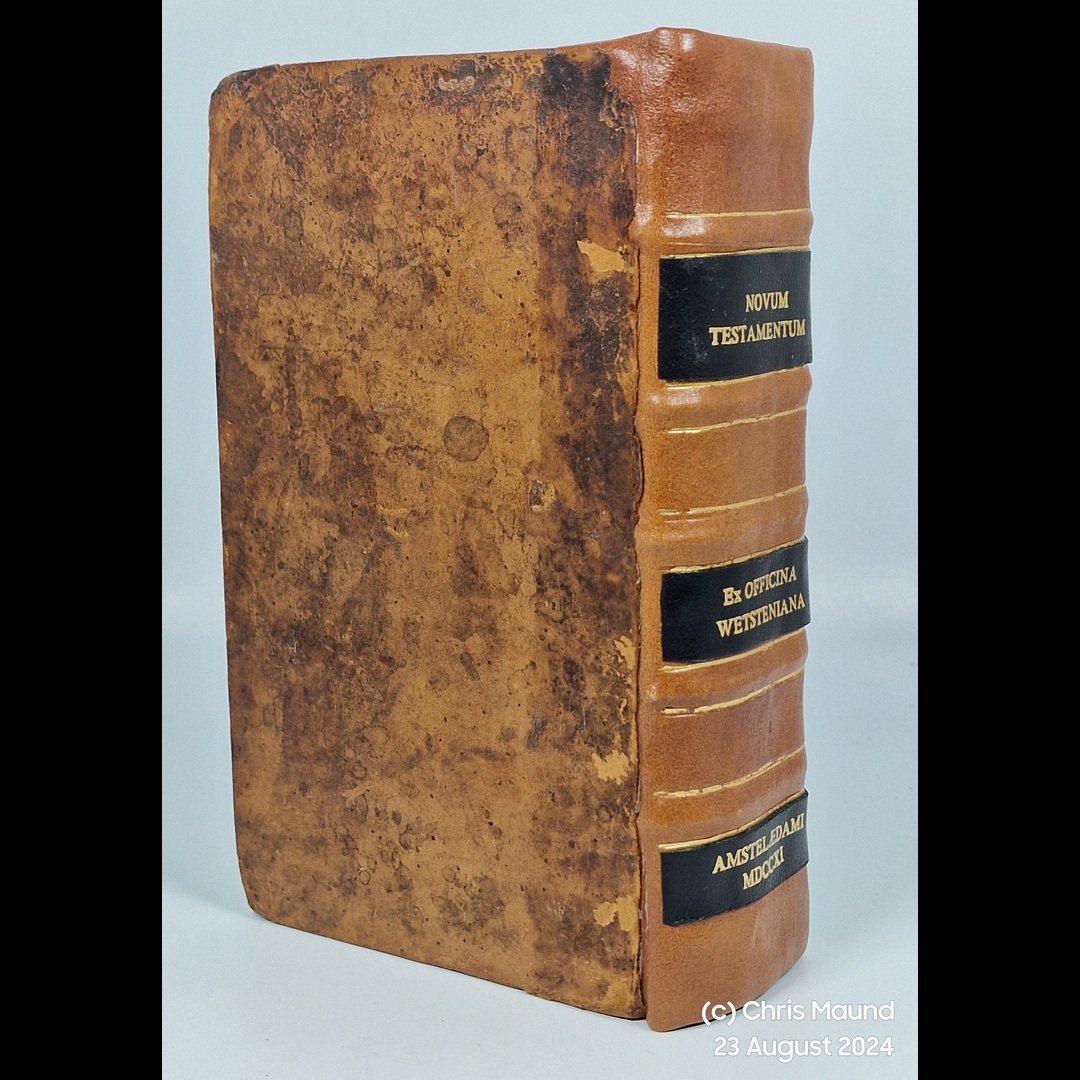 Image 23 of 24
 Image 24 of 24