Sale Price:
£425.00
Original Price:
£450.00
2008 Folio Society First Deluxe Edition Full Wassa Goatskin / Solander Box
LES MISERABLES
By Victor Hugo
KEY DETAILS
Condition: Fine
Format: Hardcover, quarto (4to 9 1⁄2 × 12 in 241 × 305 mm )
Note: Binding/size selection follows standard bibliographic conventions and is approximate; exact measurements may vary.
Published By: The Folio Society, London, 2008
Language: English
Limited Edition: 475/1750 Copies
Illustrated By: Alphonse de Neuville
Collation: pp. [i–vi] vii–xvii [xviii], [1–2] 3–1101 [1102–1104], with 25 unnumbered leaves of black-and-white plates, including frontispiece.; Vargas Llosa, Mario. The Divine Stenographer: Truth and Narration in Les Misérables.
Dust Jacket: None, as issued, No Jacket
SKU: BTETM0002017
Shipping Info: Approximate Package Dimensions H: 20, L: 30, W: 30 (Units: cm), W: 3.5Kg
Tracked Shipping, Insurance Coverage as per Customer Request
DESCRIPTION
Les Miserables
A handsome and substantial Folio Society limited edition of Victor Hugo’s great social novel, issued in 2008 in an edition of just 1,750 numbered copies, this being copy 475. Norman Denny’s translation and introduction are accompanied by black-and-white illustrations from designs by De Neuville, Bayard, Morin, Valnay and other eminent nineteenth-century French artists.
An imposing example of the Folio Society’s deluxe limited-edition production of the period. The volume is bound by Real Lachenmaier, Germany, in full blue Wassa goatskin, blocked in gilt, red and white to a striking design by Jeff Clements, with gilt top edge and ribbon marker. It is housed in the original blue cloth-covered solander/clamshell box.
Complete with the separately issued companion booklet by Nobel Prize-winning novelist Mario Vargas Llosa, The Divine Stenographer: Truth and Narration in Les Misérables, in its original red wrappers. Book, numbered limitation, companion essay and original box are all present, making this a particularly desirable complete example for the Folio Society collector.
The copyright page records the first Folio Society edition in 1976, with this edition reprinted in 2008 as a limited edition bound in leather; accordingly, this copy is most accurately catalogued as the first edition thus of the 2008 Folio Society limited leather edition.
CONDITION, COLLATION & COPY NOTES
A notably clean and highly presentable example of this substantial Folio Society limited edition.
The blue Wassa goatskin remains bright and supple, with the gilt, red and white blocking strong and well defined. Spine lettering is crisp; corners and joints present very well. The gilt top edge remains bright. Internally clean and fresh, with no ownership inscription visible and little evidence of handling. The binding appears firm and the volume presents as apparently unread.
The original blue solander/clamshell box is likewise Fine, clean and structurally sound, with strong colour and gilt spine lettering and only negligible signs of storage or handling visible in the photographs.
The separately issued Mario Vargas Llosa companion booklet, The Divine Stenographer: Truth and Narration in Les Misérables, is present in its original red wrappers and remains in excellent condition.
A particularly attractive complete copy, retaining all of the elements sought by collectors: numbered leather-bound volume, original presentation box and companion essay.
Binding:
Hardcover, full blue Wassa goatskin, blocked in gilt, red and white; gilt top edge; ribbon marker.
Please see Photos as part of condition report.
REFERENCES
Ford-Smith, Alice (comp.), Folio 76: A Bibliography of The Folio Society, 1947–2023, London: The Folio Society, 2024, item 1500.
SYNOPSIS
At the centre of Les Misérables stands Jean Valjean, condemned to years of imprisonment after stealing bread and released into a society unwilling to allow a former convict to escape his past. An unexpected act of compassion transforms the course of his life, but his attempt at moral and social redemption brings him into relentless conflict with Inspector Javert, whose absolute faith in law leaves little room for mercy.
Around Valjean unfolds an immense panorama of nineteenth-century France: the tragedy of Fantine, the childhood and eventual happiness of Cosette, Marius’s political idealism and love, the brutality of poverty, the Paris underworld and the revolutionary barricades of 1832.
Hugo combines intimate human drama with history, politics, theology and social criticism to ask enduring questions about justice and punishment, conscience and duty, poverty and privilege, and whether an individual can truly be redeemed.
Presented here in full Wassa goatskin, with historic French illustrations and Mario Vargas Llosa’s critical companion essay, the Folio Society’s 2008 numbered edition gives Hugo’s monumental novel a suitably imposing physical form.
AUTHOR BIO
Victor Hugo (1802–1885) was one of the towering figures of nineteenth-century French literature and a central voice of the Romantic movement. Poet, dramatist, novelist and political campaigner, he combined immense imaginative range with a lifelong concern for social justice, poverty, punishment and human dignity.
First published in 1862, Les Misérables became an international success almost immediately. Alongside Notre-Dame de Paris, it remains Hugo’s best-known prose work and one of the defining novels of nineteenth-century European literature.
Translator Bio:
Norman Denny (1901–1982) was an English translator particularly associated with French literature. His translation of Les Misérables, first published in 1976 by the Folio Society, was accompanied by his own introduction and became one of the Society’s enduring presentations of Hugo’s novel.
Companion Essay By Mario Vargas Llosa:
Mario Vargas Llosa (1936–2025) was a Peruvian novelist, essayist and critic and one of the leading figures of the Latin American literary boom. Awarded the Nobel Prize in Literature in 2010, he wrote extensively on the nature of fiction and the relationship between literature, politics and society.
His accompanying essay, The Divine Stenographer: Truth and Narration in Les Misérables, examines Hugo’s narrative voice and the extraordinary imaginative architecture of the novel, adding a significant critical complement to this edition.
ILLUSTRATOR
Alphonse de Neuville
Émile Bayard, Edmond Morin, Valnay and other eminent French artists
The illustrations draw upon the rich nineteenth-century visual tradition surrounding Hugo’s novel.
Alphonse de Neuville was celebrated for his dramatic historical and military compositions; Émile Bayard became inseparably associated with Les Misérables through his celebrated image of the young Cosette, subsequently one of the most recognisable images connected with the novel. Edmond Morin was an accomplished painter, printmaker and illustrator active in the flourishing illustrated press of nineteenth-century France, while Valnay and the other artists represented here contributed to the extensive visual culture through which Hugo’s work reached contemporary readers.
The monochrome illustrations complement the restrained grandeur of the Folio production and connect this modern limited edition directly with the historic illustrated tradition of Les Misérables.
2008 Folio Society First Deluxe Edition Full Wassa Goatskin / Solander Box
LES MISERABLES
By Victor Hugo
KEY DETAILS
Condition: Fine
Format: Hardcover, quarto (4to 9 1⁄2 × 12 in 241 × 305 mm )
Note: Binding/size selection follows standard bibliographic conventions and is approximate; exact measurements may vary.
Published By: The Folio Society, London, 2008
Language: English
Limited Edition: 475/1750 Copies
Illustrated By: Alphonse de Neuville
Collation: pp. [i–vi] vii–xvii [xviii], [1–2] 3–1101 [1102–1104], with 25 unnumbered leaves of black-and-white plates, including frontispiece.; Vargas Llosa, Mario. The Divine Stenographer: Truth and Narration in Les Misérables.
Dust Jacket: None, as issued, No Jacket
SKU: BTETM0002017
Shipping Info: Approximate Package Dimensions H: 20, L: 30, W: 30 (Units: cm), W: 3.5Kg
Tracked Shipping, Insurance Coverage as per Customer Request
DESCRIPTION
Les Miserables
A handsome and substantial Folio Society limited edition of Victor Hugo’s great social novel, issued in 2008 in an edition of just 1,750 numbered copies, this being copy 475. Norman Denny’s translation and introduction are accompanied by black-and-white illustrations from designs by De Neuville, Bayard, Morin, Valnay and other eminent nineteenth-century French artists.
An imposing example of the Folio Society’s deluxe limited-edition production of the period. The volume is bound by Real Lachenmaier, Germany, in full blue Wassa goatskin, blocked in gilt, red and white to a striking design by Jeff Clements, with gilt top edge and ribbon marker. It is housed in the original blue cloth-covered solander/clamshell box.
Complete with the separately issued companion booklet by Nobel Prize-winning novelist Mario Vargas Llosa, The Divine Stenographer: Truth and Narration in Les Misérables, in its original red wrappers. Book, numbered limitation, companion essay and original box are all present, making this a particularly desirable complete example for the Folio Society collector.
The copyright page records the first Folio Society edition in 1976, with this edition reprinted in 2008 as a limited edition bound in leather; accordingly, this copy is most accurately catalogued as the first edition thus of the 2008 Folio Society limited leather edition.
CONDITION, COLLATION & COPY NOTES
A notably clean and highly presentable example of this substantial Folio Society limited edition.
The blue Wassa goatskin remains bright and supple, with the gilt, red and white blocking strong and well defined. Spine lettering is crisp; corners and joints present very well. The gilt top edge remains bright. Internally clean and fresh, with no ownership inscription visible and little evidence of handling. The binding appears firm and the volume presents as apparently unread.
The original blue solander/clamshell box is likewise Fine, clean and structurally sound, with strong colour and gilt spine lettering and only negligible signs of storage or handling visible in the photographs.
The separately issued Mario Vargas Llosa companion booklet, The Divine Stenographer: Truth and Narration in Les Misérables, is present in its original red wrappers and remains in excellent condition.
A particularly attractive complete copy, retaining all of the elements sought by collectors: numbered leather-bound volume, original presentation box and companion essay.
Binding:
Hardcover, full blue Wassa goatskin, blocked in gilt, red and white; gilt top edge; ribbon marker.
Please see Photos as part of condition report.
REFERENCES
Ford-Smith, Alice (comp.), Folio 76: A Bibliography of The Folio Society, 1947–2023, London: The Folio Society, 2024, item 1500.
SYNOPSIS
At the centre of Les Misérables stands Jean Valjean, condemned to years of imprisonment after stealing bread and released into a society unwilling to allow a former convict to escape his past. An unexpected act of compassion transforms the course of his life, but his attempt at moral and social redemption brings him into relentless conflict with Inspector Javert, whose absolute faith in law leaves little room for mercy.
Around Valjean unfolds an immense panorama of nineteenth-century France: the tragedy of Fantine, the childhood and eventual happiness of Cosette, Marius’s political idealism and love, the brutality of poverty, the Paris underworld and the revolutionary barricades of 1832.
Hugo combines intimate human drama with history, politics, theology and social criticism to ask enduring questions about justice and punishment, conscience and duty, poverty and privilege, and whether an individual can truly be redeemed.
Presented here in full Wassa goatskin, with historic French illustrations and Mario Vargas Llosa’s critical companion essay, the Folio Society’s 2008 numbered edition gives Hugo’s monumental novel a suitably imposing physical form.
AUTHOR BIO
Victor Hugo (1802–1885) was one of the towering figures of nineteenth-century French literature and a central voice of the Romantic movement. Poet, dramatist, novelist and political campaigner, he combined immense imaginative range with a lifelong concern for social justice, poverty, punishment and human dignity.
First published in 1862, Les Misérables became an international success almost immediately. Alongside Notre-Dame de Paris, it remains Hugo’s best-known prose work and one of the defining novels of nineteenth-century European literature.
Translator Bio:
Norman Denny (1901–1982) was an English translator particularly associated with French literature. His translation of Les Misérables, first published in 1976 by the Folio Society, was accompanied by his own introduction and became one of the Society’s enduring presentations of Hugo’s novel.
Companion Essay By Mario Vargas Llosa:
Mario Vargas Llosa (1936–2025) was a Peruvian novelist, essayist and critic and one of the leading figures of the Latin American literary boom. Awarded the Nobel Prize in Literature in 2010, he wrote extensively on the nature of fiction and the relationship between literature, politics and society.
His accompanying essay, The Divine Stenographer: Truth and Narration in Les Misérables, examines Hugo’s narrative voice and the extraordinary imaginative architecture of the novel, adding a significant critical complement to this edition.
ILLUSTRATOR
Alphonse de Neuville
Émile Bayard, Edmond Morin, Valnay and other eminent French artists
The illustrations draw upon the rich nineteenth-century visual tradition surrounding Hugo’s novel.
Alphonse de Neuville was celebrated for his dramatic historical and military compositions; Émile Bayard became inseparably associated with Les Misérables through his celebrated image of the young Cosette, subsequently one of the most recognisable images connected with the novel. Edmond Morin was an accomplished painter, printmaker and illustrator active in the flourishing illustrated press of nineteenth-century France, while Valnay and the other artists represented here contributed to the extensive visual culture through which Hugo’s work reached contemporary readers.
The monochrome illustrations complement the restrained grandeur of the Folio production and connect this modern limited edition directly with the historic illustrated tradition of Les Misérables.

 Image 1 of 20
 Image 2 of 20
 Image 3 of 20
 Image 4 of 20
 Image 5 of 20
 Image 6 of 20
 Image 7 of 20
 Image 8 of 20
 Image 9 of 20
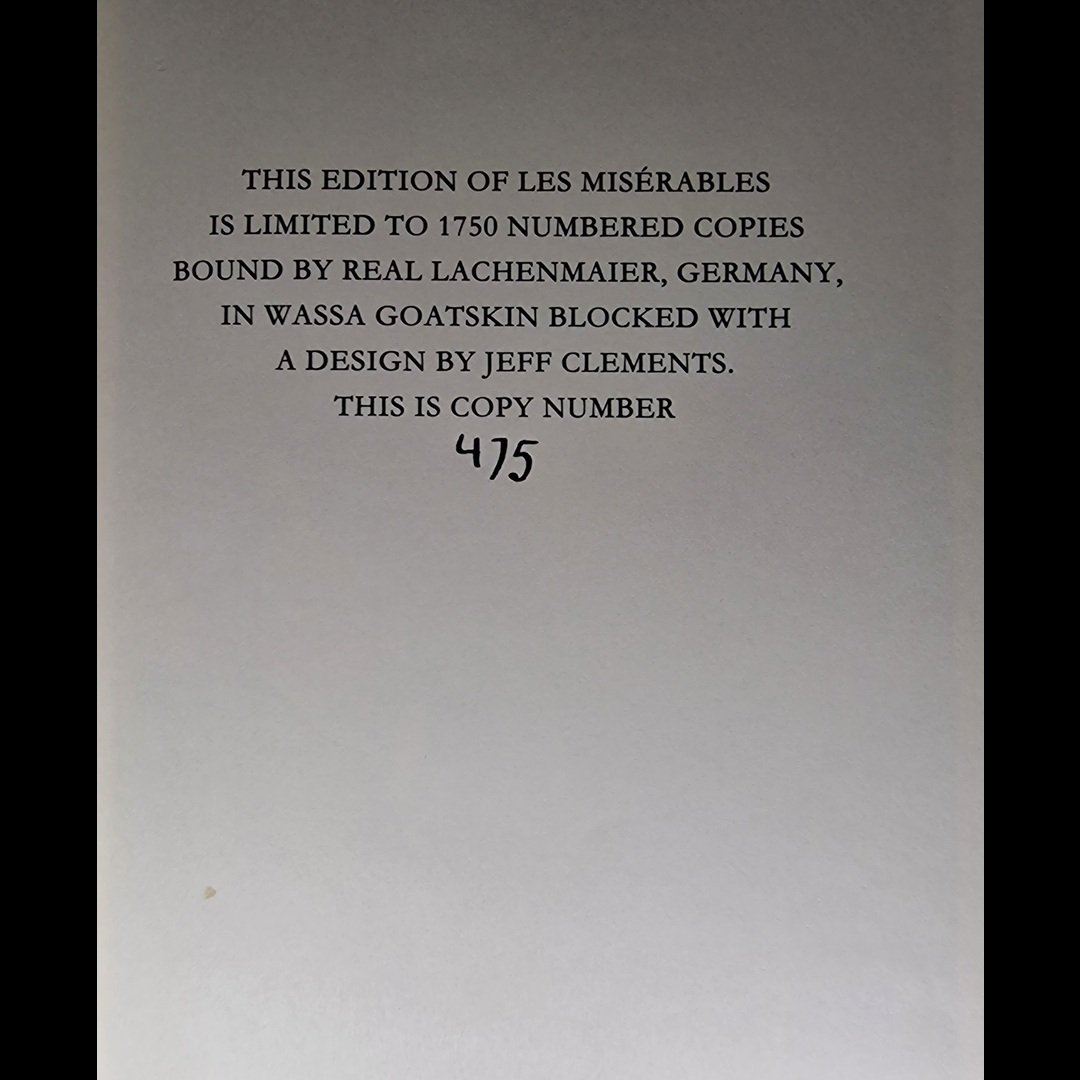 Image 10 of 20
 Image 11 of 20
 Image 12 of 20
 Image 13 of 20
 Image 14 of 20
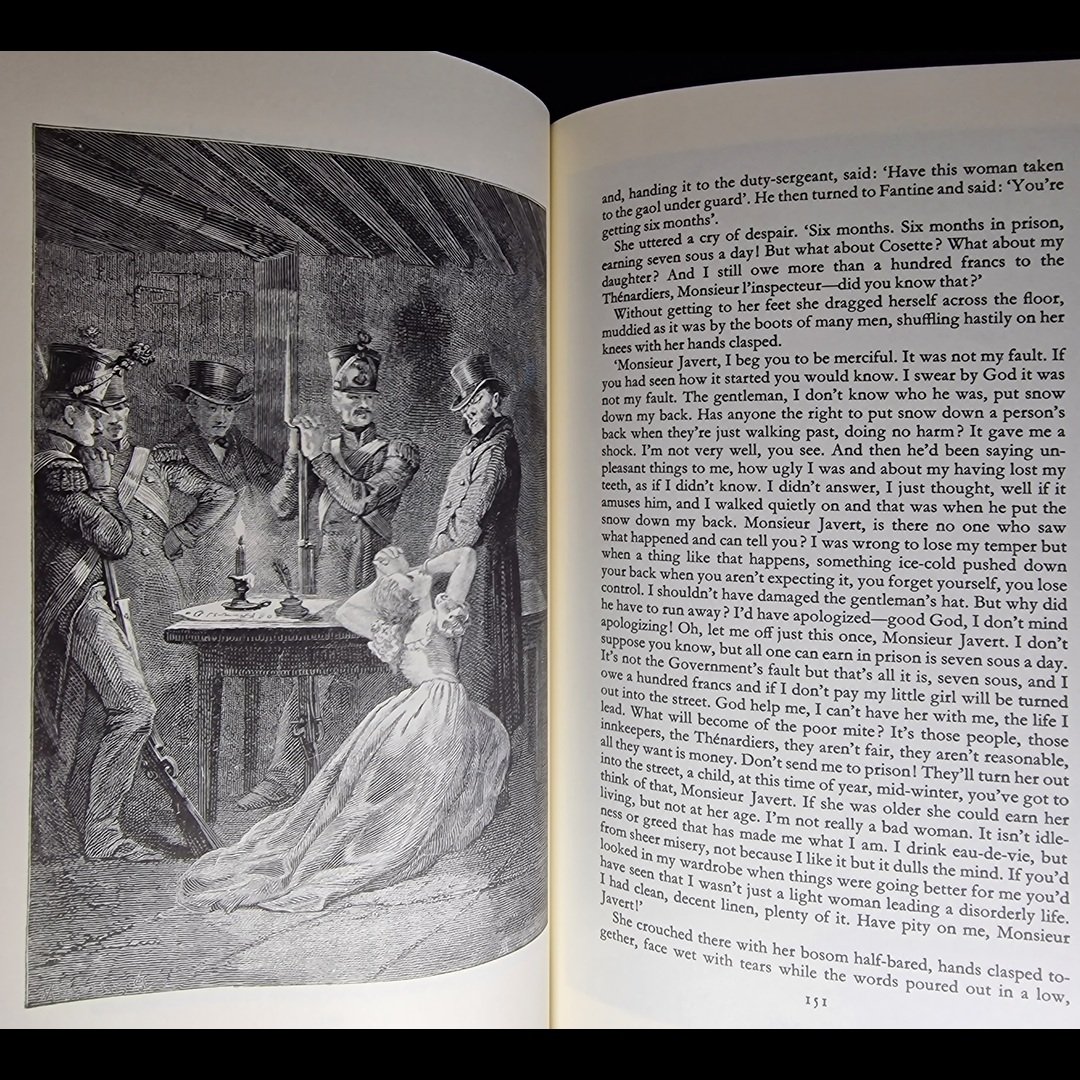 Image 15 of 20
 Image 16 of 20
 Image 17 of 20
 Image 18 of 20
 Image 19 of 20
 Image 20 of 20