1988 First American Edition Uncorrected Proof
A BRIEF HISTORY OF TIME
By Stephen Hawking
KEY DETAILS
Condition: Very Good
Format: Softcover, Octavo (Standard) (8vo 6 × 9 in 152 × 229 mm )
Note: Binding/size selection follows standard bibliographic conventions and is approximate; exact measurements may vary.
Published By: Bantam Books, New York, 1988
Language: English
Provenance: No earlier ownership provenance has been identified. The copy is free from ownership inscriptions.
Collation: The proof retains the unfinished production layout, including blank spaces and instructions indicating the intended placement and approximate size of illustrations.; The published illustrations are therefore absent by design at this proof stage, rather than being missing from the copy.
Dust Jacket: None, as issued
ISBN: 0-553-05243-8
SKU: BTETM0002029
Shipping Info: Approximate Package Dimensions H: 12.5, L: 30, W: 25 (Units: cm), W: 2Kg
Tracked Shipping, Insurance Coverage as per Customer Request
DESCRIPTION
A Brief History of Time
A scarce advance uncorrected proof of the first American edition of Stephen Hawking's landmark work of popular science, A Brief History of Time: From the Big Bang to Black Holes, issued by Bantam ahead of the April 1988 hardcover publication.
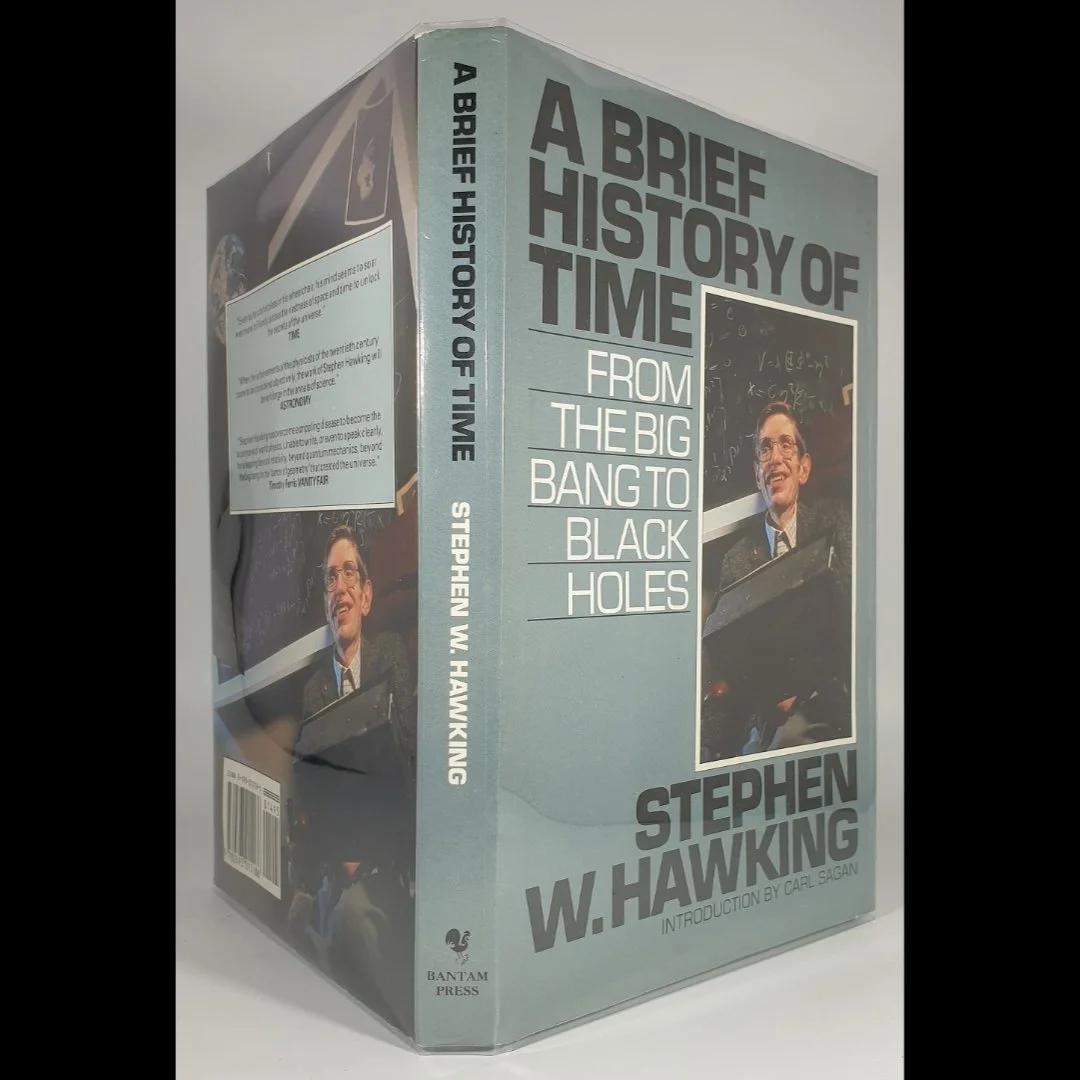
This is not a later paperback issue but a genuine pre-publication proof, produced while the book was still undergoing its final editorial and production stages. The upper wrapper is explicitly printed: “Bantam Books / Uncorrected Proofs / Hardcover Publication April 1988.”
The preliminary publisher's notice similarly states that the volume consists of uncorrected page proofs and warns that quotations should be checked against the finished edition.
The proof runs to 187 pages, rather than the longer pagination of the published trade edition, and preserves several revealing features of the book in production.
Most notably, the illustrations found in the published edition are not yet present. Instead, blank spaces remain in the text together with production instructions such as: “Fig. 1.3: ½ page” and “Fig. 2.1 ½ pg.”
Carl Sagan is credited on the title page, but the text of his celebrated introduction had not yet been inserted into this proof.
The copyright page also contains a characteristic proof-stage error, identifying the author as: “Stephen M. Hawking” rather than Stephen W. Hawking.
The same page carries the complete number line:
0 9 8 7 6 5 4 3 2 1
and the original ten-digit ISBN 0-553-05243-8.
Together these differences provide a particularly interesting record of one of the most famous scientific books of the twentieth century while it was still passing through the publication process.
Advance proofs of A Brief History of Time appear considerably less frequently on the market than ordinary first-edition copies and have an established following among collectors of Hawking, modern science, significant twentieth-century books and publishing history.
PROVENANCE
No earlier ownership provenance has been identified. The copy is free from ownership inscriptions.
CONDITION, COLLATION & COPY NOTES
Publisher's original grey printed wrappers.
The wrappers show light general handling and edge wear, with a small but noticeable area of surface abrasion/loss to the upper wrapper, principally adjacent to the subtitle From the Big Bang to Black Holes. Mild toning and light signs of use are also present.
The binding remains sound.
Internally the copy presents very well, with clean text and no significant staining or annotation observed.
Please see Photos as part of condition report.
REFERENCES
Comparable examples of this 187-page grey-wrapper proof have been recorded by major auction houses and specialist booksellers.
Christie's catalogued the same proof issue in its 2019 sale On the Shoulders of Giants: Making the Modern World, describing the grey printed wrappers, absence of illustrations and blank spaces indicating their intended positions.
A Fine example of the same proof was sold by RR Auction in 2018 for US$2,427 including buyer's premium.
Specialist dealer examples have also been offered materially above the value of ordinary first-edition copies, reflecting the comparative scarcity of the advance proof.
The present copy should therefore be distinguished clearly from the much more commonly encountered published American and British first editions.
SYNOPSIS
A Brief History of Time is Stephen Hawking's celebrated attempt to explain some of the most profound questions in modern physics and cosmology to a general readership.
Beginning with humanity's changing understanding of the universe, Hawking moves from Aristotle and Ptolemy through Galileo, Newton and Einstein before introducing the major ideas underlying twentieth-century cosmology.
He discusses the expanding universe, the Big Bang, relativity, quantum mechanics, elementary particles, black holes and the phenomenon now closely associated with his own name: Hawking radiation.
The book also explores deeper conceptual questions.
Why does time appear to move in only one direction?
Did the universe have a beginning?
Does it possess a boundary?
Can the apparently incompatible frameworks of general relativity and quantum mechanics ultimately be reconciled in a single unified theory?
Hawking's achievement lay not merely in summarising modern cosmology but in bringing questions previously confined largely to theoretical physics into mainstream public discussion.
Published in 1988, A Brief History of Time became an extraordinary international success and one of the best-known works of popular science ever written.
This advance proof is especially appealing because it records the work before that extraordinary publication history began: still without its illustrations, still carrying production instructions, still containing textual errors and still awaiting some of the material that would appear in the finished book.
As such, it represents not simply an early copy of Hawking's most famous work, but a surviving artefact from the making of one of the defining scientific books of the late twentieth century.
AUTHOR BIO
Stephen William Hawking (1942–2018) was a British theoretical physicist and cosmologist whose research transformed modern understanding of black holes and the relationship between gravitation, thermodynamics and quantum mechanics.
He spent much of his academic career at the University of Cambridge and served as Lucasian Professor of Mathematics from 1979 to 2009, a chair previously held by figures including Isaac Newton.
Hawking's most famous theoretical result demonstrated that black holes are not entirely black but can emit thermal radiation as a consequence of quantum effects near the event horizon. This phenomenon became known as Hawking radiation.
Alongside his scientific work, Hawking became one of the most recognisable scientific figures of the modern era.
A Brief History of Time transformed him into an internationally known author and communicator, bringing cosmology, black holes and the search for a unified theory to an audience far beyond academic physics.
Its enormous commercial success made the book a cultural phenomenon as well as a major work of twentieth-century popular science.
1988 First American Edition Uncorrected Proof
A BRIEF HISTORY OF TIME
By Stephen Hawking
KEY DETAILS
Condition: Very Good
Format: Softcover, Octavo (Standard) (8vo 6 × 9 in 152 × 229 mm )
Note: Binding/size selection follows standard bibliographic conventions and is approximate; exact measurements may vary.
Published By: Bantam Books, New York, 1988
Language: English
Provenance: No earlier ownership provenance has been identified. The copy is free from ownership inscriptions.
Collation: The proof retains the unfinished production layout, including blank spaces and instructions indicating the intended placement and approximate size of illustrations.; The published illustrations are therefore absent by design at this proof stage, rather than being missing from the copy.
Dust Jacket: None, as issued
ISBN: 0-553-05243-8
SKU: BTETM0002029
Shipping Info: Approximate Package Dimensions H: 12.5, L: 30, W: 25 (Units: cm), W: 2Kg
Tracked Shipping, Insurance Coverage as per Customer Request
DESCRIPTION
A Brief History of Time
A scarce advance uncorrected proof of the first American edition of Stephen Hawking's landmark work of popular science, A Brief History of Time: From the Big Bang to Black Holes, issued by Bantam ahead of the April 1988 hardcover publication.
This is not a later paperback issue but a genuine pre-publication proof, produced while the book was still undergoing its final editorial and production stages. The upper wrapper is explicitly printed: “Bantam Books / Uncorrected Proofs / Hardcover Publication April 1988.”
The preliminary publisher's notice similarly states that the volume consists of uncorrected page proofs and warns that quotations should be checked against the finished edition.
The proof runs to 187 pages, rather than the longer pagination of the published trade edition, and preserves several revealing features of the book in production.
Most notably, the illustrations found in the published edition are not yet present. Instead, blank spaces remain in the text together with production instructions such as: “Fig. 1.3: ½ page” and “Fig. 2.1 ½ pg.”
Carl Sagan is credited on the title page, but the text of his celebrated introduction had not yet been inserted into this proof.
The copyright page also contains a characteristic proof-stage error, identifying the author as: “Stephen M. Hawking” rather than Stephen W. Hawking.
The same page carries the complete number line:
0 9 8 7 6 5 4 3 2 1
and the original ten-digit ISBN 0-553-05243-8.
Together these differences provide a particularly interesting record of one of the most famous scientific books of the twentieth century while it was still passing through the publication process.
Advance proofs of A Brief History of Time appear considerably less frequently on the market than ordinary first-edition copies and have an established following among collectors of Hawking, modern science, significant twentieth-century books and publishing history.
PROVENANCE
No earlier ownership provenance has been identified. The copy is free from ownership inscriptions.
CONDITION, COLLATION & COPY NOTES
Publisher's original grey printed wrappers.
The wrappers show light general handling and edge wear, with a small but noticeable area of surface abrasion/loss to the upper wrapper, principally adjacent to the subtitle From the Big Bang to Black Holes. Mild toning and light signs of use are also present.
The binding remains sound.
Internally the copy presents very well, with clean text and no significant staining or annotation observed.
Please see Photos as part of condition report.
REFERENCES
Comparable examples of this 187-page grey-wrapper proof have been recorded by major auction houses and specialist booksellers.
Christie's catalogued the same proof issue in its 2019 sale On the Shoulders of Giants: Making the Modern World, describing the grey printed wrappers, absence of illustrations and blank spaces indicating their intended positions.
A Fine example of the same proof was sold by RR Auction in 2018 for US$2,427 including buyer's premium.
Specialist dealer examples have also been offered materially above the value of ordinary first-edition copies, reflecting the comparative scarcity of the advance proof.
The present copy should therefore be distinguished clearly from the much more commonly encountered published American and British first editions.
SYNOPSIS
A Brief History of Time is Stephen Hawking's celebrated attempt to explain some of the most profound questions in modern physics and cosmology to a general readership.
Beginning with humanity's changing understanding of the universe, Hawking moves from Aristotle and Ptolemy through Galileo, Newton and Einstein before introducing the major ideas underlying twentieth-century cosmology.
He discusses the expanding universe, the Big Bang, relativity, quantum mechanics, elementary particles, black holes and the phenomenon now closely associated with his own name: Hawking radiation.
The book also explores deeper conceptual questions.
Why does time appear to move in only one direction?
Did the universe have a beginning?
Does it possess a boundary?
Can the apparently incompatible frameworks of general relativity and quantum mechanics ultimately be reconciled in a single unified theory?
Hawking's achievement lay not merely in summarising modern cosmology but in bringing questions previously confined largely to theoretical physics into mainstream public discussion.
Published in 1988, A Brief History of Time became an extraordinary international success and one of the best-known works of popular science ever written.
This advance proof is especially appealing because it records the work before that extraordinary publication history began: still without its illustrations, still carrying production instructions, still containing textual errors and still awaiting some of the material that would appear in the finished book.
As such, it represents not simply an early copy of Hawking's most famous work, but a surviving artefact from the making of one of the defining scientific books of the late twentieth century.
AUTHOR BIO
Stephen William Hawking (1942–2018) was a British theoretical physicist and cosmologist whose research transformed modern understanding of black holes and the relationship between gravitation, thermodynamics and quantum mechanics.
He spent much of his academic career at the University of Cambridge and served as Lucasian Professor of Mathematics from 1979 to 2009, a chair previously held by figures including Isaac Newton.
Hawking's most famous theoretical result demonstrated that black holes are not entirely black but can emit thermal radiation as a consequence of quantum effects near the event horizon. This phenomenon became known as Hawking radiation.
Alongside his scientific work, Hawking became one of the most recognisable scientific figures of the modern era.
A Brief History of Time transformed him into an internationally known author and communicator, bringing cosmology, black holes and the search for a unified theory to an audience far beyond academic physics.
Its enormous commercial success made the book a cultural phenomenon as well as a major work of twentieth-century popular science.

 Image 1 of 7
 Image 2 of 7
 Image 3 of 7
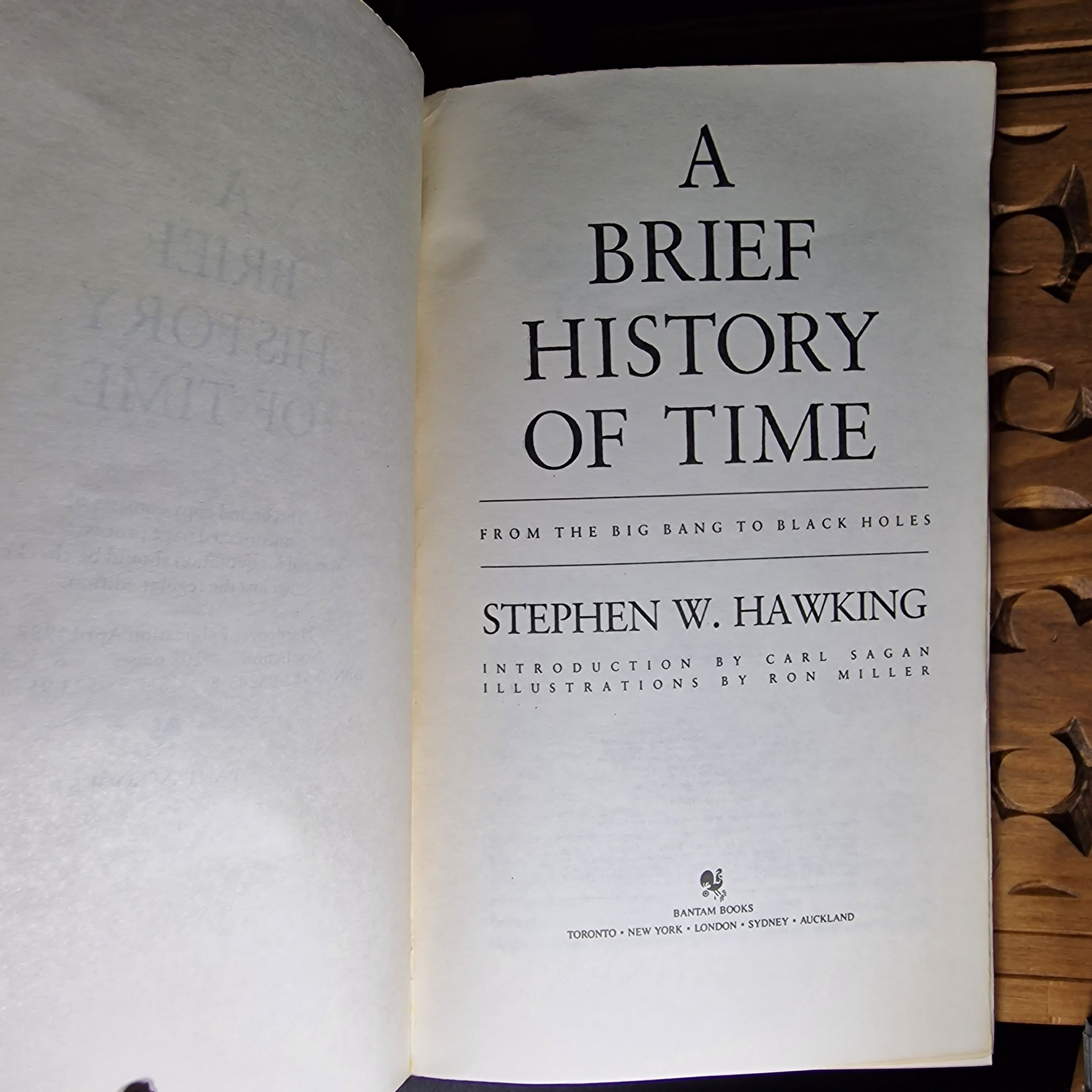 Image 4 of 7
 Image 5 of 7
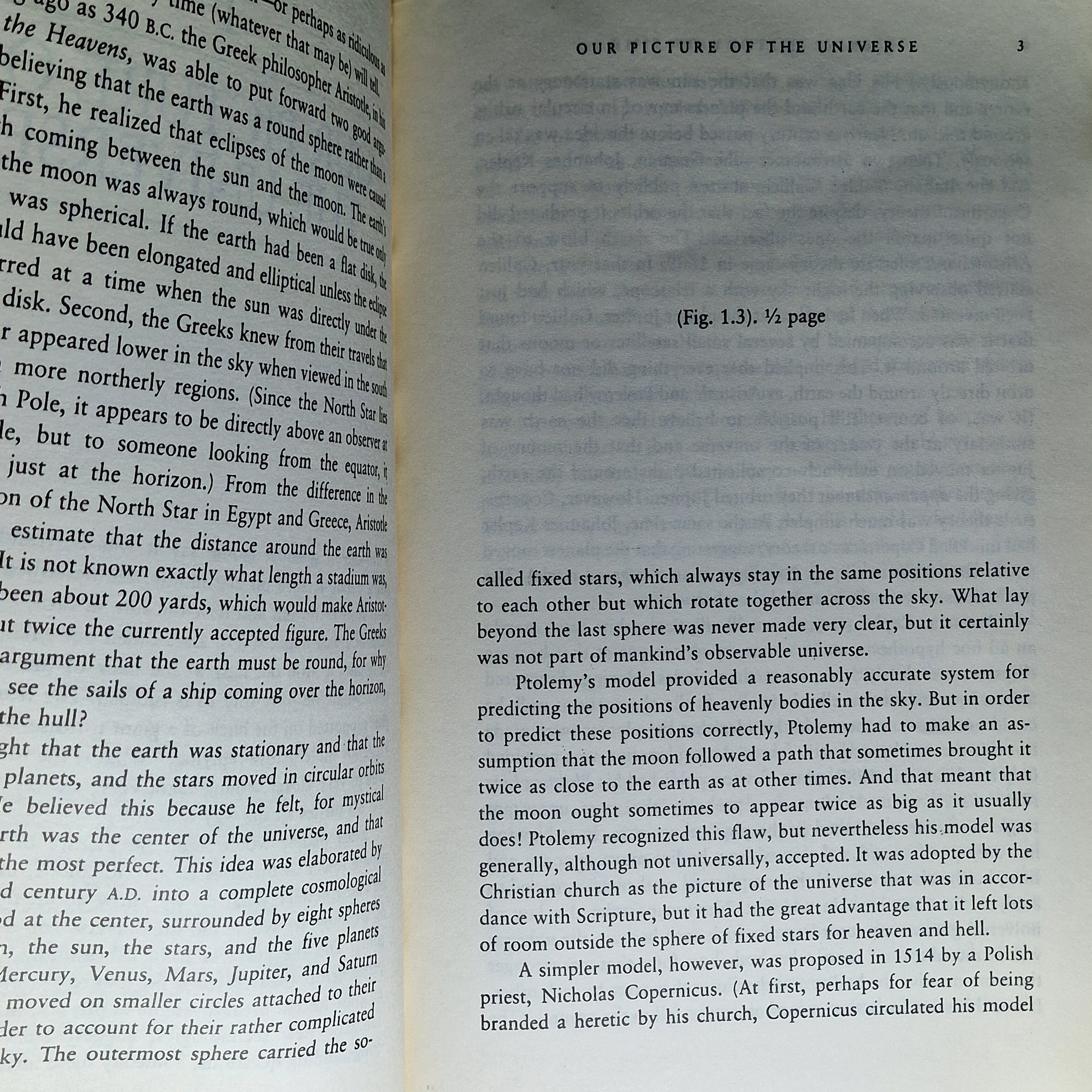 Image 6 of 7
 Image 7 of 7