1567 First German Edition With Provenance
CATECHISMUS ROMANUS
By CATHOLIC CHURCH
KEY DETAILS
Condition: Good
Format: Hardcover, Contemporary blind-tooled leather over wooden boards: Octavo (8vo)
Published By: Sebald Mayer, Dillingen, Germany, 1567
Language: Latin
Illustrated By: Anonymous
Provenance: 1. Contemporary ownership inscription apparently reading “Friderich/Friedrich Frey…”. A possible identification with Friedrich von Freyberg-Eisenberg, a member of the Catholic Swabian noble family and Stadtvogt of Mar...
Collation: [4] leaves, 935 [recte 937], [1] pp., [29] leaves.
Dust Jacket: None, as issued, No Jacket
SKU: BTETM0002407
Shipping Info: Approximate Package Dimensions H: 12.5, L: 30, W: 25 (Units: cm), W: 2Kg
Tracked Shipping, Insurance Coverage as per Customer Request
DESCRIPTION
Catechismus Romanus
Ex decreto Concilii Tridentini, ad Parochos
Pii Quinti Pont. Max. iussu editus, nunc vero primum in Germania cum Maiorum autoritate, & permissu Pauli Manutii recusus
A particularly appealing copy of the first German edition of the Roman Catechism, one of the defining doctrinal texts of the Catholic Counter-Reformation, printed at Dillingen by Sebald Mayer in 1567, only a year after the first Roman edition issued under Pope Pius V.
Prepared in consequence of the Council of Trent and intended principally as an authoritative manual for parish clergy, the Catechismus Romanus sought to establish consistency in the teaching of Catholic doctrine across the post-Tridentine Church. This important German printing carries a prefatory address by Cardinal Otto Truchseß von Waldburg, Prince-Bishop of Augsburg and founder of the University of Dillingen, and states explicitly that it was issued with ecclesiastical authority and with the permission of Paulus Manutius, printer of the first Roman edition and holder of the papal privilege.
An evocative copy in a substantial contemporary German Renaissance binding of brown leather over wooden boards, richly blind-tooled with a portrait-medallion and foliate roll surrounding repeated interlaced arabesque or mauresque ornament, retaining both decorated metal clasps. The tooling belongs firmly to the South-German Renaissance binding tradition and the portrait roll appears to be of the widespread sixteenth-century Reformers type. Exact workshop attribution remains under investigation.
Of particular interest is a contemporary ownership inscription on the title page apparently reading “Friderich/Friedrich Frey…”. Research has identified Friedrich von Freyberg-Eisenberg, a member of the prominent Swabian noble family and Stadtvogt of Markdorf in the later sixteenth century, as a plausible candidate; this identification remains provisional pending comparison with an authenticated example of his hand. A further early inscription above has been deliberately cancelled or abraded, while additional contemporary manuscript notes survive on the endpapers and occasionally within the text.
PROVENANCE
1. Contemporary ownership inscription apparently reading “Friderich/Friedrich Frey…”. A possible identification with Friedrich von Freyberg-Eisenberg, a member of the Catholic Swabian noble family and Stadtvogt of Markdorf during the later sixteenth century, is currently under investigation. Attribution is not yet regarded as proven.
2. A second early inscription immediately above the ownership entry has been intentionally cancelled or abraded and cannot presently be read with confidence.
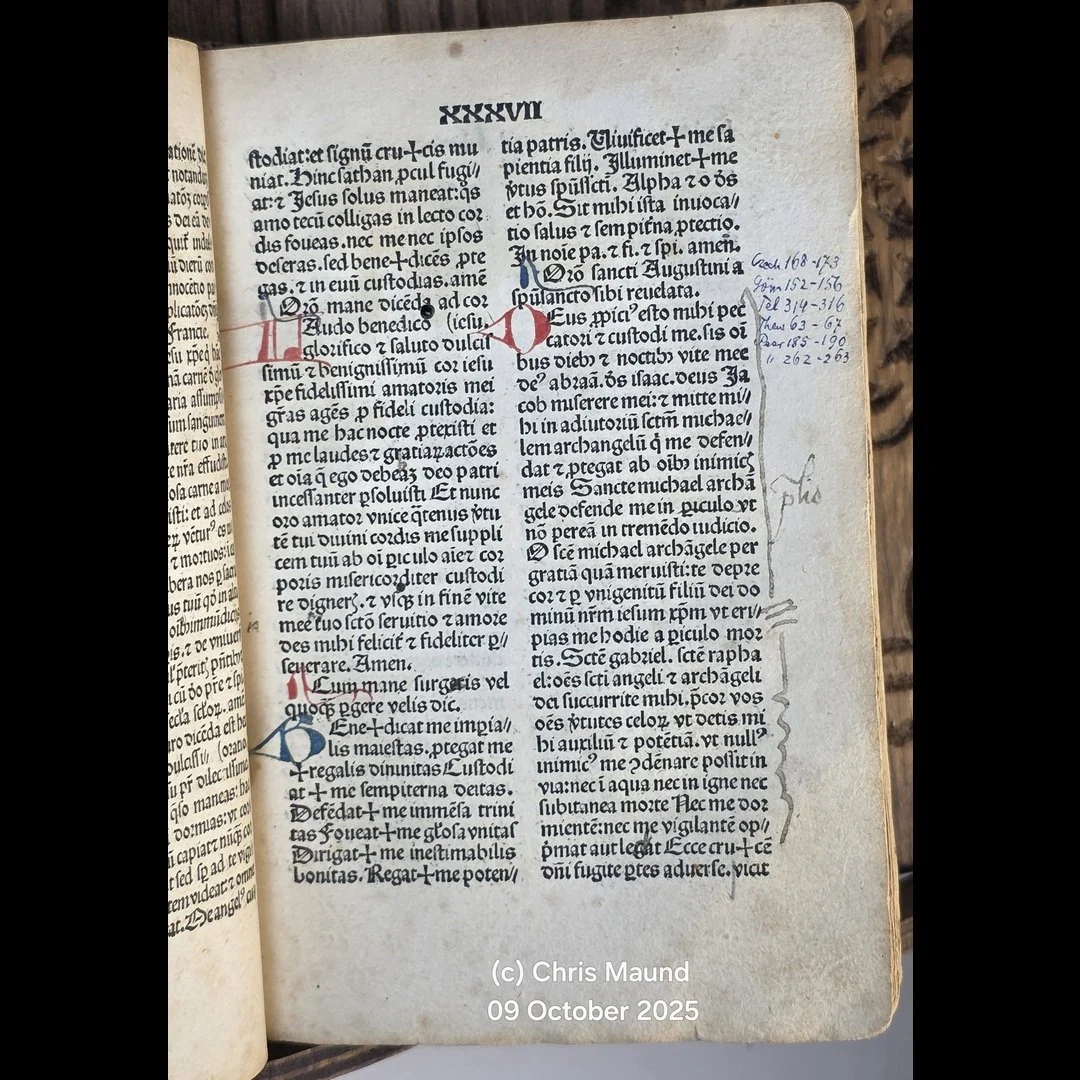
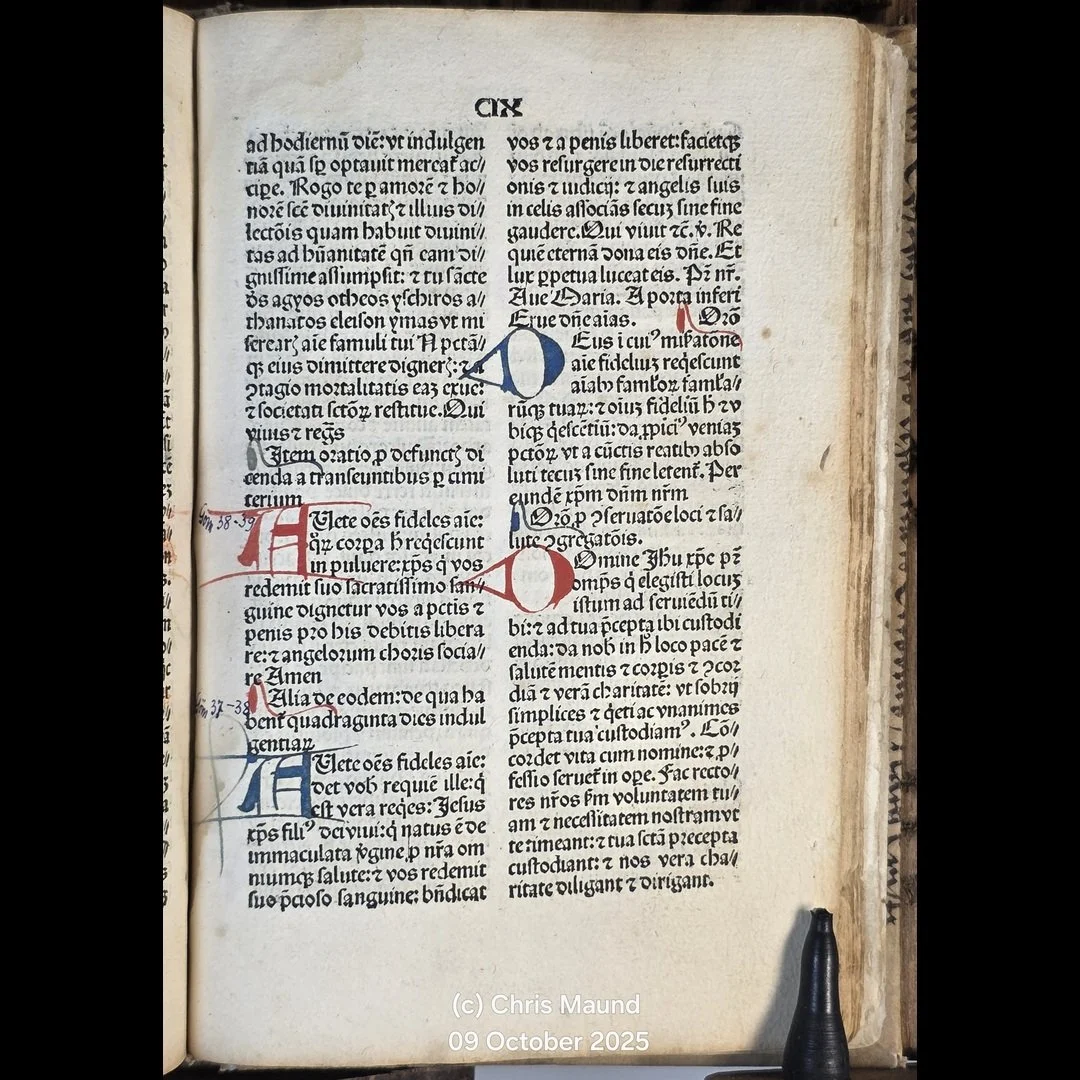
3. Further early manuscript annotations occur on the endpapers and occasionally within the text.
4. Traces of a subsequently erased or shaved institutional ownership mark suggest later library or religious-house provenance. A possible association with the Capuchin monastery at Markdorf is under investigation but is not presently established.
CONDITION, COLLATION & COPY NOTES
An attractive and substantially preserved contemporary German Renaissance binding of brown leather over wooden boards, the covers extensively blind-tooled with an outer portrait-medallion and scrolling foliate roll enclosing a broad central field of repeated interlaced arabesque/mauresque ornament. Five raised spine bands; early manuscript or paper title label to spine; both decorated metal clasps preserved.
Binding rubbed and marked with age, corners bumped and worn, joints showing wear, and with old restoration or reworking to the spine. The tooling nevertheless remains readily visible and the binding retains considerable period character and visual appeal.
Title page present, bearing an early ownership inscription apparently reading “Friderich/Friedrich Frey…”, with a further inscription above deliberately cancelled or abraded. An additional former institutional mark or stamp has been shaved or erased. Marginal areas of the title page have undergone old restoration.
Front free flyleaf absent. Endpapers with contemporary manuscript annotations, with occasional early annotation or marking elsewhere in the volume. Some waterstaining, age-toning, scattered browning and staining consistent with a sixteenth-century working theological book. The text remains substantially clear and legible.
Title page with woodcut arms of Cardinal Otto Truchseß von Waldburg and figurative/decorative woodcut initials.
Binding:
The contemporary binding is an especially appealing feature of this copy. Its blind-tooled outer roll consists of portrait heads within circular medallions separated by Renaissance foliage, surrounding repeated arabesque or mauresque ornament.
The portrait sequence appears consistent with the widespread sixteenth-century German “Reformers” type, examples of which depict figures such as Martin Luther, Philipp Melanchthon, Erasmus and Jan Hus. The juxtaposition would be particularly striking on a foundational text of the Catholic Counter-Reformation, although such rolls were workshop tools and their use should not be interpreted as evidence of the binder's or owner's religious allegiance.
The tooling is stylistically consistent with contemporary South-German, Swabian and Augsburg-region binding practice. Research into an exact workshop attribution, including comparison with documented Augsburg and Dillingen-area tools, remains ongoing.
Please see Photos as part of condition report.
REFERENCES
VD16 K 2052
Bayerische Staatsbibliothek, Rar. 4177
OCLC 633509428
Cf. Adams C 1056
Maggs Bros., Ownership & Annotation catalogue, copy of the same 1567 Dillingen edition
SYNOPSIS
The Catechismus Romanus was one of the most important practical outcomes of the Council of Trent. The Council had recognised the need for a clear and authoritative exposition of Catholic teaching that could be used consistently by parish clergy, particularly in a Europe transformed by the Reformation.
The work is organised around four principal areas of Christian doctrine.
The first treats the Apostles’ Creed and the foundations of Catholic belief, explaining the nature of God, Christ, the Church, resurrection and eternal life.
The second addresses the seven sacraments — Baptism, Confirmation, the Eucharist, Penance, Extreme Unction, Holy Orders and Matrimony — setting out their theology, purpose and administration.
The third turns to Christian moral teaching through an extended exposition of the Ten Commandments.
The fourth concerns prayer, centred upon the Lord’s Prayer and the proper relationship between the Christian believer and God.
The Catechism was designed not simply to define doctrine but to enable priests to communicate it effectively. Its combination of theology, scripture, patristic authority and pastoral instruction made it one of the central teaching texts of post-Tridentine Catholicism.
This Dillingen edition is particularly significant. Issued in 1567, only a year after the first Roman printing, it announces itself as the first German edition and represents the rapid transmission of Tridentine reform into the German-speaking lands.
Printed within the intellectual orbit of Cardinal Otto Truchseß von Waldburg and the University of Dillingen, and surviving here in an unusually evocative contemporary Renaissance binding with early ownership and manuscript evidence, this copy preserves not merely the text of the Counter-Reformation but something of the environment in which that text was first read, owned and used.
AUTHOR BIO
The Catechismus Romanus, commonly known as the Roman Catechism or Catechism of the Council of Trent, was prepared under the authority of the Catholic Church following the Council of Trent and promulgated under Pope Pius V in 1566.
Rather than a catechism principally intended for children or lay memorisation, it was conceived as an authoritative instructional manual for parish priests. Its purpose was to give clergy a coherent foundation from which to preach, teach and explain Catholic doctrine at a moment when the Church was responding both to internal reform and to the profound theological challenge of the Protestant Reformation.
The Roman Catechism consequently became one of the principal instruments through which the doctrinal programme of Trent was communicated throughout Catholic Europe.
Contributor Bio:
Cardinal Otto Truchseß von Waldburg (1514–1573), Prince-Bishop of Augsburg, was one of the important German Catholic churchmen of the Reformation era. A determined advocate of Catholic reform and education, he founded the University of Dillingen, which developed into an important intellectual centre of the Counter-Reformation.
His prefatory contribution to this edition is therefore particularly appropriate: the first German printing of the Roman Catechism emerged from precisely the ecclesiastical and educational environment that Waldburg had worked to establish.
ILLUSTRATOR
Anonymous
No individual woodcut artist has been identified for this edition. The title page carries the woodcut arms of Cardinal Otto Truchseß von Waldburg and the text includes large figurative and decorative woodcut initials characteristic of learned German printing of the period.
Printer Bio:
Sebald Mayer was the pioneering sixteenth-century printer associated with Dillingen and its developing university culture. His press played an important role in the production of Catholic theological and educational literature in the region during the Counter-Reformation.
For this 1567 edition Mayer expressly printed the Roman Catechism with ecclesiastical authority and the permission of Paulus Manutius, who held the papal privilege for the work and had printed its first Roman edition the previous year.
1567 First German Edition With Provenance
CATECHISMUS ROMANUS
By CATHOLIC CHURCH
KEY DETAILS
Condition: Good
Format: Hardcover, Contemporary blind-tooled leather over wooden boards: Octavo (8vo)
Published By: Sebald Mayer, Dillingen, Germany, 1567
Language: Latin
Illustrated By: Anonymous
Provenance: 1. Contemporary ownership inscription apparently reading “Friderich/Friedrich Frey…”. A possible identification with Friedrich von Freyberg-Eisenberg, a member of the Catholic Swabian noble family and Stadtvogt of Mar...
Collation: [4] leaves, 935 [recte 937], [1] pp., [29] leaves.
Dust Jacket: None, as issued, No Jacket
SKU: BTETM0002407
Shipping Info: Approximate Package Dimensions H: 12.5, L: 30, W: 25 (Units: cm), W: 2Kg
Tracked Shipping, Insurance Coverage as per Customer Request
DESCRIPTION
Catechismus Romanus
Ex decreto Concilii Tridentini, ad Parochos
Pii Quinti Pont. Max. iussu editus, nunc vero primum in Germania cum Maiorum autoritate, & permissu Pauli Manutii recusus
A particularly appealing copy of the first German edition of the Roman Catechism, one of the defining doctrinal texts of the Catholic Counter-Reformation, printed at Dillingen by Sebald Mayer in 1567, only a year after the first Roman edition issued under Pope Pius V.
Prepared in consequence of the Council of Trent and intended principally as an authoritative manual for parish clergy, the Catechismus Romanus sought to establish consistency in the teaching of Catholic doctrine across the post-Tridentine Church. This important German printing carries a prefatory address by Cardinal Otto Truchseß von Waldburg, Prince-Bishop of Augsburg and founder of the University of Dillingen, and states explicitly that it was issued with ecclesiastical authority and with the permission of Paulus Manutius, printer of the first Roman edition and holder of the papal privilege.
An evocative copy in a substantial contemporary German Renaissance binding of brown leather over wooden boards, richly blind-tooled with a portrait-medallion and foliate roll surrounding repeated interlaced arabesque or mauresque ornament, retaining both decorated metal clasps. The tooling belongs firmly to the South-German Renaissance binding tradition and the portrait roll appears to be of the widespread sixteenth-century Reformers type. Exact workshop attribution remains under investigation.
Of particular interest is a contemporary ownership inscription on the title page apparently reading “Friderich/Friedrich Frey…”. Research has identified Friedrich von Freyberg-Eisenberg, a member of the prominent Swabian noble family and Stadtvogt of Markdorf in the later sixteenth century, as a plausible candidate; this identification remains provisional pending comparison with an authenticated example of his hand. A further early inscription above has been deliberately cancelled or abraded, while additional contemporary manuscript notes survive on the endpapers and occasionally within the text.
PROVENANCE
1. Contemporary ownership inscription apparently reading “Friderich/Friedrich Frey…”. A possible identification with Friedrich von Freyberg-Eisenberg, a member of the Catholic Swabian noble family and Stadtvogt of Markdorf during the later sixteenth century, is currently under investigation. Attribution is not yet regarded as proven.
2. A second early inscription immediately above the ownership entry has been intentionally cancelled or abraded and cannot presently be read with confidence.
3. Further early manuscript annotations occur on the endpapers and occasionally within the text.
4. Traces of a subsequently erased or shaved institutional ownership mark suggest later library or religious-house provenance. A possible association with the Capuchin monastery at Markdorf is under investigation but is not presently established.
CONDITION, COLLATION & COPY NOTES
An attractive and substantially preserved contemporary German Renaissance binding of brown leather over wooden boards, the covers extensively blind-tooled with an outer portrait-medallion and scrolling foliate roll enclosing a broad central field of repeated interlaced arabesque/mauresque ornament. Five raised spine bands; early manuscript or paper title label to spine; both decorated metal clasps preserved.
Binding rubbed and marked with age, corners bumped and worn, joints showing wear, and with old restoration or reworking to the spine. The tooling nevertheless remains readily visible and the binding retains considerable period character and visual appeal.
Title page present, bearing an early ownership inscription apparently reading “Friderich/Friedrich Frey…”, with a further inscription above deliberately cancelled or abraded. An additional former institutional mark or stamp has been shaved or erased. Marginal areas of the title page have undergone old restoration.
Front free flyleaf absent. Endpapers with contemporary manuscript annotations, with occasional early annotation or marking elsewhere in the volume. Some waterstaining, age-toning, scattered browning and staining consistent with a sixteenth-century working theological book. The text remains substantially clear and legible.
Title page with woodcut arms of Cardinal Otto Truchseß von Waldburg and figurative/decorative woodcut initials.
Binding:
The contemporary binding is an especially appealing feature of this copy. Its blind-tooled outer roll consists of portrait heads within circular medallions separated by Renaissance foliage, surrounding repeated arabesque or mauresque ornament.
The portrait sequence appears consistent with the widespread sixteenth-century German “Reformers” type, examples of which depict figures such as Martin Luther, Philipp Melanchthon, Erasmus and Jan Hus. The juxtaposition would be particularly striking on a foundational text of the Catholic Counter-Reformation, although such rolls were workshop tools and their use should not be interpreted as evidence of the binder's or owner's religious allegiance.
The tooling is stylistically consistent with contemporary South-German, Swabian and Augsburg-region binding practice. Research into an exact workshop attribution, including comparison with documented Augsburg and Dillingen-area tools, remains ongoing.
Please see Photos as part of condition report.
REFERENCES
VD16 K 2052
Bayerische Staatsbibliothek, Rar. 4177
OCLC 633509428
Cf. Adams C 1056
Maggs Bros., Ownership & Annotation catalogue, copy of the same 1567 Dillingen edition
SYNOPSIS
The Catechismus Romanus was one of the most important practical outcomes of the Council of Trent. The Council had recognised the need for a clear and authoritative exposition of Catholic teaching that could be used consistently by parish clergy, particularly in a Europe transformed by the Reformation.
The work is organised around four principal areas of Christian doctrine.
The first treats the Apostles’ Creed and the foundations of Catholic belief, explaining the nature of God, Christ, the Church, resurrection and eternal life.
The second addresses the seven sacraments — Baptism, Confirmation, the Eucharist, Penance, Extreme Unction, Holy Orders and Matrimony — setting out their theology, purpose and administration.
The third turns to Christian moral teaching through an extended exposition of the Ten Commandments.
The fourth concerns prayer, centred upon the Lord’s Prayer and the proper relationship between the Christian believer and God.
The Catechism was designed not simply to define doctrine but to enable priests to communicate it effectively. Its combination of theology, scripture, patristic authority and pastoral instruction made it one of the central teaching texts of post-Tridentine Catholicism.
This Dillingen edition is particularly significant. Issued in 1567, only a year after the first Roman printing, it announces itself as the first German edition and represents the rapid transmission of Tridentine reform into the German-speaking lands.
Printed within the intellectual orbit of Cardinal Otto Truchseß von Waldburg and the University of Dillingen, and surviving here in an unusually evocative contemporary Renaissance binding with early ownership and manuscript evidence, this copy preserves not merely the text of the Counter-Reformation but something of the environment in which that text was first read, owned and used.
AUTHOR BIO
The Catechismus Romanus, commonly known as the Roman Catechism or Catechism of the Council of Trent, was prepared under the authority of the Catholic Church following the Council of Trent and promulgated under Pope Pius V in 1566.
Rather than a catechism principally intended for children or lay memorisation, it was conceived as an authoritative instructional manual for parish priests. Its purpose was to give clergy a coherent foundation from which to preach, teach and explain Catholic doctrine at a moment when the Church was responding both to internal reform and to the profound theological challenge of the Protestant Reformation.
The Roman Catechism consequently became one of the principal instruments through which the doctrinal programme of Trent was communicated throughout Catholic Europe.
Contributor Bio:
Cardinal Otto Truchseß von Waldburg (1514–1573), Prince-Bishop of Augsburg, was one of the important German Catholic churchmen of the Reformation era. A determined advocate of Catholic reform and education, he founded the University of Dillingen, which developed into an important intellectual centre of the Counter-Reformation.
His prefatory contribution to this edition is therefore particularly appropriate: the first German printing of the Roman Catechism emerged from precisely the ecclesiastical and educational environment that Waldburg had worked to establish.
ILLUSTRATOR
Anonymous
No individual woodcut artist has been identified for this edition. The title page carries the woodcut arms of Cardinal Otto Truchseß von Waldburg and the text includes large figurative and decorative woodcut initials characteristic of learned German printing of the period.
Printer Bio:
Sebald Mayer was the pioneering sixteenth-century printer associated with Dillingen and its developing university culture. His press played an important role in the production of Catholic theological and educational literature in the region during the Counter-Reformation.
For this 1567 edition Mayer expressly printed the Roman Catechism with ecclesiastical authority and the permission of Paulus Manutius, who held the papal privilege for the work and had printed its first Roman edition the previous year.

 Image 1 of 15
 Image 2 of 15
 Image 3 of 15
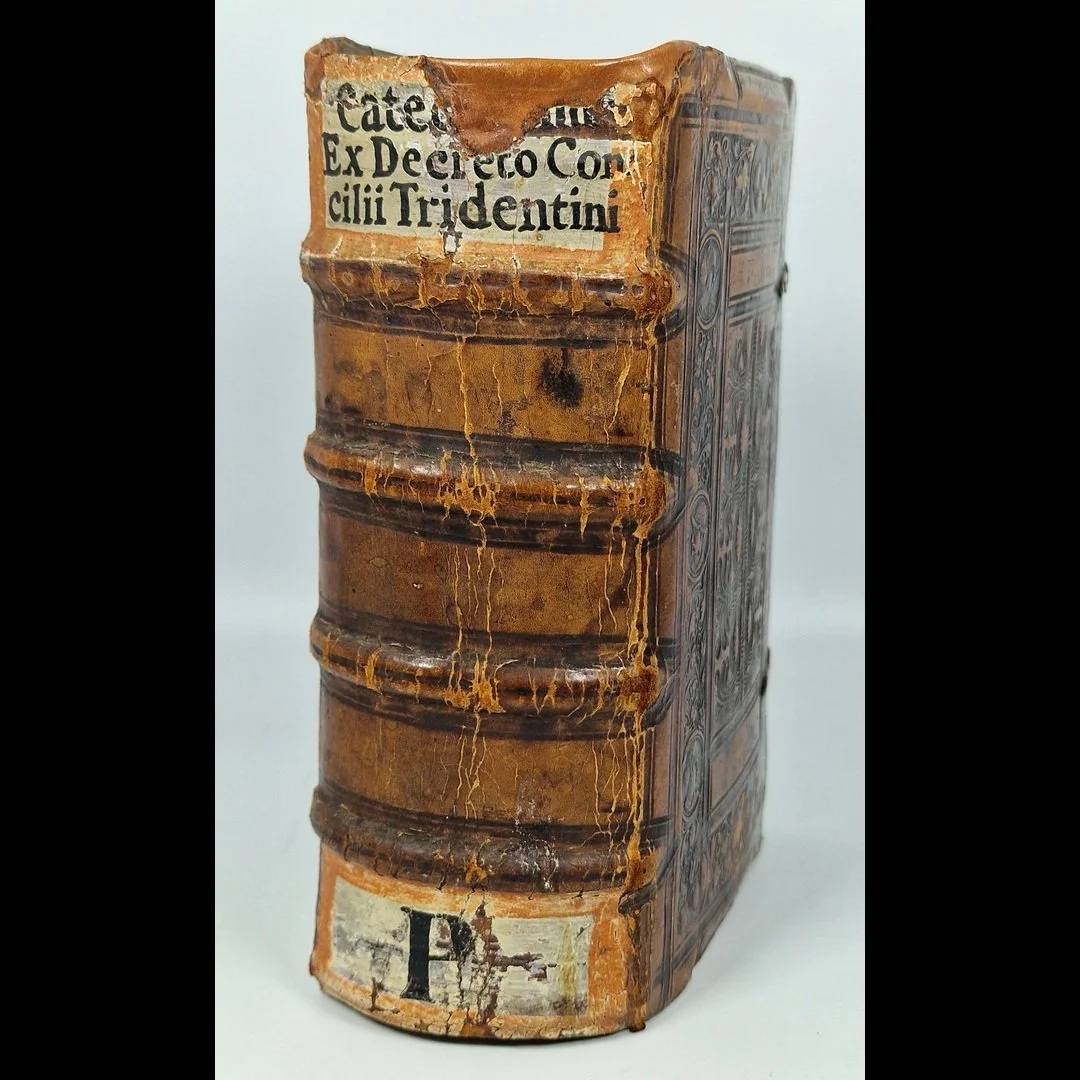 Image 4 of 15
 Image 5 of 15
 Image 6 of 15
 Image 7 of 15
 Image 8 of 15
 Image 9 of 15
 Image 10 of 15
 Image 11 of 15
 Image 12 of 15
 Image 13 of 15
 Image 14 of 15
 Image 15 of 15