1588 Paris Fourth Edition
PSALMI DAVIDIS VULGATA EDITIONE
By Gilbert Génébrard
KEY DETAILS
Condition: Good
Format: Old vellum over later boards, Octavo (Standard) (8vo 6 × 9 in 152 × 229 mm )
Note: Binding/size selection follows standard bibliographic conventions and is approximate; exact measurements may vary.
Published By: Parisiis, Ex Officina Petri L’Huillier, via Jacobaea, sub signo Olivae, Paris, 1588
Language: Latin, with Hebrew, Greek and Syriac material
Illustrated By: Anonymous
Provenance: Early ink ownership inscription “Paternina” to title page; attribution currently under research.
Collation: [144], 943, [41] pp.; illustrated
Dust Jacket: None, as issued, No Jacket
SKU: BTETM0002409
Shipping Info: Approximate Package Dimensions H: 12.5, L: 30, W: 25 (Units: cm), W: 2Kg
Tracked Shipping, Insurance Coverage as per Customer Request
DESCRIPTION
Psalmi Davidis Vulgata Editione
Calendario Hebraeo, Syro, Graeco, Latino, argumentis et commentariis
By Gilbert Génébrard
A handsome and scholarly late-Renaissance Psalter by Gilbert Génébrard, one of the leading Christian Hebraists of sixteenth-century France, printed at Paris by Pierre L’Huillier in 1588.
This fourth edition presents the Psalms according to the Latin Vulgate, accompanied by substantial linguistic, historical and exegetical commentary and prefaced by comparative Hebrew, Syriac, Greek and Latin calendrical material. Génébrard’s purpose was not simply devotional: the work belongs to the Renaissance recovery of the biblical languages and attempts to illuminate the primary sense of the Psalms through Hebrew philology, ancient textual traditions and Jewish as well as Christian exegetical learning. The Bibliothèque nationale de France notes that the commentary following each Psalm derives from lectures given by Génébrard at the University of Paris in 1577–1578.
An attractive production, with the title and calendar printed in red and black, Pierre L’Huillier’s woodcut olive-tree device to the title, an accomplished large woodcut of King David with his harp, ornamental headpieces and numerous historiated and decorative woodcut initials. The result is considerably richer visually than the compact octavo format might suggest.
This particular copy also preserves a layered and increasingly researchable provenance. The front endpaper bears a Spanish Franciscan use inscription identifying Fr. Lucas María Vélez de Elorriaga (1782–1846), while the title carries the earlier ink name “Paternina” and a later library stamp of the Abbaye Saint-Martin de Ligugé. The Paternina inscription remains under palaeographical investigation and is therefore recorded here without attribution.
PROVENANCE
Early ink ownership inscription “Paternina” to title page; attribution currently under research.
Manuscript Franciscan use inscription of Fr. Lucas María Vélez de Elorriaga (1782–1846) to front endpaper.
Circular library stamp of the Abbaye Saint-Martin de Ligugé, France, to title page.
Jeschke Jádi Auctions, Berlin, Auction 150, 20 January 2024, Lot 25. The auction description corresponds to the present copy in its inscriptions, Ligugé stamp, binding and condition.
CONDITION, COLLATION & COPY NOTES
A sound and visually appealing sixteenth-century scholarly Psalter, retaining strong impressions of the woodcut material and attractive red-and-black printing.
Bound in contemporary vellum reused over later boards, with manuscript titling to the spine. The vellum with general age-soiling, rubbing, surface wear and small areas of loss, particularly to the spine and extremities. The volume is housed in a later fitted slipcase. The 2024 Jeschke Jádi catalogue likewise described the binding as modern boards utilising the contemporary vellum covering.
Title page present, printed in red and black and retaining Pierre L’Huillier’s woodcut printer’s device. The title and following leaf have been strengthened at the margins, with visible restoration but no obvious loss affecting the principal printed text. The title bears an early ink inscription “Paternina” together with the circular library stamp of the Abbaye Saint-Martin de Ligugé.
The front endpaper bears the manuscript inscription:
“Esta interpretación de Salmos es del uso simple del P.e Fr. Lucas Mª Vélez de Elorriaga.”
Translated:
“This interpretation of the Psalms is for the simple use of Father Friar Lucas María Vélez de Elorriaga.”
Lucas María Vélez de Elorriaga was born at Elorriaga, Álava, in 1782 and died at Vitoria in 1846. After returning to Arantzazu in 1814 to complete studies interrupted during the Napoleonic period, he became a preacher and confessor and was thereafter associated with the Franciscan Recollect community of the Immaculate Conception at Vitoria.
The wording “del uso simple” is significant in Franciscan book culture. Comparable Franciscan ownership marks use precisely this formula for books assigned to an individual friar for use while remaining conventual rather than private property.
Internally with general age-toning, scattered brown spotting and staining, and areas of waterstaining, in places more pronounced, but the text remains substantially sound and legible. The pages examined retain crisp typography and good impressions of the woodcuts and decorative initials.
With title and calendar in red and black; woodcut printer’s device to title; large woodcut of King David; ornamental headpieces; and numerous historiated and decorative woodcut initials throughout.
A handsome working copy of an important Renaissance biblical commentary, particularly notable for its Christian Hebraist scholarship, decorative woodcut programme and layered Spanish Franciscan and French Benedictine provenance.
Please see Photos as part of condition report.
REFERENCES
Bibliothèque nationale de France, FRBNF36116038.
Jeschke Jádi Auctions, Berlin, Auction 150, Lot 25, 20 January 2024.
SYNOPSIS
Génébrard’s Psalmi Davidis Vulgata Editione is considerably more than a straightforward printing of the Latin Psalms. It combines the Vulgate Psalter with an extensive commentary designed to uncover the genuine and primary sense of the text, paying particular attention to Hebrew idiom and linguistic features which could be obscured in Latin translation.
The work draws upon the Hebrew text, the Septuagint, Syriac and other ancient traditions, together with Jewish and Christian commentary. This comparative method places Génébrard firmly within the intellectual world of Christian Hebraism, in which Renaissance scholars sought a deeper understanding of Scripture through renewed study of Hebrew and rabbinic sources.
Its extensive preliminary calendar similarly juxtaposes Hebrew, Syriac, Greek and Latin traditions, giving the work a broader chronological and cultural framework before the Psalter proper begins.
The commentary was closely connected with Génébrard’s Paris teaching in 1577–1578 and was repeatedly revised and enlarged. This 1588 fourth edition therefore represents a mature form of one of his principal exegetical works.
As an object, the book combines several strands of collecting interest: sixteenth-century Paris printing, Renaissance biblical scholarship, Christian Hebraism, decorative woodcut illustration and a distinctive provenance extending through Spanish Franciscan use and the Benedictine library at Ligugé.
AUTHOR BIO
Gilbert Génébrard (1537–1597) was a French Benedictine theologian, exegete, Orientalist and one of the leading Hebrew scholars of the later sixteenth century. He became closely associated with the learned culture of the Collège Royal, where the study and printing of Hebrew formed an important strand of Renaissance scholarship in Paris. The BnF identifies him as a specialist in ancient languages, holder of the Hebrew chair at the Collège de France and later Archbishop of Aix.
His scholarship ranged across Hebrew grammar, rabbinic commentary, biblical chronology, patristics and scriptural exegesis. Among his earlier publications were works expressly intended to assist Christian scholars in reading rabbinic commentary, illustrating the degree to which Hebrew and Jewish exegetical traditions informed his biblical scholarship.
ILLUSTRATOR
Anonymous
No individual woodcut artist is identified in the bibliographical records consulted. The volume employs a varied Renaissance decorative programme including Pierre L’Huillier’s printer’s device, ornamental headpieces, historiated initials and a large woodcut of King David with his harp.
The cuts are integral to the visual character of the edition, combining the compact practicality of a scholarly octavo with a level of decoration more commonly associated with larger biblical and theological productions.
1588 Paris Fourth Edition
PSALMI DAVIDIS VULGATA EDITIONE
By Gilbert Génébrard
KEY DETAILS
Condition: Good
Format: Old vellum over later boards, Octavo (Standard) (8vo 6 × 9 in 152 × 229 mm )
Note: Binding/size selection follows standard bibliographic conventions and is approximate; exact measurements may vary.
Published By: Parisiis, Ex Officina Petri L’Huillier, via Jacobaea, sub signo Olivae, Paris, 1588
Language: Latin, with Hebrew, Greek and Syriac material
Illustrated By: Anonymous
Provenance: Early ink ownership inscription “Paternina” to title page; attribution currently under research.
Collation: [144], 943, [41] pp.; illustrated
Dust Jacket: None, as issued, No Jacket
SKU: BTETM0002409
Shipping Info: Approximate Package Dimensions H: 12.5, L: 30, W: 25 (Units: cm), W: 2Kg
Tracked Shipping, Insurance Coverage as per Customer Request
DESCRIPTION
Psalmi Davidis Vulgata Editione
Calendario Hebraeo, Syro, Graeco, Latino, argumentis et commentariis
By Gilbert Génébrard
A handsome and scholarly late-Renaissance Psalter by Gilbert Génébrard, one of the leading Christian Hebraists of sixteenth-century France, printed at Paris by Pierre L’Huillier in 1588.
This fourth edition presents the Psalms according to the Latin Vulgate, accompanied by substantial linguistic, historical and exegetical commentary and prefaced by comparative Hebrew, Syriac, Greek and Latin calendrical material. Génébrard’s purpose was not simply devotional: the work belongs to the Renaissance recovery of the biblical languages and attempts to illuminate the primary sense of the Psalms through Hebrew philology, ancient textual traditions and Jewish as well as Christian exegetical learning. The Bibliothèque nationale de France notes that the commentary following each Psalm derives from lectures given by Génébrard at the University of Paris in 1577–1578.
An attractive production, with the title and calendar printed in red and black, Pierre L’Huillier’s woodcut olive-tree device to the title, an accomplished large woodcut of King David with his harp, ornamental headpieces and numerous historiated and decorative woodcut initials. The result is considerably richer visually than the compact octavo format might suggest.
This particular copy also preserves a layered and increasingly researchable provenance. The front endpaper bears a Spanish Franciscan use inscription identifying Fr. Lucas María Vélez de Elorriaga (1782–1846), while the title carries the earlier ink name “Paternina” and a later library stamp of the Abbaye Saint-Martin de Ligugé. The Paternina inscription remains under palaeographical investigation and is therefore recorded here without attribution.
PROVENANCE
Early ink ownership inscription “Paternina” to title page; attribution currently under research.
Manuscript Franciscan use inscription of Fr. Lucas María Vélez de Elorriaga (1782–1846) to front endpaper.
Circular library stamp of the Abbaye Saint-Martin de Ligugé, France, to title page.
Jeschke Jádi Auctions, Berlin, Auction 150, 20 January 2024, Lot 25. The auction description corresponds to the present copy in its inscriptions, Ligugé stamp, binding and condition.
CONDITION, COLLATION & COPY NOTES
A sound and visually appealing sixteenth-century scholarly Psalter, retaining strong impressions of the woodcut material and attractive red-and-black printing.
Bound in contemporary vellum reused over later boards, with manuscript titling to the spine. The vellum with general age-soiling, rubbing, surface wear and small areas of loss, particularly to the spine and extremities. The volume is housed in a later fitted slipcase. The 2024 Jeschke Jádi catalogue likewise described the binding as modern boards utilising the contemporary vellum covering.
Title page present, printed in red and black and retaining Pierre L’Huillier’s woodcut printer’s device. The title and following leaf have been strengthened at the margins, with visible restoration but no obvious loss affecting the principal printed text. The title bears an early ink inscription “Paternina” together with the circular library stamp of the Abbaye Saint-Martin de Ligugé.
The front endpaper bears the manuscript inscription:
“Esta interpretación de Salmos es del uso simple del P.e Fr. Lucas Mª Vélez de Elorriaga.”
Translated:
“This interpretation of the Psalms is for the simple use of Father Friar Lucas María Vélez de Elorriaga.”
Lucas María Vélez de Elorriaga was born at Elorriaga, Álava, in 1782 and died at Vitoria in 1846. After returning to Arantzazu in 1814 to complete studies interrupted during the Napoleonic period, he became a preacher and confessor and was thereafter associated with the Franciscan Recollect community of the Immaculate Conception at Vitoria.
The wording “del uso simple” is significant in Franciscan book culture. Comparable Franciscan ownership marks use precisely this formula for books assigned to an individual friar for use while remaining conventual rather than private property.
Internally with general age-toning, scattered brown spotting and staining, and areas of waterstaining, in places more pronounced, but the text remains substantially sound and legible. The pages examined retain crisp typography and good impressions of the woodcuts and decorative initials.
With title and calendar in red and black; woodcut printer’s device to title; large woodcut of King David; ornamental headpieces; and numerous historiated and decorative woodcut initials throughout.
A handsome working copy of an important Renaissance biblical commentary, particularly notable for its Christian Hebraist scholarship, decorative woodcut programme and layered Spanish Franciscan and French Benedictine provenance.
Please see Photos as part of condition report.
REFERENCES
Bibliothèque nationale de France, FRBNF36116038.
Jeschke Jádi Auctions, Berlin, Auction 150, Lot 25, 20 January 2024.
SYNOPSIS
Génébrard’s Psalmi Davidis Vulgata Editione is considerably more than a straightforward printing of the Latin Psalms. It combines the Vulgate Psalter with an extensive commentary designed to uncover the genuine and primary sense of the text, paying particular attention to Hebrew idiom and linguistic features which could be obscured in Latin translation.
The work draws upon the Hebrew text, the Septuagint, Syriac and other ancient traditions, together with Jewish and Christian commentary. This comparative method places Génébrard firmly within the intellectual world of Christian Hebraism, in which Renaissance scholars sought a deeper understanding of Scripture through renewed study of Hebrew and rabbinic sources.
Its extensive preliminary calendar similarly juxtaposes Hebrew, Syriac, Greek and Latin traditions, giving the work a broader chronological and cultural framework before the Psalter proper begins.
The commentary was closely connected with Génébrard’s Paris teaching in 1577–1578 and was repeatedly revised and enlarged. This 1588 fourth edition therefore represents a mature form of one of his principal exegetical works.
As an object, the book combines several strands of collecting interest: sixteenth-century Paris printing, Renaissance biblical scholarship, Christian Hebraism, decorative woodcut illustration and a distinctive provenance extending through Spanish Franciscan use and the Benedictine library at Ligugé.
AUTHOR BIO
Gilbert Génébrard (1537–1597) was a French Benedictine theologian, exegete, Orientalist and one of the leading Hebrew scholars of the later sixteenth century. He became closely associated with the learned culture of the Collège Royal, where the study and printing of Hebrew formed an important strand of Renaissance scholarship in Paris. The BnF identifies him as a specialist in ancient languages, holder of the Hebrew chair at the Collège de France and later Archbishop of Aix.
His scholarship ranged across Hebrew grammar, rabbinic commentary, biblical chronology, patristics and scriptural exegesis. Among his earlier publications were works expressly intended to assist Christian scholars in reading rabbinic commentary, illustrating the degree to which Hebrew and Jewish exegetical traditions informed his biblical scholarship.
ILLUSTRATOR
Anonymous
No individual woodcut artist is identified in the bibliographical records consulted. The volume employs a varied Renaissance decorative programme including Pierre L’Huillier’s printer’s device, ornamental headpieces, historiated initials and a large woodcut of King David with his harp.
The cuts are integral to the visual character of the edition, combining the compact practicality of a scholarly octavo with a level of decoration more commonly associated with larger biblical and theological productions.

 Image 1 of 20
 Image 2 of 20
 Image 3 of 20
 Image 4 of 20
 Image 5 of 20
 Image 6 of 20
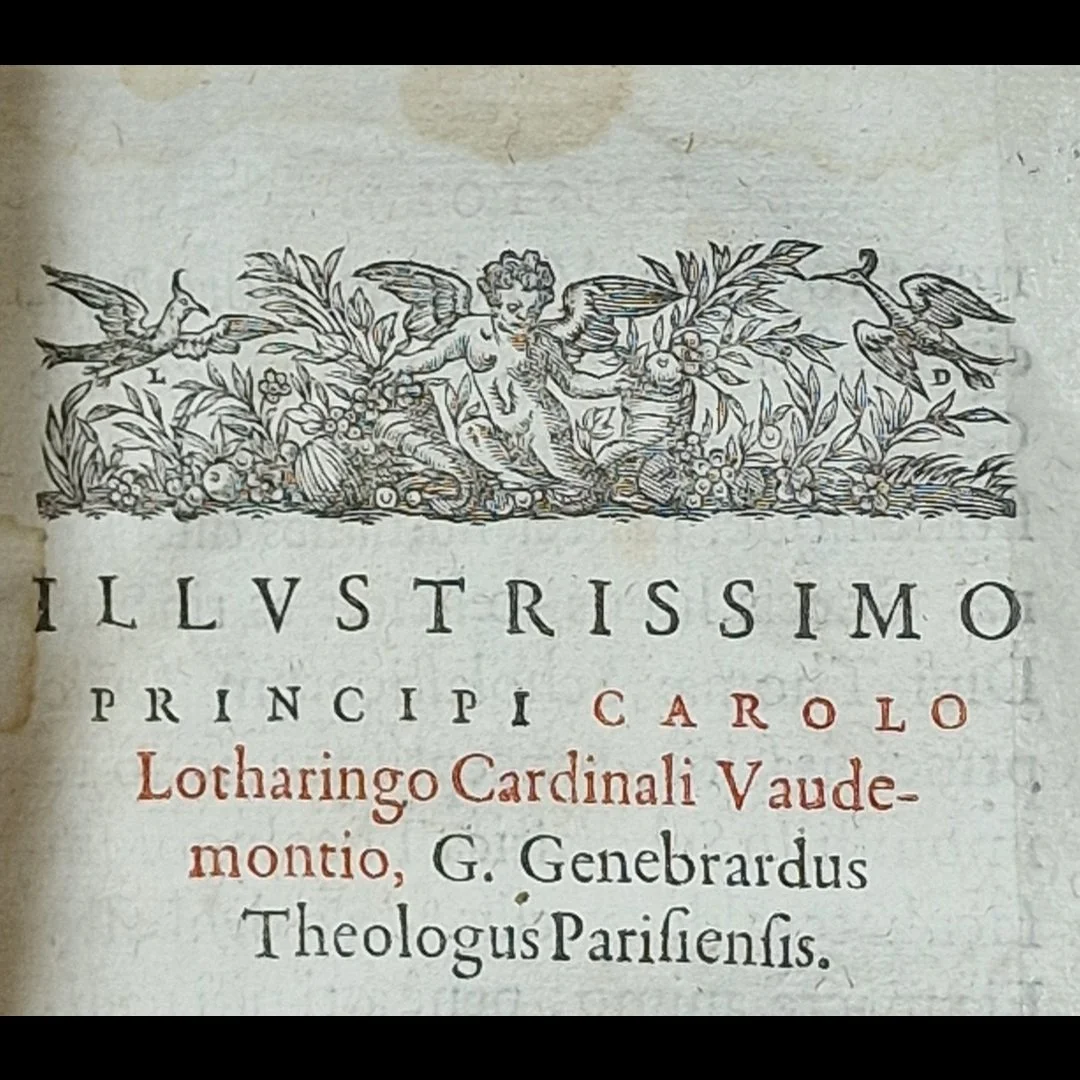 Image 7 of 20
 Image 8 of 20
 Image 9 of 20
 Image 10 of 20
 Image 11 of 20
 Image 12 of 20
 Image 13 of 20
 Image 14 of 20
 Image 15 of 20
 Image 16 of 20
 Image 17 of 20
 Image 18 of 20
 Image 19 of 20
 Image 20 of 20
![1775 First Edtn 8 Tomes Bound in 6 Volumes LECTIONUM THEOLOGICO-MORALIUM By Francesco da Pieve di Teco [OFM Cap.] Illus. Carlo Benza](https://images.squarespace-cdn.com/content/v1/634dab4938c13d5c1f88d382/1719949412797-NJ27NXRJXLACWH7WGG85/20240605_184820-26.jpg)