Sale Price:
£1,700.00
Original Price:
£1,995.00
1965 First Edition 5th Printing or Later Final Impressions
THE LORD OF THE RINGS-THREE VOLS
By J.R.R. Tolkien
KEY DETAILS
Condition: Very Good
Format: Hardcover, Octavo (Standard) (8vo 6 × 9 in 152 × 229 mm )
Note: Binding/size selection follows standard bibliographic conventions and is approximate; exact measurements may vary.
Published By: George Allen & Unwin Ltd, London, 1965
Language: English
Collation: THE FELLOWSHIP OF THE RING
Dust Jacket: Yes, Very Good
SKU: BTETM0002512
Shipping Info: Approximate Package Dimensions H: 12.5, L: 30, W: 25 (Units: cm), W: 3Kg
Tracked Shipping, Insurance Coverage as per Customer Request
DESCRIPTION
The Lord of the Rings-Three Vols
THE FELLOWSHIP OF THE RING — Fifteenth Impression, 1966
THE TWO TOWERS — Twelfth Impression, 1966
THE RETURN OF THE KING — Eleventh Impression, 1965
By J. R. R. Tolkien
An attractive and increasingly collectible complete three-volume set of J. R. R. Tolkien’s The Lord of the Rings, comprising the final impressions of the original UK first edition of each volume: the fifteenth impression of The Fellowship of the Ring, the twelfth impression of The Two Towers, and the eleventh impression of The Return of the King.
Published by George Allen & Unwin in 1965–1966, this 15th/12th/11th set represents the terminal printing state of Tolkien’s original first edition immediately before the work passed into the revised second edition.
Particularly desirable as a coherent set, all three volumes retain their corresponding original Tolkien-designed dust jackets, each correctly stating the impression of the book it encloses and retaining the original printed price of 25s net. The books are complete with the three folding maps by Christopher Tolkien at the rear; all three maps have been examined and are clean and free from tears or repairs.
There are no previous-owner inscriptions in any of the volumes.
An appealing opportunity to acquire Tolkien’s great twentieth-century epic in the classic three-volume Allen & Unwin first-edition format, retaining the original red cloth bindings, matching impression-specific dust jackets and all three folding maps.
Bibliographical Note:
This set occupies a particularly interesting position in the publication history of The Lord of the Rings.
The Fellowship of the Ring reached its fifteenth and final impression of the original first edition in 1966.
The Two Towers reached its twelfth and final first-edition impression in the same year.
The Return of the King had reached its eleventh and final first-edition impression in 1965.
The final first-edition impressions of Fellowship and Two Towers were comparatively small 4,000-copy printings.
The present set therefore brings together the final impressions of all three volumes of the original UK first edition — 15th/12th/11th — immediately preceding the revised second edition.
With all three corresponding impression-specific, originally priced dust jackets, all three clean folding maps and no ownership inscriptions, this is a coherent and attractive example of the closing state of Tolkien’s original first-edition text.
A highly collectable complete set of one of the defining works of twentieth-century literature.
CONDITION, COLLATION & COPY NOTES
A sound and attractive complete set in the original red cloth bindings with the original corresponding dust jackets.
All three jackets are correct for their respective impressions and retain the original printed price of 25s net.
The dust jackets show age-related browning and toning, most noticeably to the spines and margins, together with scattered spotting, handling marks and general edge wear. There are small nicks and areas of rubbing at the extremities consistent with age and use, but the jackets remain substantially complete and present well as a uniform set.
The original red cloth bindings remain attractive, with gilt spine lettering present. General light shelf and handling wear commensurate with age.
Internally the volumes are generally clean and well preserved. Some scattered spotting and foxing is present, principally to preliminaries, endpapers and adjoining leaves, with general light age-toning.
No previous-owner inscriptions or bookplates.
The three folding maps by Christopher Tolkien are present at the rear of their respective volumes. Each has been examined and is clean, complete and without tears or repairs.
A particularly pleasing feature of the set is its bibliographical consistency: the fifteenth-impression Fellowship is retained in its fifteenth-impression jacket, the twelfth-impression Two Towers in its twelfth-impression jacket, and the eleventh-impression Return of the King in its eleventh-impression jacket.
Complete.
Edition / Impression:
The Fellowship of the Ring — First UK Edition, Fifteenth Impression, 1966
The Two Towers — First UK Edition, Twelfth Impression, 1966
The Return of the King — First UK Edition, Eleventh Impression, 1965
These are the final impressions of the original first edition of each of the three volumes.
Please see Photos as part of condition report.
REFERENCES
Hammond, Wayne G., with the assistance of Douglas A. Anderson. J.R.R. Tolkien: A Descriptive Bibliography. Winchester: St Paul’s Bibliographies; New Castle, Delaware: Oak Knoll Books, 1993. A5, pp. 82–138.
Hammond records the publication and printing history of the original George Allen & Unwin edition of The Lord of the Rings, including the successive impressions and textual and physical changes.
The present set comprises the terminal impressions of the original UK first edition of each volume:
The Fellowship of the Ring — First Edition, Fifteenth Impression, 1966; the fifteenth and final impression of the first edition.
The Two Towers — First Edition, Twelfth Impression, 1966; the twelfth and final impression of the first edition.
The Return of the King — First Edition, Eleventh Impression, 1965; the eleventh and final impression of the first edition.
The Fellowship of the Ring and The Two Towers were subsequently reset for the revised Second Edition in 1966.
The present 15th/12th/11th set therefore represents the final impression sequence of the complete original UK First Edition, retaining the corresponding impression-specific George Allen & Unwin dust jackets and all three folding maps.
SYNOPSIS
The Lord of the Rings begins in the apparently peaceful Shire, where the hobbit Frodo Baggins inherits a mysterious ring from his cousin Bilbo.
The wizard Gandalf eventually discovers that this is the One Ring, forged by the Dark Lord Sauron to dominate the other Rings of Power and their bearers. Although Sauron was defeated long before the events of the story, he has regained strength in Mordor and searches relentlessly for the lost Ring.
Its destruction is possible only in the fires of Mount Doom, where it was originally forged.
THE FELLOWSHIP OF THE RING
Frodo leaves the Shire accompanied by Sam Gamgee, Merry Brandybuck and Pippin Took. Pursued by the terrifying Black Riders, the hobbits make their way through the Old Forest, Bree and finally Rivendell.
At the Council of Elrond the true nature of the Ring is revealed and the representatives of the Free Peoples determine that it must be taken into Mordor and destroyed.
A Fellowship of nine is formed: Frodo, Sam, Merry, Pippin, Gandalf, Aragorn, Boromir, Legolas and Gimli.
Their journey takes them through the mines of Moria, where Gandalf confronts the Balrog, and onward to the Elvish realm of Lothlórien. The Fellowship ultimately fractures after Boromir attempts to take the Ring, leaving Frodo and Sam to continue towards Mordor alone.
THE TWO TOWERS
The narrative divides.
Aragorn, Legolas and Gimli pursue the Orcs who have captured Merry and Pippin and become drawn into the war threatening the kingdom of Rohan. Their path brings them to King Théoden and the great defensive battle at Helm’s Deep.
Merry and Pippin escape into Fangorn Forest, where they encounter Treebeard and the Ents. Their intervention culminates in the assault upon Isengard and the overthrow of Saruman’s military power.
Meanwhile Frodo and Sam continue towards Mordor under the reluctant guidance of Gollum, the Ring’s former possessor. Gollum’s divided nature becomes increasingly dangerous as he leads them through the Dead Marshes, into Ithilien and ultimately towards the pass of Cirith Ungol.
THE RETURN OF THE KING
Sauron launches his great assault upon Gondor.
Gandalf and Pippin travel to Minas Tirith while Aragorn accepts the responsibility of his ancestry and seeks the aid of the Dead. Théoden and the Riders of Rohan ride to Gondor, culminating in the Battle of the Pelennor Fields.
As the armies of the West attempt a final diversion before the Black Gate of Mordor, Frodo and Sam struggle across the wasteland towards Mount Doom.
At the Crack of Doom, Frodo finally succumbs to the Ring and claims it for himself, but Gollum seizes it and falls with it into the fire, accomplishing through accident and obsession what Frodo could no longer willingly achieve.
With the Ring destroyed, Sauron’s power collapses.
The surviving members of the Fellowship return home, but victory is not without loss. The passing of the Elves, the departure of the Ring-bearers and Frodo’s inability fully to recover from his wounds lend the conclusion its characteristic sense of melancholy and transition.
The work closes not simply with the defeat of evil but with the ending of an age.
AUTHOR BIO
John Ronald Reuel Tolkien (1892–1973) was an English philologist, academic, poet and author whose imaginative writings fundamentally transformed modern fantasy literature.
Educated at Exeter College, Oxford, Tolkien served during the First World War before pursuing an academic career specialising in Old and Middle English language and literature. He became Rawlinson and Bosworth Professor of Anglo-Saxon at Oxford in 1925 and later Merton Professor of English Language and Literature.
His professional study of languages, mythology and early European literature profoundly informed his creative work. Tolkien did not merely devise a setting for his stories but constructed an elaborate secondary world possessing its own languages, histories, genealogies, legends and mythology.
The Hobbit appeared in 1937 and introduced readers to Middle-earth, Bilbo Baggins and the One Ring. Its success led Tolkien to begin the much larger work that became The Lord of the Rings.
Published in three volumes between 1954 and 1955, The Lord of the Rings became one of the most influential works of twentieth-century imaginative literature. Its conception of a fully realised secondary world, its linguistic depth and its fusion of heroic, mythological and elegiac traditions established a model against which subsequent fantasy literature would repeatedly be measured.
Tolkien continued revising and expanding the mythology of Middle-earth throughout his life. Much of this material was subsequently edited and published by his son Christopher Tolkien, most notably as The Silmarillion in 1977.
Maps By:
Christopher Tolkien
Christopher John Reuel Tolkien (1924–2020), the third son of J. R. R. Tolkien, was an academic, editor and cartographer who played an essential role in both the original publication and the later preservation of his father’s legendarium.
He prepared the finished maps used in The Lord of the Rings from his father’s working material and later became literary executor of the Tolkien Estate.
Following J. R. R. Tolkien’s death, Christopher undertook the immense editorial task of organising and publishing his father’s unfinished manuscripts, producing The Silmarillion, Unfinished Tales and the twelve-volume History of Middle-earth, among other works.
The folding maps in these volumes are therefore not incidental illustrations but form part of the Tolkien family’s original conception and presentation of Middle-earth.
1965 First Edition 5th Printing or Later Final Impressions
THE LORD OF THE RINGS-THREE VOLS
By J.R.R. Tolkien
KEY DETAILS
Condition: Very Good
Format: Hardcover, Octavo (Standard) (8vo 6 × 9 in 152 × 229 mm )
Note: Binding/size selection follows standard bibliographic conventions and is approximate; exact measurements may vary.
Published By: George Allen & Unwin Ltd, London, 1965
Language: English
Collation: THE FELLOWSHIP OF THE RING
Dust Jacket: Yes, Very Good
SKU: BTETM0002512
Shipping Info: Approximate Package Dimensions H: 12.5, L: 30, W: 25 (Units: cm), W: 3Kg
Tracked Shipping, Insurance Coverage as per Customer Request
DESCRIPTION
The Lord of the Rings-Three Vols
THE FELLOWSHIP OF THE RING — Fifteenth Impression, 1966
THE TWO TOWERS — Twelfth Impression, 1966
THE RETURN OF THE KING — Eleventh Impression, 1965
By J. R. R. Tolkien
An attractive and increasingly collectible complete three-volume set of J. R. R. Tolkien’s The Lord of the Rings, comprising the final impressions of the original UK first edition of each volume: the fifteenth impression of The Fellowship of the Ring, the twelfth impression of The Two Towers, and the eleventh impression of The Return of the King.
Published by George Allen & Unwin in 1965–1966, this 15th/12th/11th set represents the terminal printing state of Tolkien’s original first edition immediately before the work passed into the revised second edition.
Particularly desirable as a coherent set, all three volumes retain their corresponding original Tolkien-designed dust jackets, each correctly stating the impression of the book it encloses and retaining the original printed price of 25s net. The books are complete with the three folding maps by Christopher Tolkien at the rear; all three maps have been examined and are clean and free from tears or repairs.
There are no previous-owner inscriptions in any of the volumes.
An appealing opportunity to acquire Tolkien’s great twentieth-century epic in the classic three-volume Allen & Unwin first-edition format, retaining the original red cloth bindings, matching impression-specific dust jackets and all three folding maps.
Bibliographical Note:
This set occupies a particularly interesting position in the publication history of The Lord of the Rings.
The Fellowship of the Ring reached its fifteenth and final impression of the original first edition in 1966.
The Two Towers reached its twelfth and final first-edition impression in the same year.
The Return of the King had reached its eleventh and final first-edition impression in 1965.
The final first-edition impressions of Fellowship and Two Towers were comparatively small 4,000-copy printings.
The present set therefore brings together the final impressions of all three volumes of the original UK first edition — 15th/12th/11th — immediately preceding the revised second edition.
With all three corresponding impression-specific, originally priced dust jackets, all three clean folding maps and no ownership inscriptions, this is a coherent and attractive example of the closing state of Tolkien’s original first-edition text.
A highly collectable complete set of one of the defining works of twentieth-century literature.
CONDITION, COLLATION & COPY NOTES
A sound and attractive complete set in the original red cloth bindings with the original corresponding dust jackets.
All three jackets are correct for their respective impressions and retain the original printed price of 25s net.
The dust jackets show age-related browning and toning, most noticeably to the spines and margins, together with scattered spotting, handling marks and general edge wear. There are small nicks and areas of rubbing at the extremities consistent with age and use, but the jackets remain substantially complete and present well as a uniform set.
The original red cloth bindings remain attractive, with gilt spine lettering present. General light shelf and handling wear commensurate with age.
Internally the volumes are generally clean and well preserved. Some scattered spotting and foxing is present, principally to preliminaries, endpapers and adjoining leaves, with general light age-toning.
No previous-owner inscriptions or bookplates.
The three folding maps by Christopher Tolkien are present at the rear of their respective volumes. Each has been examined and is clean, complete and without tears or repairs.
A particularly pleasing feature of the set is its bibliographical consistency: the fifteenth-impression Fellowship is retained in its fifteenth-impression jacket, the twelfth-impression Two Towers in its twelfth-impression jacket, and the eleventh-impression Return of the King in its eleventh-impression jacket.
Complete.
Edition / Impression:
The Fellowship of the Ring — First UK Edition, Fifteenth Impression, 1966
The Two Towers — First UK Edition, Twelfth Impression, 1966
The Return of the King — First UK Edition, Eleventh Impression, 1965
These are the final impressions of the original first edition of each of the three volumes.
Please see Photos as part of condition report.
REFERENCES
Hammond, Wayne G., with the assistance of Douglas A. Anderson. J.R.R. Tolkien: A Descriptive Bibliography. Winchester: St Paul’s Bibliographies; New Castle, Delaware: Oak Knoll Books, 1993. A5, pp. 82–138.
Hammond records the publication and printing history of the original George Allen & Unwin edition of The Lord of the Rings, including the successive impressions and textual and physical changes.
The present set comprises the terminal impressions of the original UK first edition of each volume:
The Fellowship of the Ring — First Edition, Fifteenth Impression, 1966; the fifteenth and final impression of the first edition.
The Two Towers — First Edition, Twelfth Impression, 1966; the twelfth and final impression of the first edition.
The Return of the King — First Edition, Eleventh Impression, 1965; the eleventh and final impression of the first edition.
The Fellowship of the Ring and The Two Towers were subsequently reset for the revised Second Edition in 1966.
The present 15th/12th/11th set therefore represents the final impression sequence of the complete original UK First Edition, retaining the corresponding impression-specific George Allen & Unwin dust jackets and all three folding maps.
SYNOPSIS
The Lord of the Rings begins in the apparently peaceful Shire, where the hobbit Frodo Baggins inherits a mysterious ring from his cousin Bilbo.
The wizard Gandalf eventually discovers that this is the One Ring, forged by the Dark Lord Sauron to dominate the other Rings of Power and their bearers. Although Sauron was defeated long before the events of the story, he has regained strength in Mordor and searches relentlessly for the lost Ring.
Its destruction is possible only in the fires of Mount Doom, where it was originally forged.
THE FELLOWSHIP OF THE RING
Frodo leaves the Shire accompanied by Sam Gamgee, Merry Brandybuck and Pippin Took. Pursued by the terrifying Black Riders, the hobbits make their way through the Old Forest, Bree and finally Rivendell.
At the Council of Elrond the true nature of the Ring is revealed and the representatives of the Free Peoples determine that it must be taken into Mordor and destroyed.
A Fellowship of nine is formed: Frodo, Sam, Merry, Pippin, Gandalf, Aragorn, Boromir, Legolas and Gimli.
Their journey takes them through the mines of Moria, where Gandalf confronts the Balrog, and onward to the Elvish realm of Lothlórien. The Fellowship ultimately fractures after Boromir attempts to take the Ring, leaving Frodo and Sam to continue towards Mordor alone.
THE TWO TOWERS
The narrative divides.
Aragorn, Legolas and Gimli pursue the Orcs who have captured Merry and Pippin and become drawn into the war threatening the kingdom of Rohan. Their path brings them to King Théoden and the great defensive battle at Helm’s Deep.
Merry and Pippin escape into Fangorn Forest, where they encounter Treebeard and the Ents. Their intervention culminates in the assault upon Isengard and the overthrow of Saruman’s military power.
Meanwhile Frodo and Sam continue towards Mordor under the reluctant guidance of Gollum, the Ring’s former possessor. Gollum’s divided nature becomes increasingly dangerous as he leads them through the Dead Marshes, into Ithilien and ultimately towards the pass of Cirith Ungol.
THE RETURN OF THE KING
Sauron launches his great assault upon Gondor.
Gandalf and Pippin travel to Minas Tirith while Aragorn accepts the responsibility of his ancestry and seeks the aid of the Dead. Théoden and the Riders of Rohan ride to Gondor, culminating in the Battle of the Pelennor Fields.
As the armies of the West attempt a final diversion before the Black Gate of Mordor, Frodo and Sam struggle across the wasteland towards Mount Doom.
At the Crack of Doom, Frodo finally succumbs to the Ring and claims it for himself, but Gollum seizes it and falls with it into the fire, accomplishing through accident and obsession what Frodo could no longer willingly achieve.
With the Ring destroyed, Sauron’s power collapses.
The surviving members of the Fellowship return home, but victory is not without loss. The passing of the Elves, the departure of the Ring-bearers and Frodo’s inability fully to recover from his wounds lend the conclusion its characteristic sense of melancholy and transition.
The work closes not simply with the defeat of evil but with the ending of an age.
AUTHOR BIO
John Ronald Reuel Tolkien (1892–1973) was an English philologist, academic, poet and author whose imaginative writings fundamentally transformed modern fantasy literature.
Educated at Exeter College, Oxford, Tolkien served during the First World War before pursuing an academic career specialising in Old and Middle English language and literature. He became Rawlinson and Bosworth Professor of Anglo-Saxon at Oxford in 1925 and later Merton Professor of English Language and Literature.
His professional study of languages, mythology and early European literature profoundly informed his creative work. Tolkien did not merely devise a setting for his stories but constructed an elaborate secondary world possessing its own languages, histories, genealogies, legends and mythology.
The Hobbit appeared in 1937 and introduced readers to Middle-earth, Bilbo Baggins and the One Ring. Its success led Tolkien to begin the much larger work that became The Lord of the Rings.
Published in three volumes between 1954 and 1955, The Lord of the Rings became one of the most influential works of twentieth-century imaginative literature. Its conception of a fully realised secondary world, its linguistic depth and its fusion of heroic, mythological and elegiac traditions established a model against which subsequent fantasy literature would repeatedly be measured.
Tolkien continued revising and expanding the mythology of Middle-earth throughout his life. Much of this material was subsequently edited and published by his son Christopher Tolkien, most notably as The Silmarillion in 1977.
Maps By:
Christopher Tolkien
Christopher John Reuel Tolkien (1924–2020), the third son of J. R. R. Tolkien, was an academic, editor and cartographer who played an essential role in both the original publication and the later preservation of his father’s legendarium.
He prepared the finished maps used in The Lord of the Rings from his father’s working material and later became literary executor of the Tolkien Estate.
Following J. R. R. Tolkien’s death, Christopher undertook the immense editorial task of organising and publishing his father’s unfinished manuscripts, producing The Silmarillion, Unfinished Tales and the twelve-volume History of Middle-earth, among other works.
The folding maps in these volumes are therefore not incidental illustrations but form part of the Tolkien family’s original conception and presentation of Middle-earth.

 Image 1 of 17
 Image 2 of 17
 Image 3 of 17
 Image 4 of 17
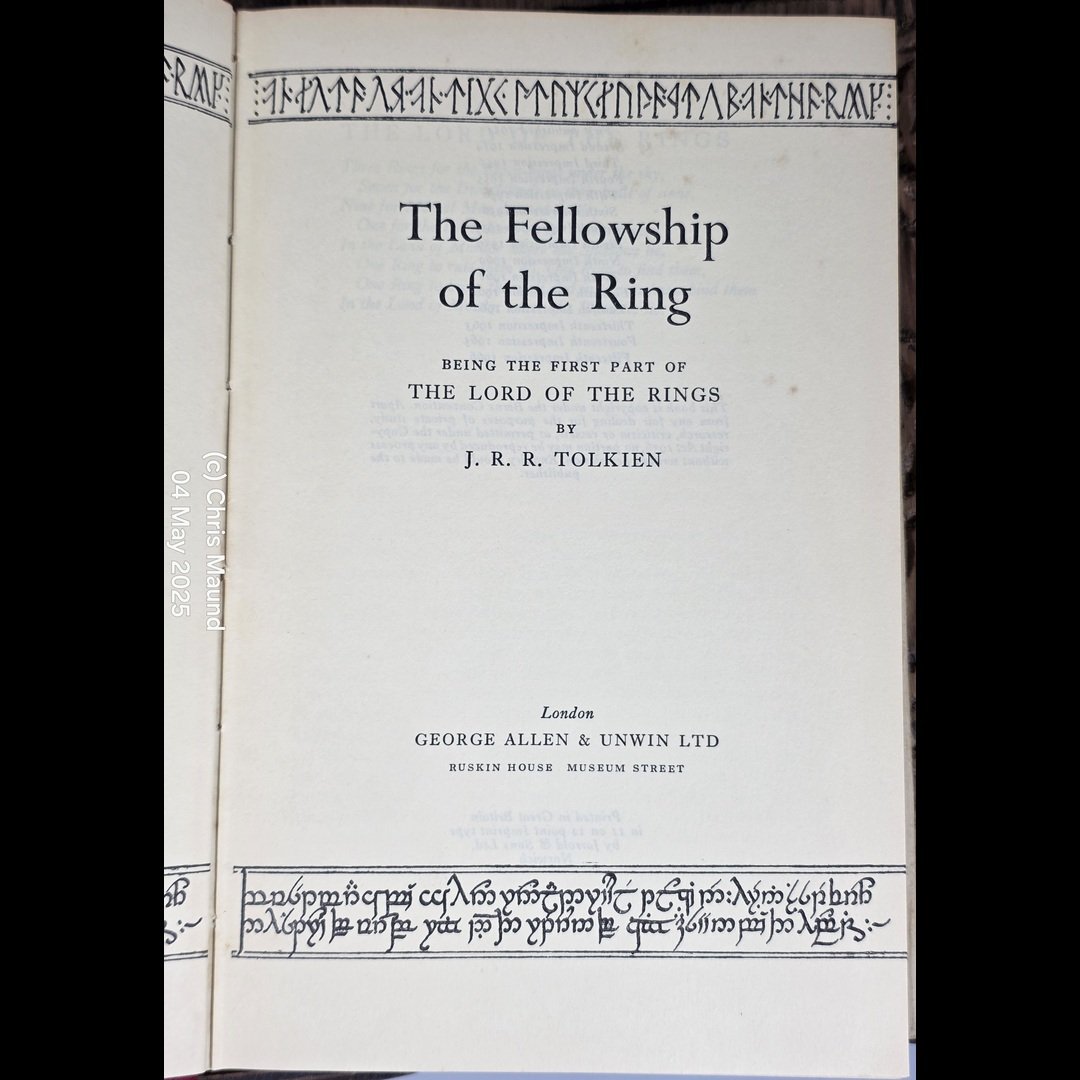 Image 5 of 17
 Image 6 of 17
 Image 7 of 17
 Image 8 of 17
 Image 9 of 17
 Image 10 of 17
 Image 11 of 17
 Image 12 of 17
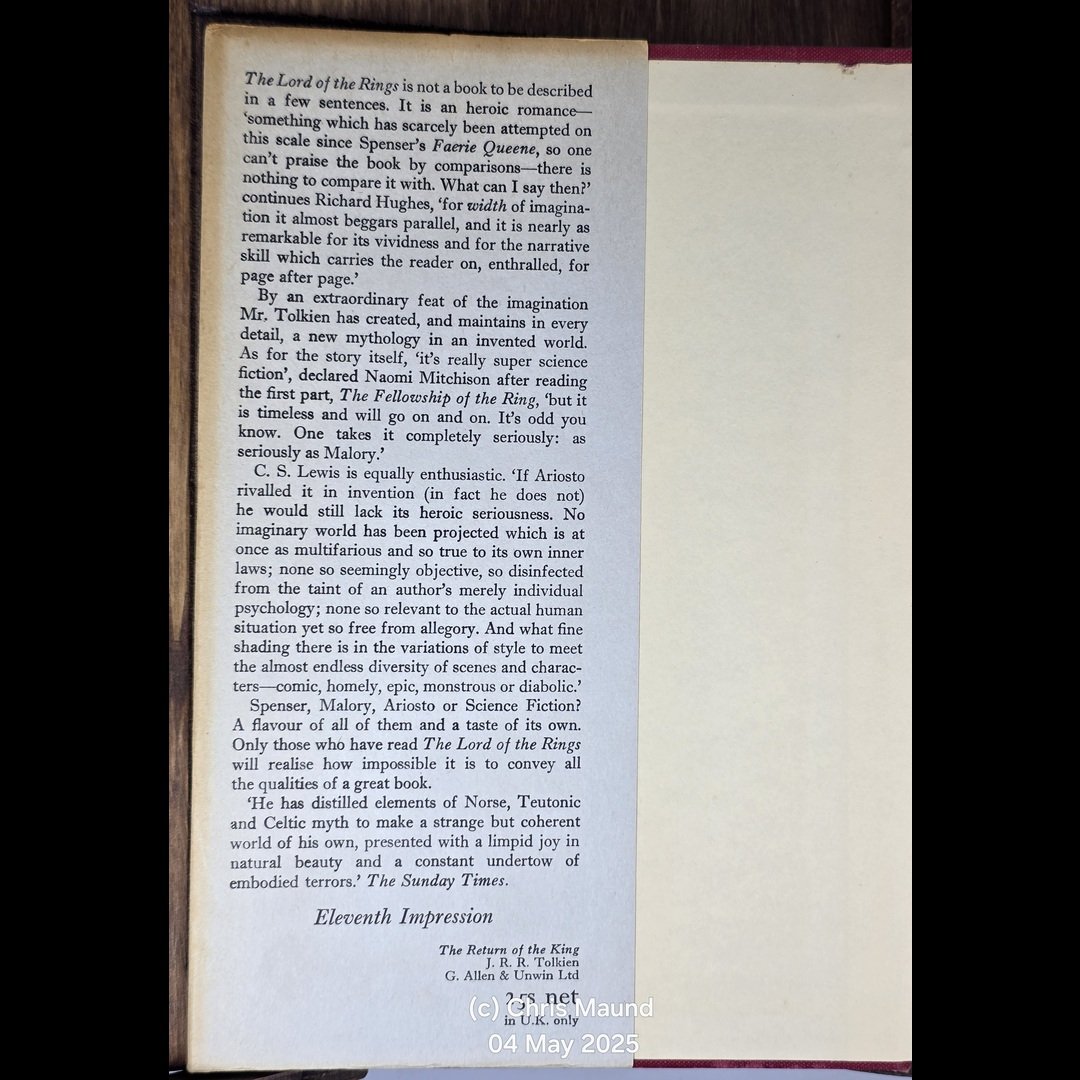 Image 13 of 17
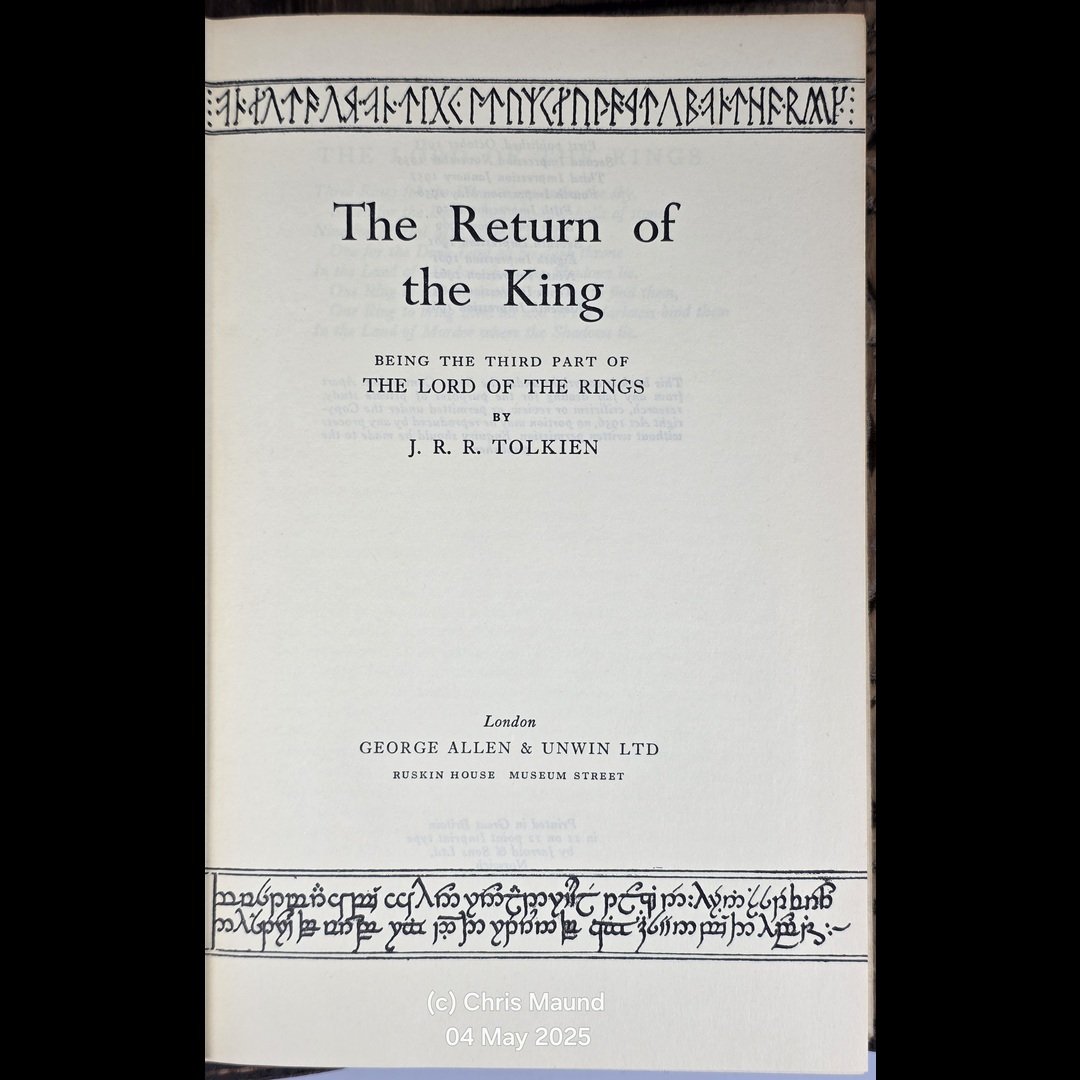 Image 14 of 17
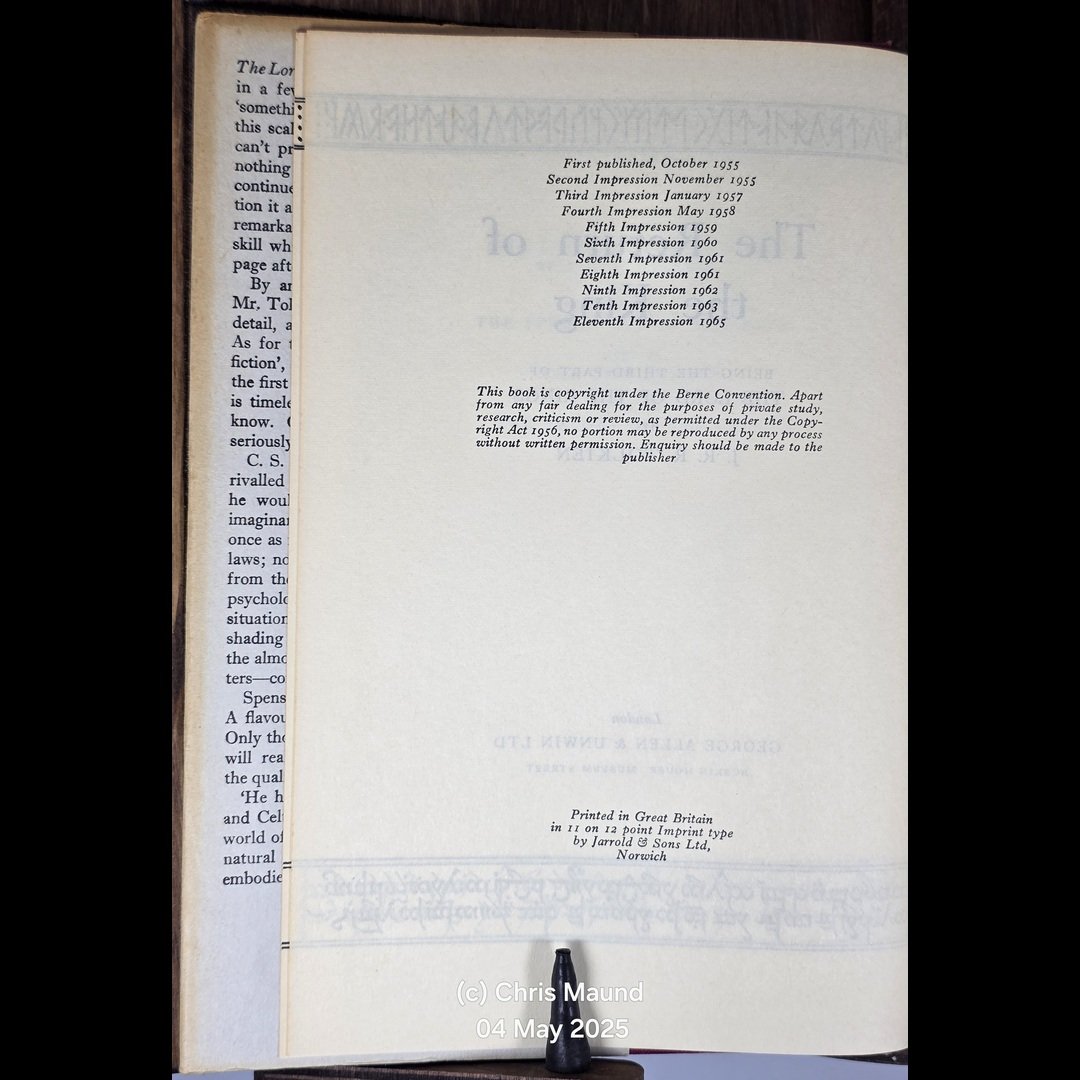 Image 15 of 17
 Image 16 of 17
 Image 17 of 17