1542
HERODOTI HALICARNASSEI HISTORIOGRAPHI LIBRI VIIII
By Herodotus
KEY DETAILS
Condition: Very Good
Format: Vellum, Small/Crown octavo (8vo 5 3⁄8 × 8 in 137 × 203 mm )
Note: Binding/size selection follows standard bibliographic conventions and is approximate; exact measurements may vary.
Published By: Seb. Gryphium; Lugduni, Lyon, 1542
Language: Latin
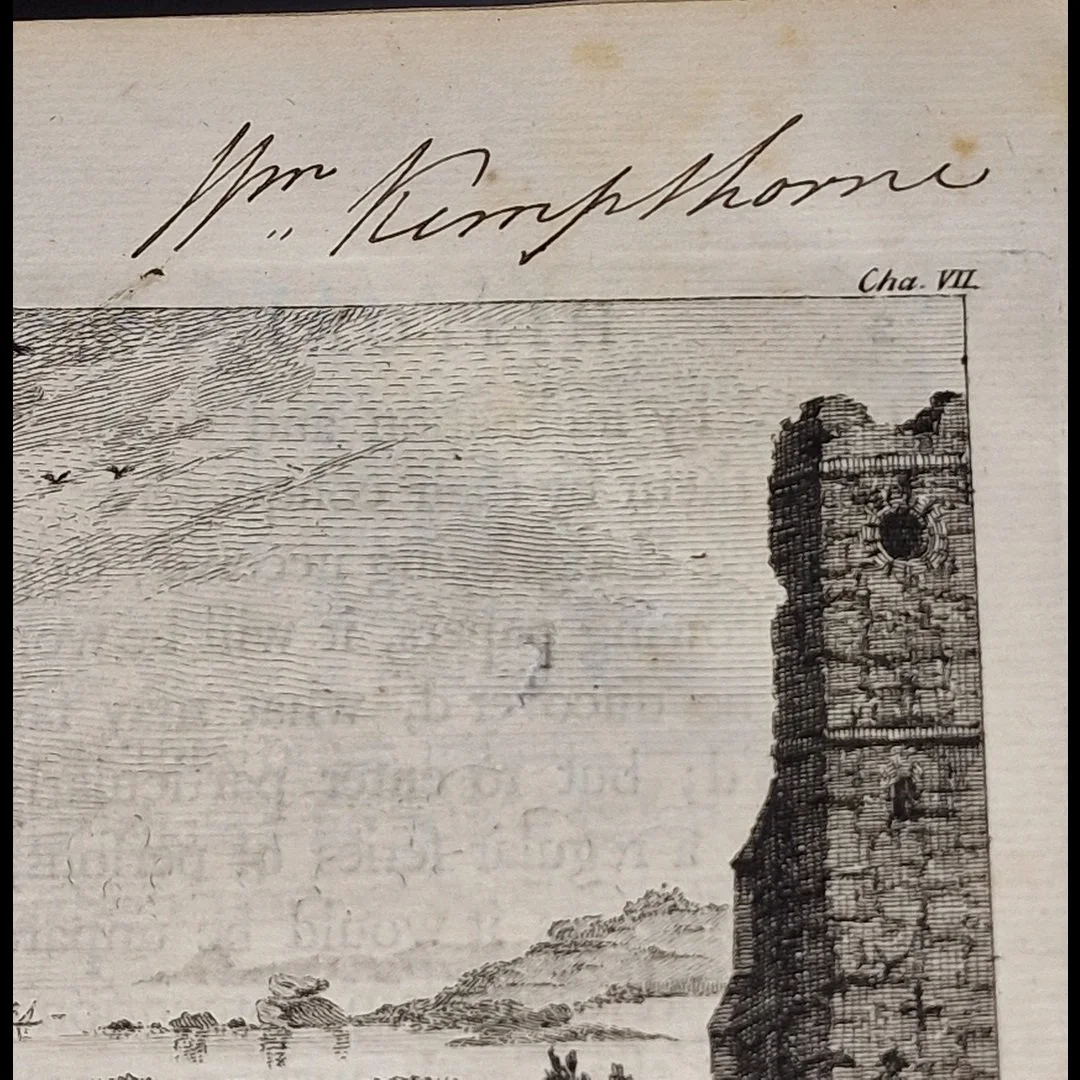
Provenance: Several early ownership inscriptions in brown ink occur on the title page and preliminary leaves. These were subsequently deliberately cancelled or struck through, apparently during an early period of the book's history.
Collation: 691, [101] pp.
Dust Jacket: None, as issued
SKU: BTETM0002560
Shipping Info: Approximate Package Dimensions H: 12.5, L: 30, W: 25 (Units: cm), W: 2Kg
Tracked Shipping, Insurance Coverage as per Customer Request
DESCRIPTION
Herodoti Halicarnassei historiographi libri VIIII
Translated by Lorenzo Valla; revised and augmented by Conrad Heresbach
Herodoti Halicarnassei historiographi Libri VIIII musarum nominibus inscripti, per Laurent. Vallam interpretati, castigati verò ac locupletati à Conrado Heresbachio ad fidem vetusti exemplaris Graeci; eiusdem De genere vitaque Homeri libellus, eodem Heresbachio interprete.
An attractive Renaissance edition of Herodotus's Histories, printed at Lyon in 1542 by the celebrated humanist printer Sébastien Gryphe (Sebastianus Gryphius), preserving Lorenzo Valla's influential Latin translation as revised and augmented by the German humanist Conrad Heresbach.
Valla's translation played a major role in making Herodotus accessible to the Latin-reading scholars of Renaissance Europe. In this recension Heresbach corrected and supplemented Valla's text through comparison with an older Greek exemplar, an editorial intervention explicitly proclaimed on the title page: castigati verò ac locupletati ... ad fidem vetusti exemplaris Graeci. The volume therefore represents not simply the transmission of an ancient historian, but the Renaissance humanist effort to recover, compare and improve classical texts.
The Histories are arranged in the traditional nine books named for the Muses and are followed by De genere vitaque Homeri, the anonymous ancient Vita Homeri, historically attributed to Herodotus, here in Heresbach's Latin translation. Bibliographical records give the volume as 691, [101] pages and confirm the accompanying Vita Homeri and index.
The title page bears Gryphe's striking woodcut printer's device of a griffin above the winged globe, surrounded by the celebrated motto:
VIRTVTE DVCE, COMITE FORTVNA
With virtue as guide, fortune as companion.
A different large griffin device appears at the end of the volume. Decorative woodcut initials occur throughout.
This copy has particular appeal as an early reader's copy: several early ownership inscriptions have been deliberately cancelled on the title page and preliminaries, while occasional early manuscript marginalia survive within the text. The combination of old vellum, red-stained edges, early manuscript intervention and the two Gryphius devices gives the volume considerable visual and historical character.
PROVENANCE
Several early ownership inscriptions in brown ink occur on the title page and preliminary leaves. These were subsequently deliberately cancelled or struck through, apparently during an early period of the book's history.
One of the underlying title-page inscriptions appears on close examination to begin “Francisc…”, potentially Franciscus or Francisci, but the cancellation obscures too many of the original letterforms for a responsible identification of the owner, and no named provenance is therefore asserted.
Further manuscript intervention elsewhere in the preliminaries appears likewise early.
Occasional early manuscript annotations occur within the text, apparently representing active Renaissance or early-modern readership rather than later bibliographical notation. A marginal annotation near the opening of Book I appears to incorporate the word “fabula”, apparently commenting upon the legendary or narrative material under discussion. The complete reading of the annotation remains unresolved.
Taken together, the surviving inscriptions and marginalia provide appealing physical evidence of the volume's early ownership and use.
CONDITION, COLLATION & COPY NOTES
COLLATION
691, [101] pp.
Signatures:
a–z⁸ A–Z⁸ 2a–c⁸ 2d⁴
Complete.
An attractive early full-vellum copy, the binding over stiff boards with manuscript titling to the spine and red-stained text-block edges. The vellum shows expected age-soiling, rubbing, staining and surface abrasion, with wear and some loss/distress around the head of the spine and minor age-related distortion to the boards. The binding nevertheless remains highly evocative and presents well as an early Renaissance classical volume.
Title page complete, retaining the large Gryphius woodcut device and imprint. Several early ownership inscriptions have been deliberately cancelled in brown ink, as described under Provenance.
Internally the printing is generally dark, crisp and attractive. Leaves show expected age-toning, occasional spotting, staining, handling marks and minor creasing or edge wear. Decorative woodcut initials remain sharp. Occasional early manuscript marginalia are present.
The terminal index and large final griffin printer's device are present.
Please see Photos as part of condition report.
REFERENCES
Baudrier, Bibliographie lyonnaise, VIII, p. 164. The Folger catalogue cites Baudrier for this edition and its Gryphius devices.
Folger Shakespeare Library, call no. 258-701q.
OCLC / WorldCat 8854354.
Bibliothèque nationale de France, FRBNF 39361266.
A digitised copy of the 1542 edition is also recorded from the historic collection of the Universidad de Murcia.
SYNOPSIS
Herodotus's Histories is one of the foundational works of Western historical writing and the principal ancient narrative source for the great conflict between the Greek city-states and the expanding Persian Empire during the fifth century BC.
The nine books trace the rise of Persian power from the reign of Croesus and the conquests of Cyrus through Cambyses, Darius and Xerxes, culminating in the Persian invasions of Greece and the celebrated battles of Marathon, Thermopylae, Artemisium, Salamis, Plataea and Mycale.
Yet the work is considerably broader than a military history. Herodotus continually expands his narrative to explore the peoples encountered by the Persian Empire and the Greek world, recording traditions concerning Egypt, Lydia, Babylon, Persia, Scythia and Libya, together with accounts of geography, religion, political institutions, customs, marvels, monuments and oral traditions.
That breadth is central to Herodotus's enduring importance. His method combines enquiry, eyewitness testimony, received tradition, comparison and critical hesitation: he frequently records competing explanations and distinguishes between what he has personally observed, what others report and what he himself considers credible.
The volume concludes with De genere vitaque Homeri, an ancient account of the life and origins of Homer traditionally associated with Herodotus but now regarded as anonymous, presented here in Conrad Heresbach's Latin translation. The Folger catalogue explicitly identifies it as the anonymous Vita Homeri, incorrectly attributed to Herodotus.
A significant Renaissance presentation of one of antiquity's defining historical works, combining Herodotus, Lorenzo Valla, Conrad Heresbach and the Lyon press of Sébastien Gryphe in a copy retaining compelling evidence of early ownership and readership.
AUTHOR BIO
Herodotus of Halicarnassus (c. 484–c. 425 BC) was a Greek historian and traveller born at Halicarnassus in Asia Minor. His surviving Histories investigates the origins and course of the wars between the Greeks and the Persian Empire while ranging widely across the histories, cultures, religions and geography of the ancient Mediterranean and Near East.
Cicero famously called Herodotus the “father of history”, reflecting his importance in the development of extended historical enquiry and narrative. Although ancient and modern readers have debated the reliability of individual episodes, Herodotus frequently presents alternative traditions and explicitly signals uncertainty rather than offering every report as established fact.
His combination of historical narrative, ethnography, geography, oral testimony and cultural observation makes the Histories an indispensable source for both the Greco-Persian Wars and the intellectual world of classical Greece.
TRANSLATOR BIO
Lorenzo Valla (c. 1407–1457) was one of the leading Italian humanists of the fifteenth century: a classical scholar, philologist, rhetorician and translator whose critical approach to language became enormously influential in Renaissance scholarship.
His Latin translation of Herodotus helped restore the Greek historian to a Western European readership for whom Latin remained the principal international language of scholarship. Valla's work stands within the broader humanist programme of recovering Greek literature and transmitting it through critically informed Latin versions.
EDITOR / TRANSLATOR BIO
Conrad Heresbach (1496–1576) was a German humanist scholar, educator and statesman associated with the intellectual culture of the Lower Rhine.
For this recension of Herodotus he revised and augmented Valla's Latin translation through comparison with an older Greek manuscript, correcting the inherited text and restoring material where necessary. He also supplied the Latin translation of the accompanying Vita Homeri.
His involvement gives this edition particular interest as an example of the increasingly philological approach to classical texts characteristic of sixteenth-century humanism.
1542
HERODOTI HALICARNASSEI HISTORIOGRAPHI LIBRI VIIII
By Herodotus
KEY DETAILS
Condition: Very Good
Format: Vellum, Small/Crown octavo (8vo 5 3⁄8 × 8 in 137 × 203 mm )
Note: Binding/size selection follows standard bibliographic conventions and is approximate; exact measurements may vary.
Published By: Seb. Gryphium; Lugduni, Lyon, 1542
Language: Latin
Provenance: Several early ownership inscriptions in brown ink occur on the title page and preliminary leaves. These were subsequently deliberately cancelled or struck through, apparently during an early period of the book's history.
Collation: 691, [101] pp.
Dust Jacket: None, as issued
SKU: BTETM0002560
Shipping Info: Approximate Package Dimensions H: 12.5, L: 30, W: 25 (Units: cm), W: 2Kg
Tracked Shipping, Insurance Coverage as per Customer Request
DESCRIPTION
Herodoti Halicarnassei historiographi libri VIIII
Translated by Lorenzo Valla; revised and augmented by Conrad Heresbach
Herodoti Halicarnassei historiographi Libri VIIII musarum nominibus inscripti, per Laurent. Vallam interpretati, castigati verò ac locupletati à Conrado Heresbachio ad fidem vetusti exemplaris Graeci; eiusdem De genere vitaque Homeri libellus, eodem Heresbachio interprete.
An attractive Renaissance edition of Herodotus's Histories, printed at Lyon in 1542 by the celebrated humanist printer Sébastien Gryphe (Sebastianus Gryphius), preserving Lorenzo Valla's influential Latin translation as revised and augmented by the German humanist Conrad Heresbach.
Valla's translation played a major role in making Herodotus accessible to the Latin-reading scholars of Renaissance Europe. In this recension Heresbach corrected and supplemented Valla's text through comparison with an older Greek exemplar, an editorial intervention explicitly proclaimed on the title page: castigati verò ac locupletati ... ad fidem vetusti exemplaris Graeci. The volume therefore represents not simply the transmission of an ancient historian, but the Renaissance humanist effort to recover, compare and improve classical texts.
The Histories are arranged in the traditional nine books named for the Muses and are followed by De genere vitaque Homeri, the anonymous ancient Vita Homeri, historically attributed to Herodotus, here in Heresbach's Latin translation. Bibliographical records give the volume as 691, [101] pages and confirm the accompanying Vita Homeri and index.
The title page bears Gryphe's striking woodcut printer's device of a griffin above the winged globe, surrounded by the celebrated motto:
VIRTVTE DVCE, COMITE FORTVNA
With virtue as guide, fortune as companion.
A different large griffin device appears at the end of the volume. Decorative woodcut initials occur throughout.
This copy has particular appeal as an early reader's copy: several early ownership inscriptions have been deliberately cancelled on the title page and preliminaries, while occasional early manuscript marginalia survive within the text. The combination of old vellum, red-stained edges, early manuscript intervention and the two Gryphius devices gives the volume considerable visual and historical character.
PROVENANCE
Several early ownership inscriptions in brown ink occur on the title page and preliminary leaves. These were subsequently deliberately cancelled or struck through, apparently during an early period of the book's history.
One of the underlying title-page inscriptions appears on close examination to begin “Francisc…”, potentially Franciscus or Francisci, but the cancellation obscures too many of the original letterforms for a responsible identification of the owner, and no named provenance is therefore asserted.
Further manuscript intervention elsewhere in the preliminaries appears likewise early.
Occasional early manuscript annotations occur within the text, apparently representing active Renaissance or early-modern readership rather than later bibliographical notation. A marginal annotation near the opening of Book I appears to incorporate the word “fabula”, apparently commenting upon the legendary or narrative material under discussion. The complete reading of the annotation remains unresolved.
Taken together, the surviving inscriptions and marginalia provide appealing physical evidence of the volume's early ownership and use.
CONDITION, COLLATION & COPY NOTES
COLLATION
691, [101] pp.
Signatures:
a–z⁸ A–Z⁸ 2a–c⁸ 2d⁴
Complete.
An attractive early full-vellum copy, the binding over stiff boards with manuscript titling to the spine and red-stained text-block edges. The vellum shows expected age-soiling, rubbing, staining and surface abrasion, with wear and some loss/distress around the head of the spine and minor age-related distortion to the boards. The binding nevertheless remains highly evocative and presents well as an early Renaissance classical volume.
Title page complete, retaining the large Gryphius woodcut device and imprint. Several early ownership inscriptions have been deliberately cancelled in brown ink, as described under Provenance.
Internally the printing is generally dark, crisp and attractive. Leaves show expected age-toning, occasional spotting, staining, handling marks and minor creasing or edge wear. Decorative woodcut initials remain sharp. Occasional early manuscript marginalia are present.
The terminal index and large final griffin printer's device are present.
Please see Photos as part of condition report.
REFERENCES
Baudrier, Bibliographie lyonnaise, VIII, p. 164. The Folger catalogue cites Baudrier for this edition and its Gryphius devices.
Folger Shakespeare Library, call no. 258-701q.
OCLC / WorldCat 8854354.
Bibliothèque nationale de France, FRBNF 39361266.
A digitised copy of the 1542 edition is also recorded from the historic collection of the Universidad de Murcia.
SYNOPSIS
Herodotus's Histories is one of the foundational works of Western historical writing and the principal ancient narrative source for the great conflict between the Greek city-states and the expanding Persian Empire during the fifth century BC.
The nine books trace the rise of Persian power from the reign of Croesus and the conquests of Cyrus through Cambyses, Darius and Xerxes, culminating in the Persian invasions of Greece and the celebrated battles of Marathon, Thermopylae, Artemisium, Salamis, Plataea and Mycale.
Yet the work is considerably broader than a military history. Herodotus continually expands his narrative to explore the peoples encountered by the Persian Empire and the Greek world, recording traditions concerning Egypt, Lydia, Babylon, Persia, Scythia and Libya, together with accounts of geography, religion, political institutions, customs, marvels, monuments and oral traditions.
That breadth is central to Herodotus's enduring importance. His method combines enquiry, eyewitness testimony, received tradition, comparison and critical hesitation: he frequently records competing explanations and distinguishes between what he has personally observed, what others report and what he himself considers credible.
The volume concludes with De genere vitaque Homeri, an ancient account of the life and origins of Homer traditionally associated with Herodotus but now regarded as anonymous, presented here in Conrad Heresbach's Latin translation. The Folger catalogue explicitly identifies it as the anonymous Vita Homeri, incorrectly attributed to Herodotus.
A significant Renaissance presentation of one of antiquity's defining historical works, combining Herodotus, Lorenzo Valla, Conrad Heresbach and the Lyon press of Sébastien Gryphe in a copy retaining compelling evidence of early ownership and readership.
AUTHOR BIO
Herodotus of Halicarnassus (c. 484–c. 425 BC) was a Greek historian and traveller born at Halicarnassus in Asia Minor. His surviving Histories investigates the origins and course of the wars between the Greeks and the Persian Empire while ranging widely across the histories, cultures, religions and geography of the ancient Mediterranean and Near East.
Cicero famously called Herodotus the “father of history”, reflecting his importance in the development of extended historical enquiry and narrative. Although ancient and modern readers have debated the reliability of individual episodes, Herodotus frequently presents alternative traditions and explicitly signals uncertainty rather than offering every report as established fact.
His combination of historical narrative, ethnography, geography, oral testimony and cultural observation makes the Histories an indispensable source for both the Greco-Persian Wars and the intellectual world of classical Greece.
TRANSLATOR BIO
Lorenzo Valla (c. 1407–1457) was one of the leading Italian humanists of the fifteenth century: a classical scholar, philologist, rhetorician and translator whose critical approach to language became enormously influential in Renaissance scholarship.
His Latin translation of Herodotus helped restore the Greek historian to a Western European readership for whom Latin remained the principal international language of scholarship. Valla's work stands within the broader humanist programme of recovering Greek literature and transmitting it through critically informed Latin versions.
EDITOR / TRANSLATOR BIO
Conrad Heresbach (1496–1576) was a German humanist scholar, educator and statesman associated with the intellectual culture of the Lower Rhine.
For this recension of Herodotus he revised and augmented Valla's Latin translation through comparison with an older Greek manuscript, correcting the inherited text and restoring material where necessary. He also supplied the Latin translation of the accompanying Vita Homeri.
His involvement gives this edition particular interest as an example of the increasingly philological approach to classical texts characteristic of sixteenth-century humanism.

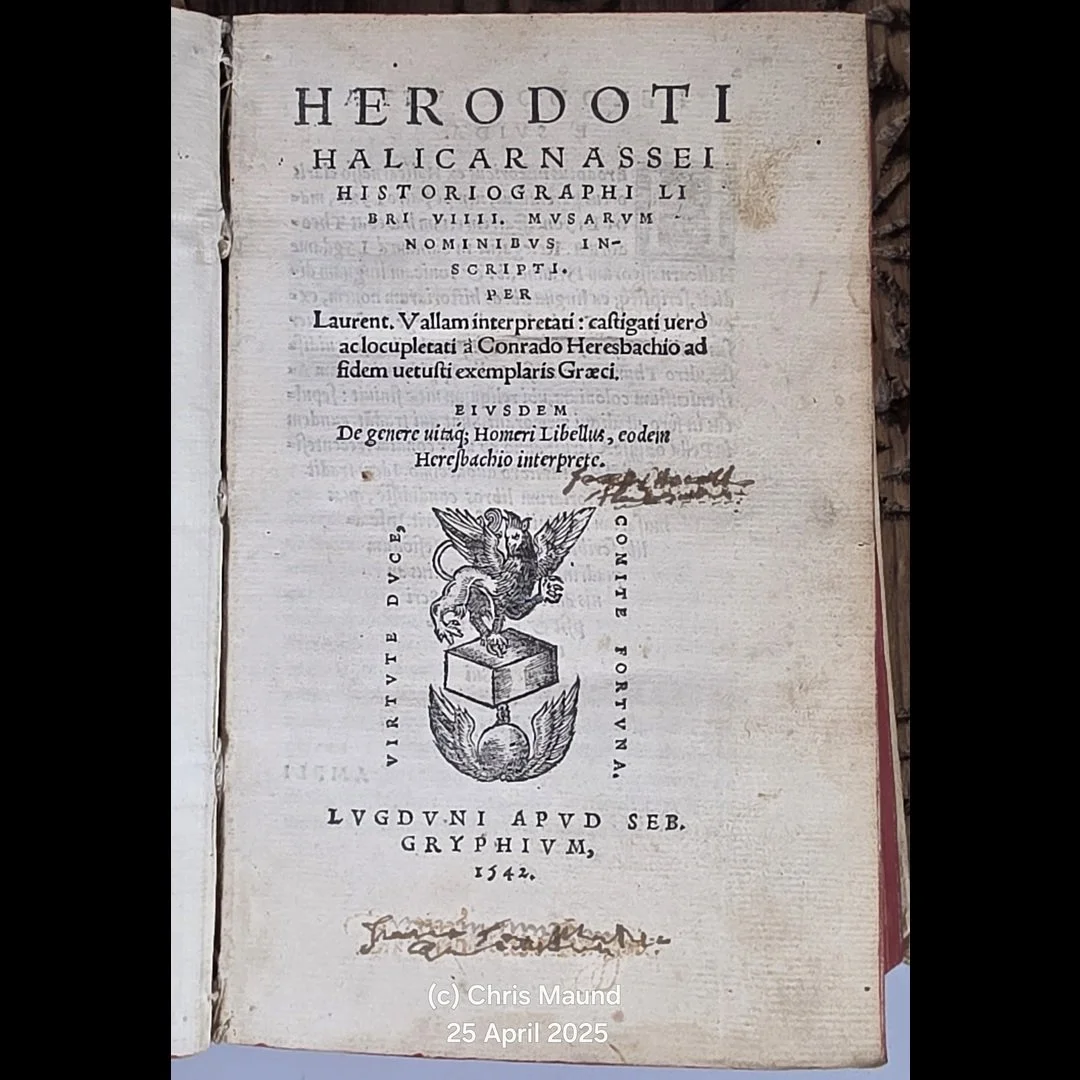 Image 1 of 22
 Image 2 of 22
 Image 3 of 22
 Image 4 of 22
 Image 5 of 22
 Image 6 of 22
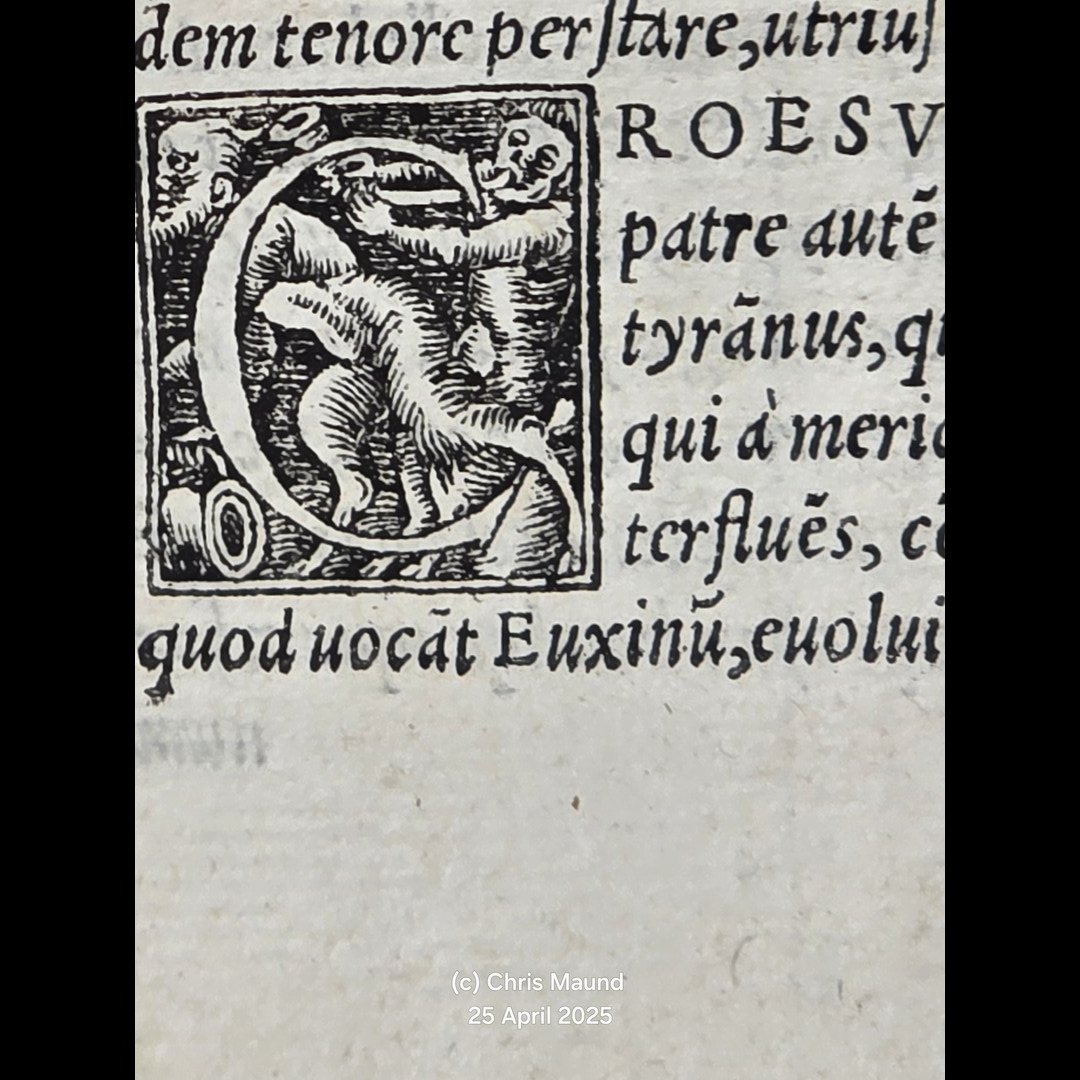 Image 7 of 22
 Image 8 of 22
 Image 9 of 22
 Image 10 of 22
 Image 11 of 22
 Image 12 of 22
 Image 13 of 22
 Image 14 of 22
 Image 15 of 22
 Image 16 of 22
 Image 17 of 22
 Image 18 of 22
 Image 19 of 22
 Image 20 of 22
 Image 21 of 22
 Image 22 of 22






























![1707 With Provenance THE HISTORY OF THE REBELLION AND CIVIL WARS IN ENGLAND [THREE VOLS] By Edward, Earl of Clarendon](https://images.squarespace-cdn.com/content/v1/634dab4938c13d5c1f88d382/c9f91097-854c-46d0-afcd-4601b9eff8aa/20241014_224316-10.jpg)