Sale Price:
£30.00
Original Price:
£50.00
1972 Revised Edition
CONNEXIONS: OUT OF YOUR MIND?
By Peter Newmark
KEY DETAILS
Condition: Good
Format: Softcover, Octavo (Standard) (8vo 6 × 9 in 152 × 229 mm )
Note: Binding/size selection follows standard bibliographic conventions and is approximate; exact measurements may vary.
Published By: Penguin Education, Harmondsworth, Middlesex, UK, 1972
Language: English
Collation: pp. 64
Dust Jacket: None, as issued
ISBN: 9780140800234
SKU: BTETM0002562
Shipping Info: Approximate Package Dimensions H: 12.5, L: 30, W: 25 (Units: cm), W: 2Kg
Tracked Shipping, Insurance Coverage as per Customer Request
DESCRIPTION
Connexions: Out of Your Mind?
The Impact of Drugs on Medicine and Everyday Life
General Editor: Richard Mabey
Designer: Arthur Lockwood
Cover Design: Peter Swan
Printer: Jarrold and Sons Ltd, Norwich
A striking early-1970s Penguin Education examination of drugs, medicine, dependency and changing social attitudes, written at the point when the drug culture of the 1960s was becoming a subject of serious public, medical and educational debate.
First published in 1968 and reprinted in 1970 and 1971, this is the substantially revised 1972 edition, explicitly updated by Penguin to reflect contemporary changes in attitudes and behaviour towards drugs. Rather than treating illegal drugs in isolation, Peter Newmark places them within the much broader human use of chemicals for pleasure, medicine, stimulation, relaxation and escape.
Produced as part of Penguin Education's visually distinctive Connexions series of topic books for students in schools and colleges of further education, Out of Your Mind? combines medical and social commentary with photographs, illustrations, contemporary journalism, popular culture and extracts from literature.
Particularly evocative of its period are its treatment of cannabis, LSD, heroin, cocaine and amphetamines alongside alcohol, nicotine, caffeine and prescription medicines; its glossary of contemporary drug slang; an extract from Alexander Trocchi's heroin novel Cain's Book; and an opening spread built around the Rolling Stones' “Mother's Little Helper”, using popular music to contrast concern over illicit drug taking with society's widespread reliance upon tranquillising and prescription drugs.
Designed by Arthur Lockwood, with a bold cover by Peter Swan, the volume is as much an artefact of progressive late-1960s and early-1970s British educational design as it is a work of social and medical history.
CONDITION, COLLATION & COPY NOTES
COLLATION
pp. 64
A sound and appealing copy in the publisher's original illustrated card wrappers.
Wrappers with general rubbing and handling wear, including numerous light surface scratches visible against the predominantly black covers, edge rubbing and whitening, light creasing and wear to corners and extremities. Some additional scuffing and small marks consistent with use as an educational paperback.
The striking Peter Swan front-cover design remains complete and strongly coloured, with the green and yellow typography still bright. Rear wrapper complete and clearly legible, including the publisher's synopsis, author biography and cover-design credit.
Internally substantially clean and firmly bound, with light age-toning and occasional minor spotting or handling marks. Text and illustrations remain clear and well preserved.
Small earlier pencilled “30p.” price to the upper-right corner of the title/copyright page.
Accordingly this copy is correctly described as the 1972 Revised Edition, rather than as a first edition.
Illustrated throughout with photographs, cartoons, reproductions and documentary material.
Please see Photos as part of condition report.
REFERENCES
Penguin Education, Connexions series.
Penguin First Editions, Penguin Education X-series bibliography.
Open British National Bibliography, ISBN 0140800239; the later 1977 second edition specifically identifies its predecessor as the “Revised ed. 1972."
SYNOPSIS
Newmark begins with a deceptively simple question: what exactly is a drug?
His definition extends beyond narcotics and prohibited substances to encompass chemicals taken for pleasure or benefit, substances capable of altering mood or mental state, and those upon which a user may become dependent. From this starting point he deliberately places accepted substances such as alcohol, caffeine and nicotine beside opiates, cocaine, cannabis, amphetamines, barbiturates and LSD.
The book proceeds through ten interconnected sections: The Drug Scene; Drugs as Medicines; The Effects of Drugs; The Dangers of Drugs; Who Uses Drugs and Why; Drugs and the Law; Attitudes to Drugs; Other Dangerous Chemicals; What Can We Do About Drugs?; and Where Now?
Medical history sits alongside contemporary drug culture. The development of anaesthesia, aspirin and other therapeutic medicines is examined before the discussion turns towards dependence, overdose, recreational use and the social circumstances in which drug taking occurs.
Newmark also considers why young people use drugs and asks whether contemporary public alarm is proportionate to the actual risks. The treatment is therefore neither simply prohibitionist nor celebratory: the book attempts to distinguish pharmacological danger from social fear while repeatedly comparing illegal substances with chemicals already embedded in everyday life.
One particularly revealing feature is its presentation of contemporary drug vocabulary. Terms associated with intoxication, heroin addiction, cannabis and LSD are explained for a student readership, preserving the language of British and American drug culture at the beginning of the 1970s.
An extended passage from Alexander Trocchi's Cain's Book illustrates heroin addiction through literature, while the use of “Mother's Little Helper” places the discussion directly within contemporary popular culture. The juxtaposition is deliberate: society could condemn the drug habits of the young while simultaneously normalising alcohol, tobacco and pharmaceutical tranquillisation.
The 1972 revision is particularly interesting historically because it captures a rapidly changing moment between the psychedelic culture of the late 1960s and the more institutionalised public-health and legislative debates of the 1970s.
Today the book offers an unusually immediate snapshot of how drugs, addiction, youth culture and altered states were being explained to British students at the height of the post-1960s counterculture.
DESIGN
The book was produced under Richard Mabey as General Editor of Penguin Education's Connexions series.
The interior was designed by Arthur Lockwood, with the text set in Monophoto Century Schoolbook and Gill Sans, creating the characteristic mixture of conventional educational typography and bold display lettering seen throughout the volume.
The cover was designed by Peter Swan, employing an unusually stark black ground with bright green and yellow typography and a minimalist figure receiving a coloured capsule. The rear wrapper combines descriptive text with a large photographic portrait, producing a distinctly contemporary visual identity.
Throughout, photographs, cartoons, historical illustrations, literary extracts, typography and documentary material are integrated into the text rather than serving merely as decoration. The result is characteristic of Penguin Education's experimental approach to illustrated educational publishing during the period.
AUTHOR BIO
Peter Newmark was a medical researcher and writer. The contemporary biographical note printed on the rear wrapper records that he was born in 1941 and, at the time of publication, was conducting research for the Medical Research Council into vitamin deficiency.
His medical background is evident throughout Out of Your Mind?, but the work extends considerably beyond pharmacology. Newmark approaches drugs through medicine, psychology, sociology, law and popular culture, attempting to place contemporary fears surrounding illicit drug use within the much longer history of humanity's reliance upon psychoactive and medicinal chemicals.

 Image 1 of 7
 Image 2 of 7
 Image 3 of 7
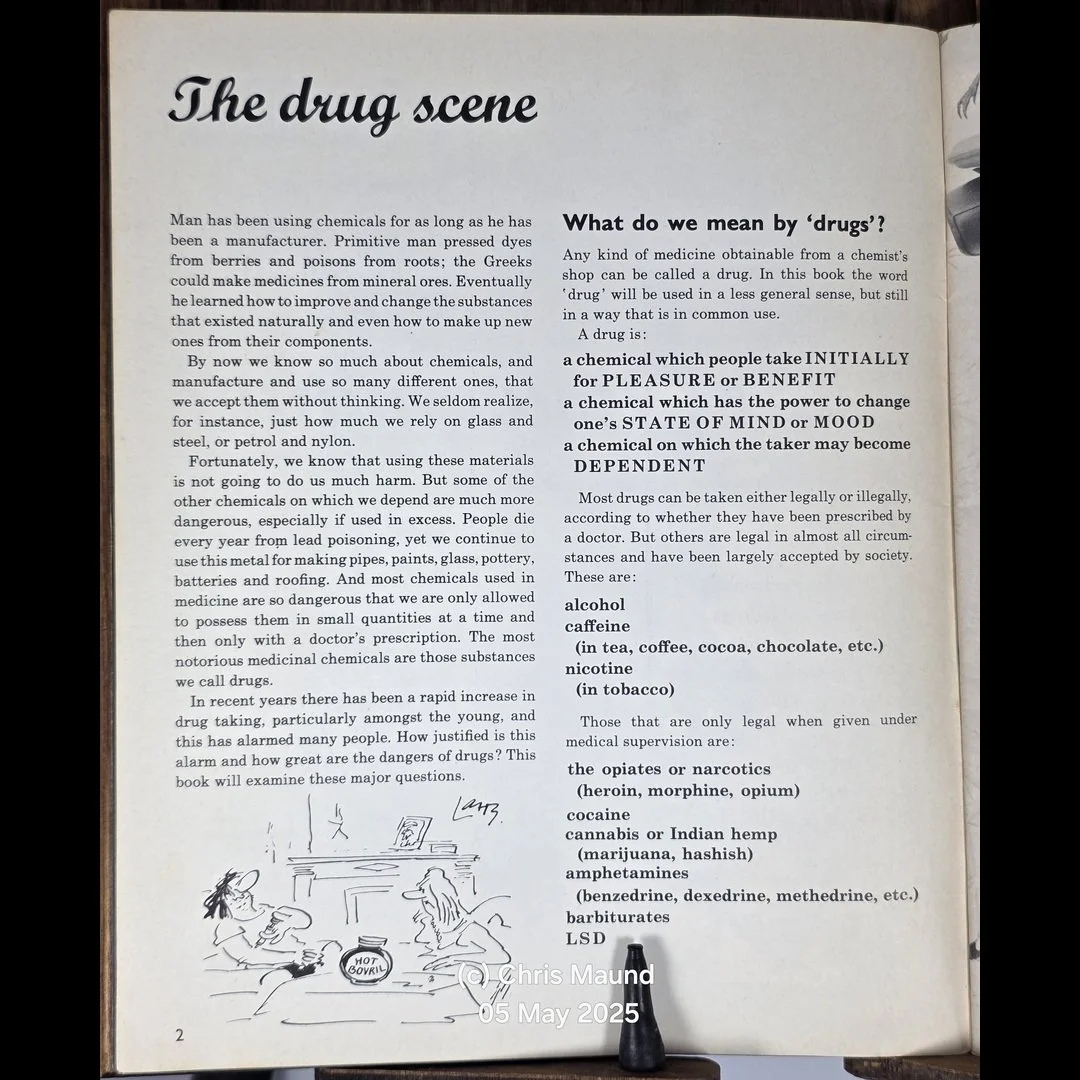 Image 4 of 7
 Image 5 of 7
 Image 6 of 7
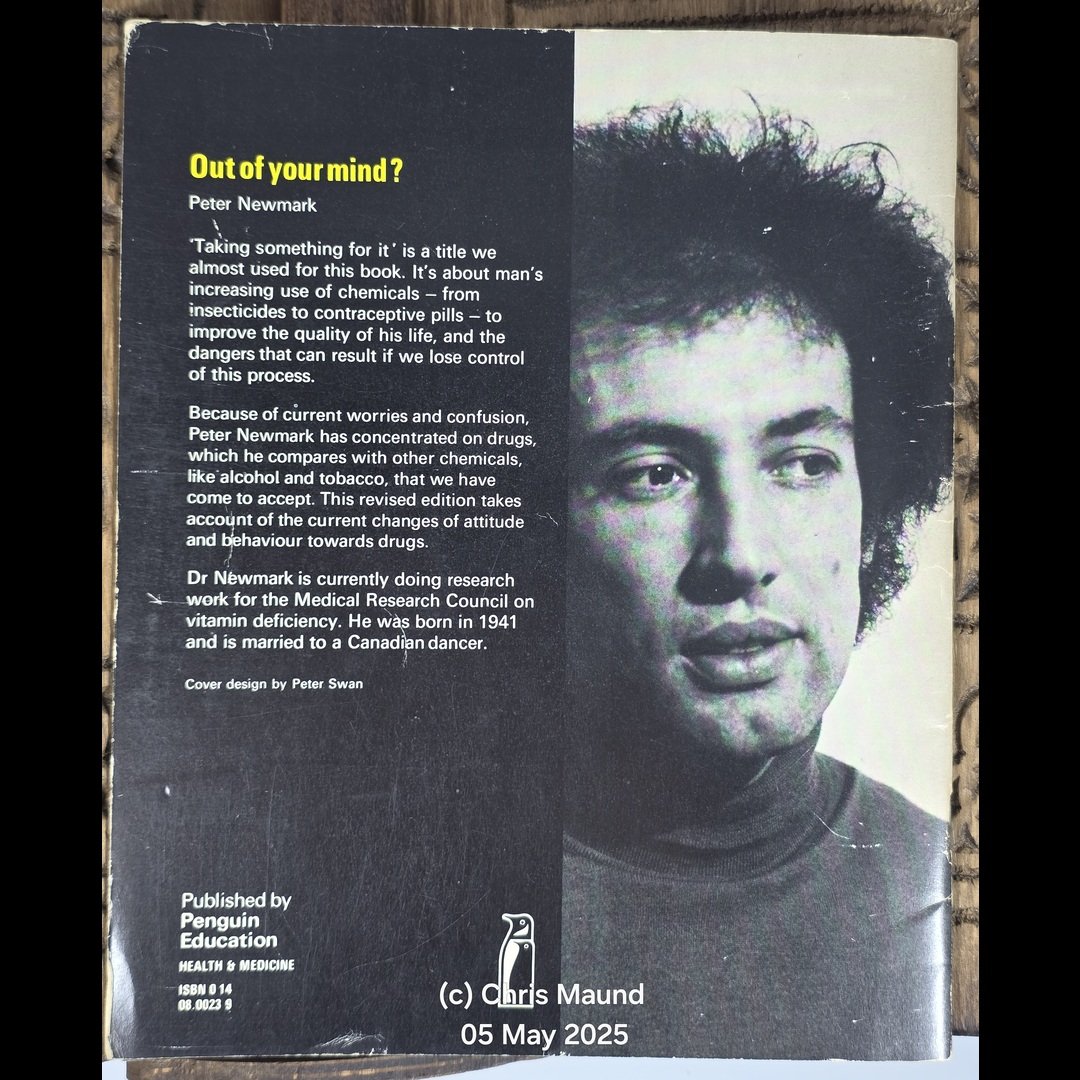 Image 7 of 7