1609
C. IULLI CAESARIS COMMENTARII
By Gaius Julius Caesar
KEY DETAILS
Condition: Good
Format: Hardcover, 8vo; Approximately 145 × 97 mm
Published By: Apud Haeredes Petri Ricciardi, Venetiis, 1609
Language: Latin
Illustrated By: Anonymous Renaissance woodcut cutter(s).
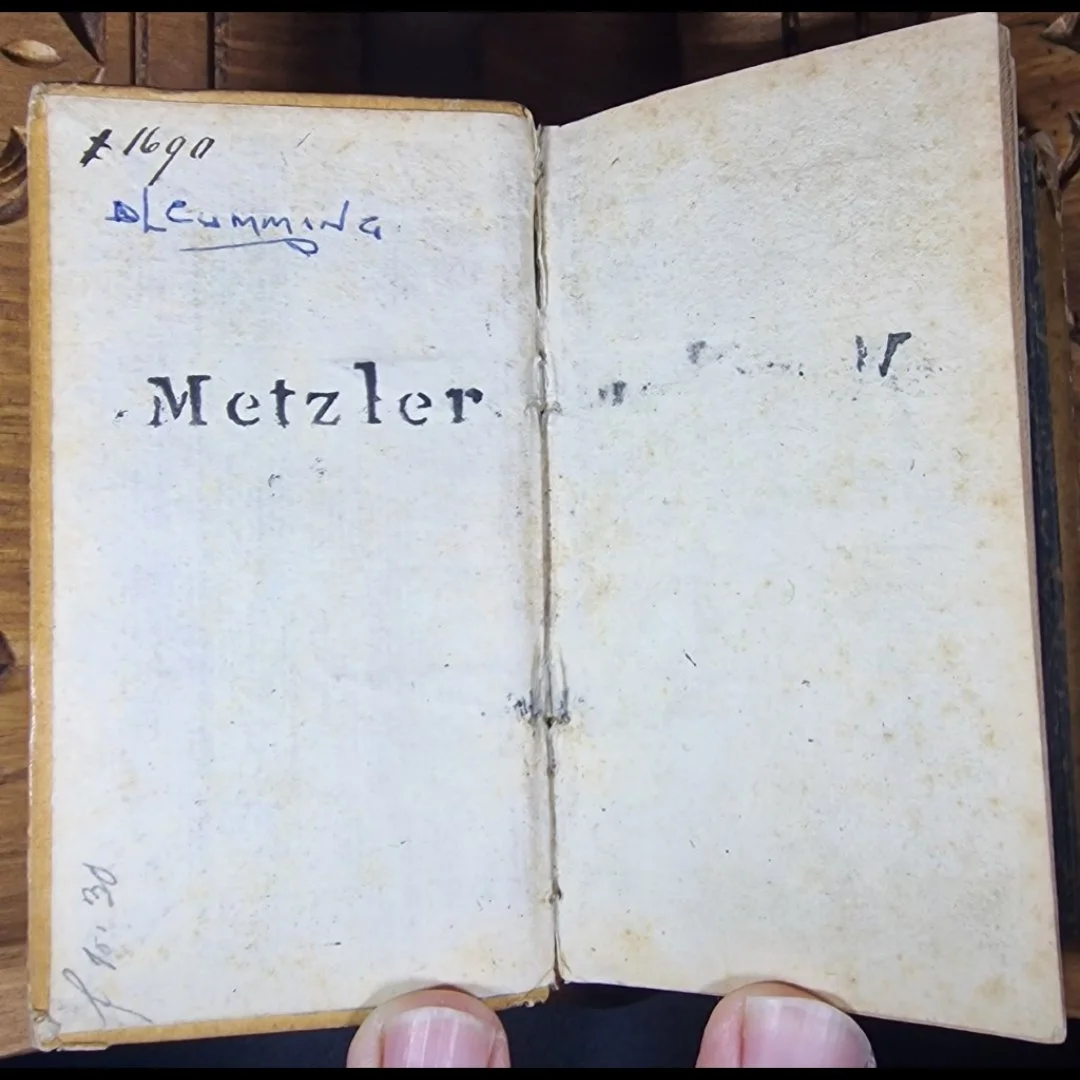
Provenance: Early ownership history remains unidentified.
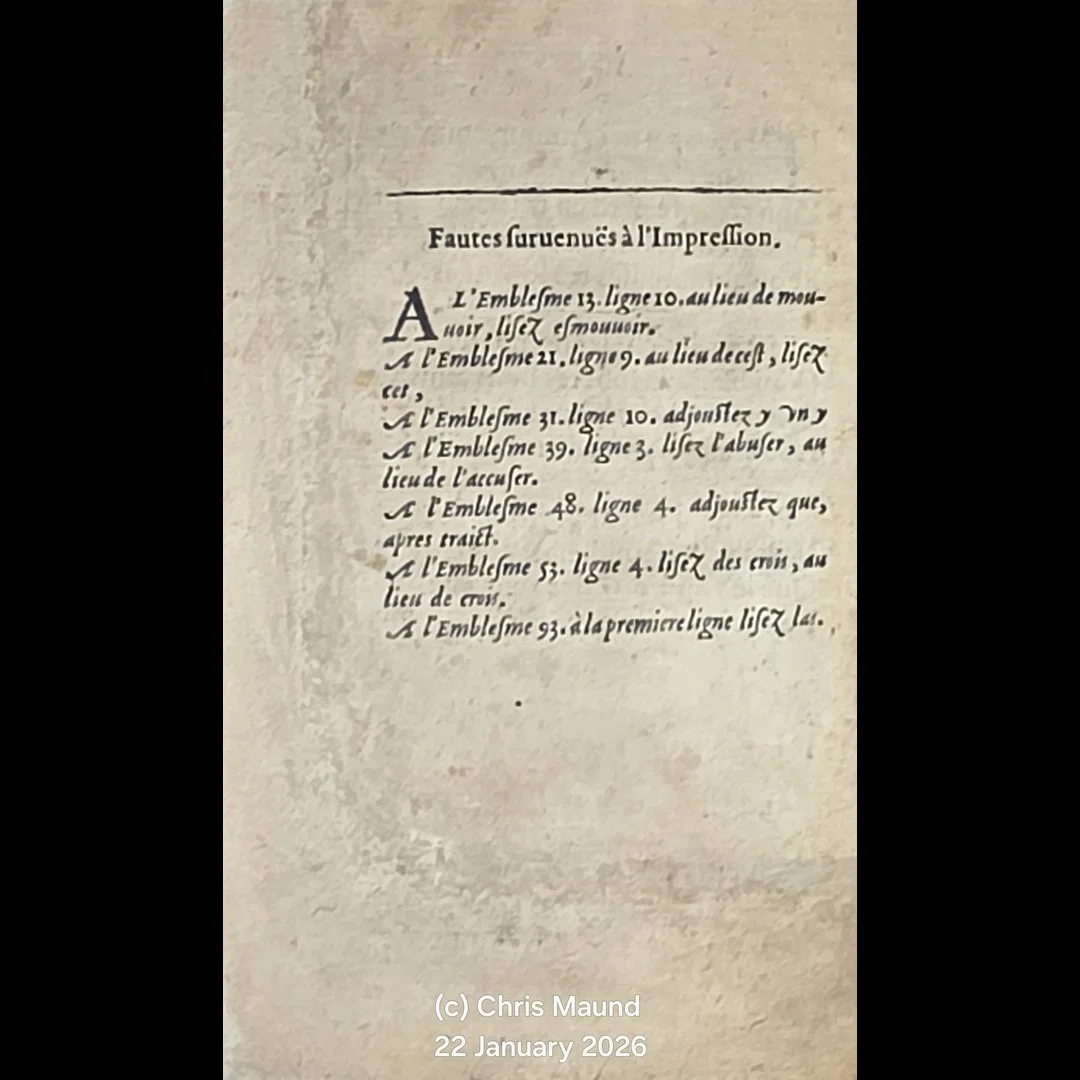
Collation: complete; preliminary and illustrative apparatus; principal Caesar text A–2P⁸, pp.1–606 with 2P8 blank; separately signed Scholia and index A–R⁸ with R8 blank; 2 folding maps. Gatherings H and I of the principal text transposed in binding as described above.
Dust Jacket: None, as issued, No Jacket
SKU: BTETM0002580
Shipping Info: Approximate Package Dimensions H: 12.5, L: 30, W: 25 (Units: cm), W: 2Kg
Tracked Shipping, Insurance Coverage as per Customer Request
DESCRIPTION
C. Iulli Caesaris Commentarii
Ab Aldo Manutio Paulli F. Aldi N. emendati et scholiis illustrati
A handsome and intellectually rich early seventeenth-century Venetian edition of the traditional Caesarian corpus, printed by the heirs of Pietro Ricciardi in 1609 and preserving the influential recension, scholia and antiquarian apparatus of Aldus Manutius the Younger, grandson of the celebrated founder of the Aldine Press.
The title-page formula “Ab Aldo Manutio Paulli F. Aldi N.” is unusually explicit about the editor’s identity: Aldus, son of Paolo Manuzio and grandson of Aldus Manutius the Elder. This is therefore not itself an Aldine Press imprint, but a later Venetian edition transmitting the textual and scholarly work of the third generation of the Manuzio dynasty. ETH-Bibliothek catalogues this exact 1609 edition with Aldus Manutius the Younger, 1547–1597, as its editor.
The volume contains Caesar’s Commentaries, including the seven books of the Gallic War, the eighth book traditionally associated with Aulus Hirtius, the Civil War, and the traditional Caesarian continuations concerning the Alexandrian, African and Spanish campaigns, together with extensive geographical, textual and antiquarian apparatus.
Particularly notable is the book’s substantial programme of woodcut illustration. Contemporary descriptions of the exact edition record eight woodcut figures, six full-page, together with two folding maps of Gaul and Spain. Both folding maps are present in this copy.
The illustrations are not merely decorative. They reconstruct places, sieges and military engineering discussed by Caesar, including Avaricum, Alesia, Uxellodunum and Massilia, alongside the celebrated representation of the bison and material concerned with Caesar’s bridge across the Rhine.
Of particular interest is the Renaissance attempt to understand Caesar’s engineering through the work of later humanist and architectural scholars. The introductory list of figures names proposed reconstructions associated with figures including Giovanni Giocondo, Guillaume Budé, Adrianus Turnebus, Leon Battista Alberti and Andrea Palladio. One of the surviving illustrations in this copy is explicitly headed “EX PALLAD. LIB. III. CAP. 6.”, referring to Palladio’s discussion of Caesar’s Rhine bridge.
The result is considerably more than a straightforward school edition of Caesar: it is a compact illustrated witness to the Renaissance and early modern attempt to reconstruct the geography, fortification, siegecraft and military engineering of the ancient Roman world.
The title page bears the printer’s woodcut device, while decorative initials and woodcut illustrations enliven the text throughout.
PROVENANCE
Early ownership history remains unidentified.
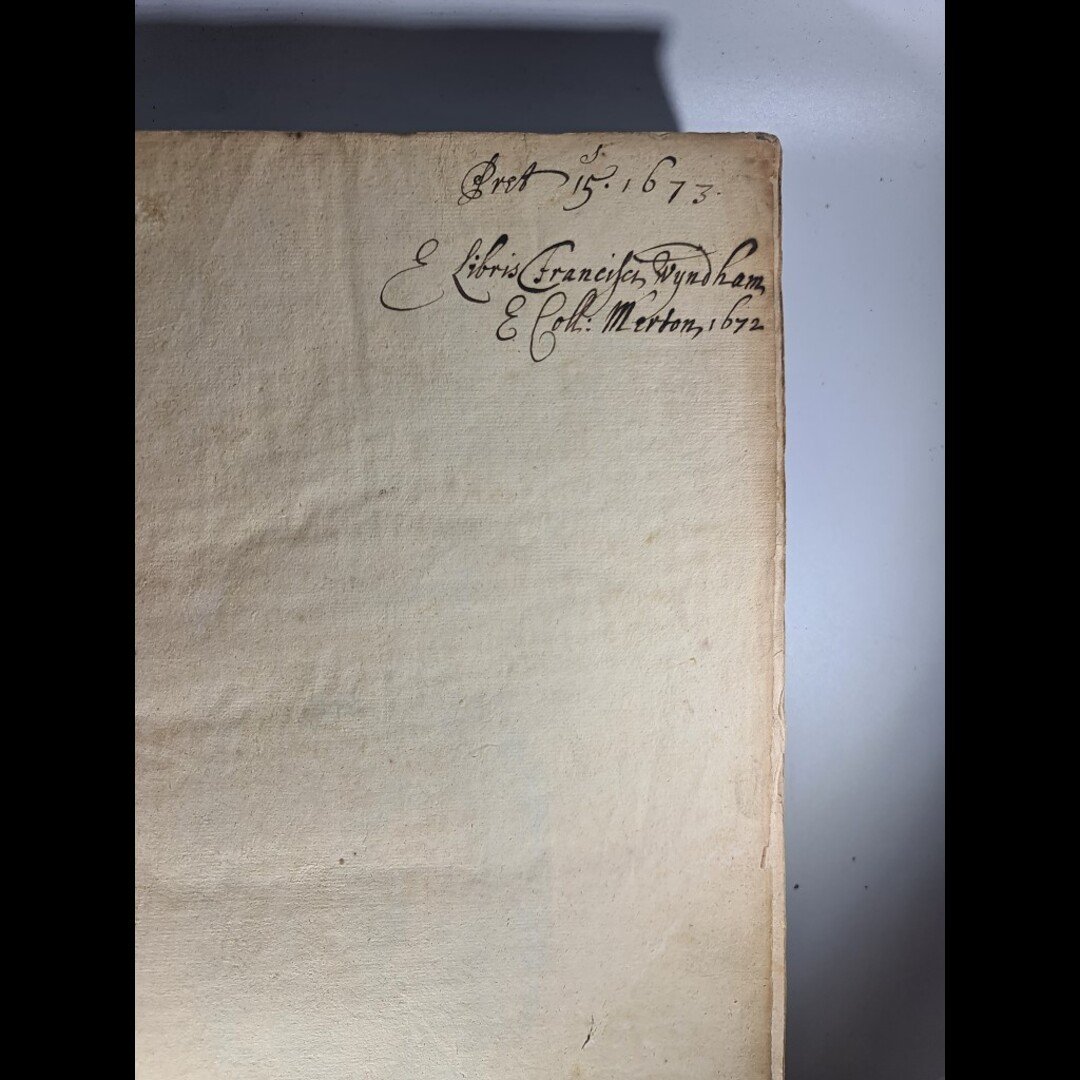
The title page bears several old manuscript inscriptions, including inscriptions deliberately cancelled in ink by an early owner. Other surviving marginal inscriptions are presently undeciphered.
The front and rear endleaves carry extensive early manuscript writing in several hands, comprising pen trials, short Latin passages or exercises, repeated words and other informal annotations. These appear to represent prolonged early use of the volume rather than modern notes and form an attractive part of the copy’s history.
No secure personal or institutional provenance has presently been established from the surviving inscriptions, and no attribution is made here beyond the evidence visible in the book.
CONDITION, COLLATION & COPY NOTES
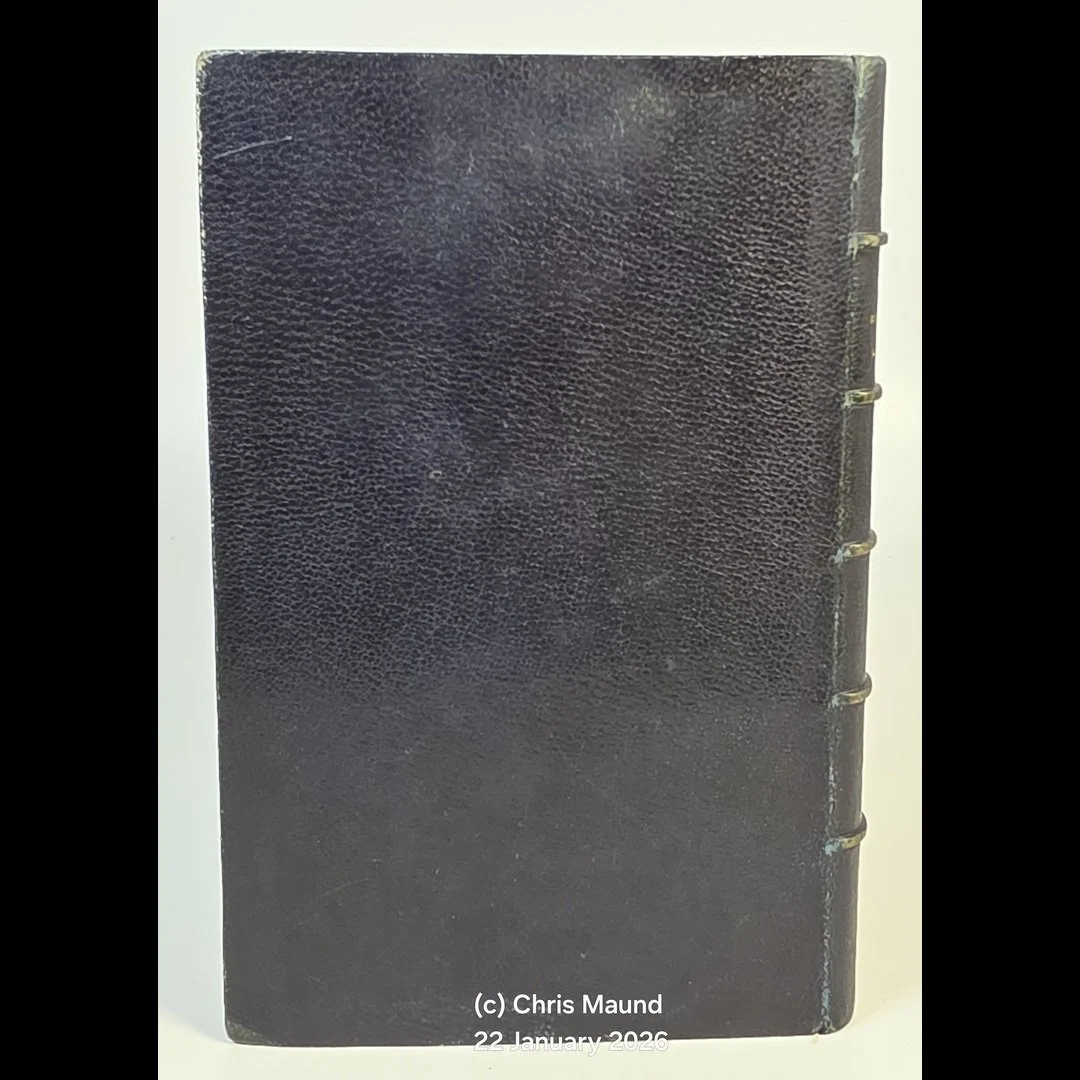
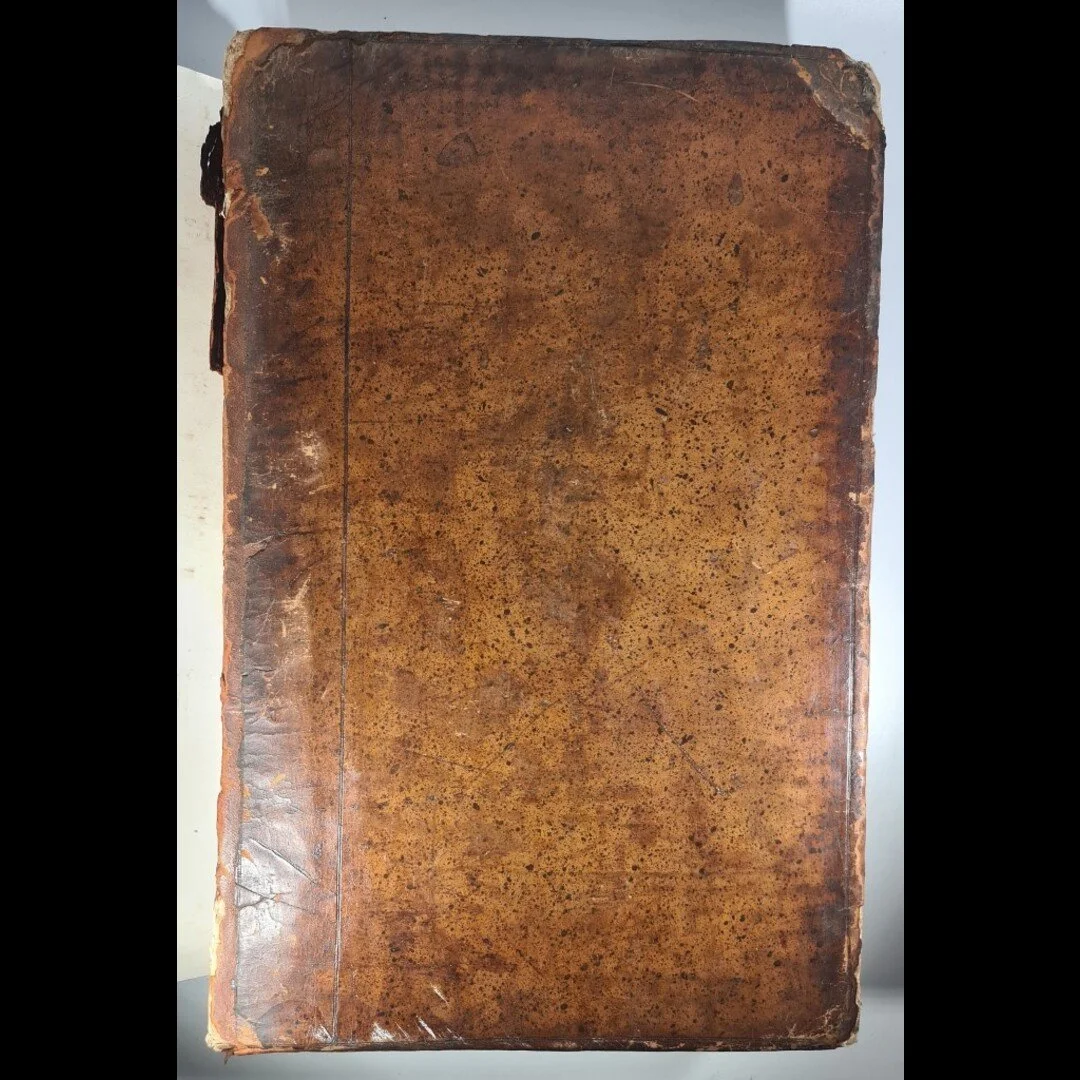
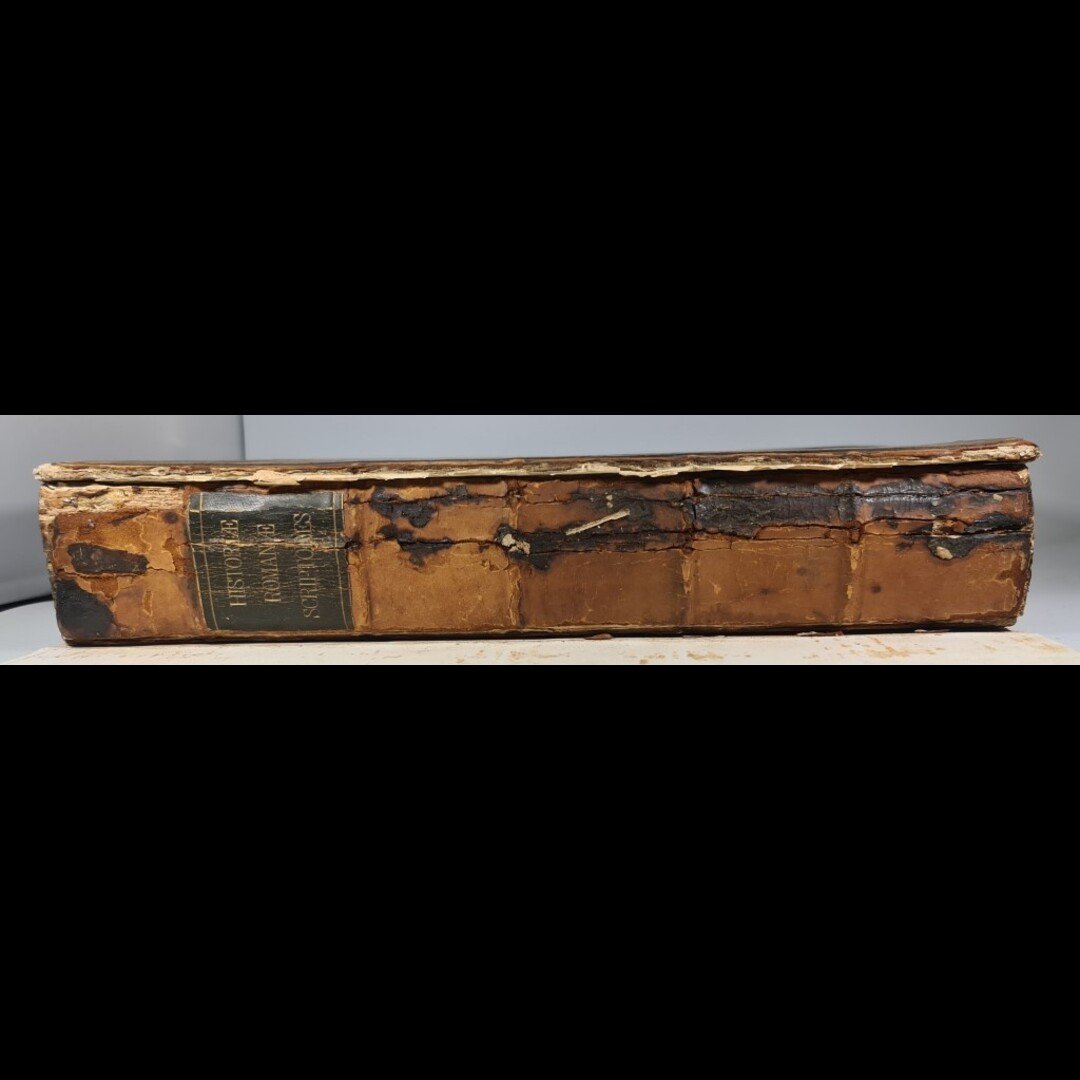
A complete and appealing copy in contemporary or near-contemporary full vellum over boards, with manuscript titling to the spine and later fabric ties.
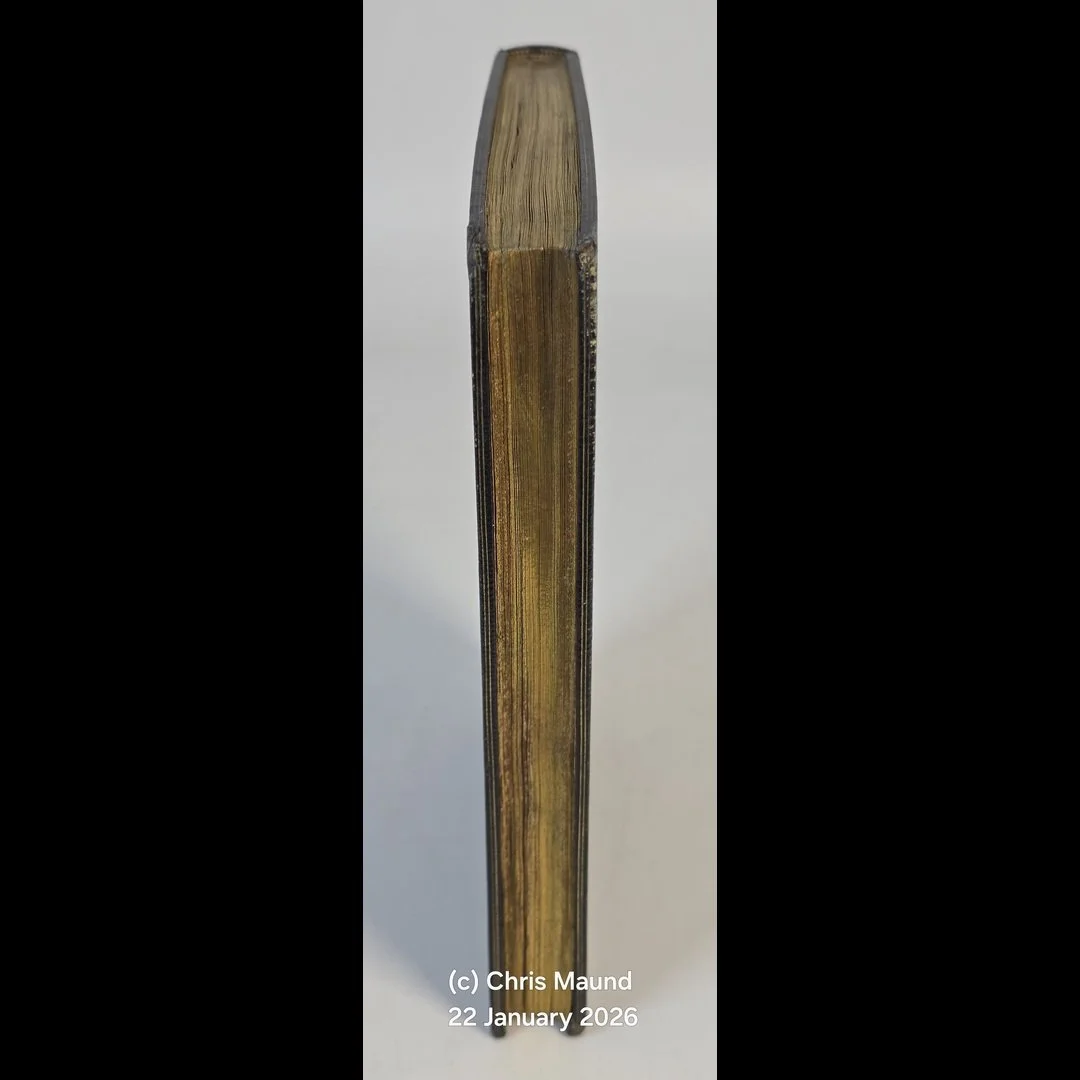
Binding with substantial age-soiling, rubbing and surface marking, wear to edges and corners, local abrasion and other signs of prolonged historical use. The vellum and boards show the expected distortion and movement associated with a binding of this age. Later pink fabric ties have been fitted.
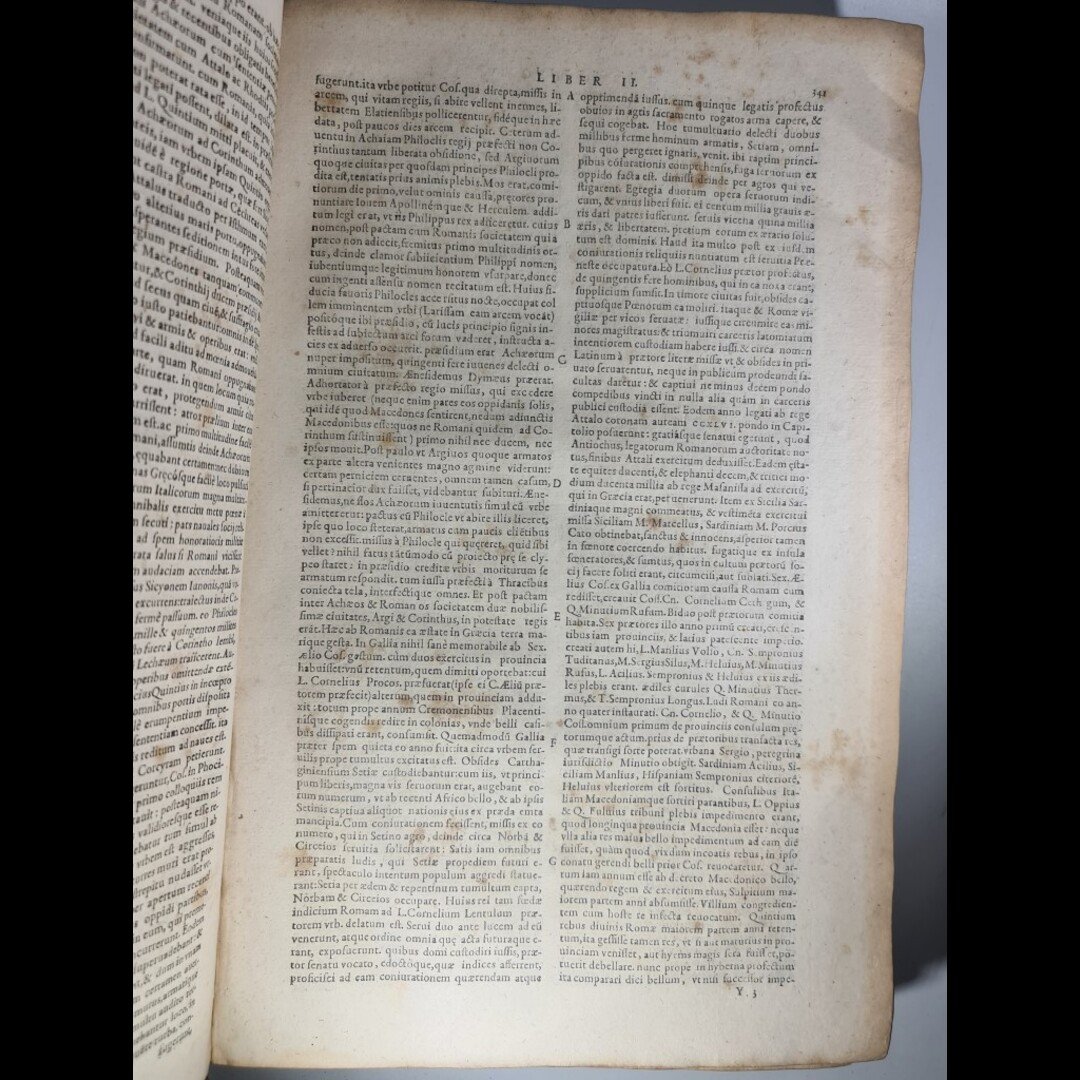
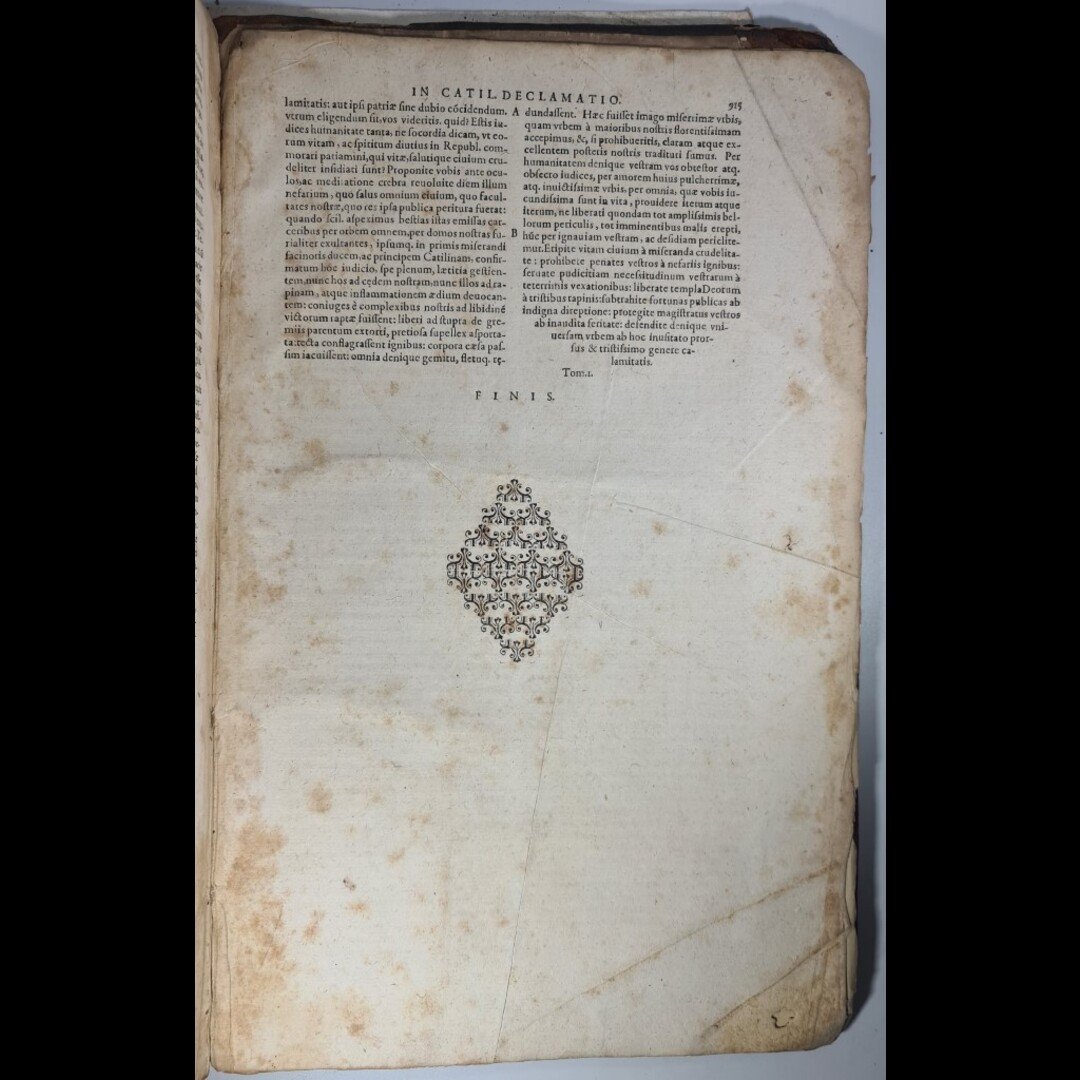
Internally substantially better preserved than the exterior might suggest. Paper generally sound and well printed, with normal age-toning, scattered spotting, occasional staining and handling marks. Woodcut impressions remain strong and attractive.
Title page complete with good margins, bearing several early manuscript inscriptions, some heavily cancelled in ink. The printer’s device remains clear.
Both folding maps are present — Gallia and Hispania — with their original folds and without observed material loss. The expected illustrated material is present, including the principal siege, topographical and military-engineering woodcuts. Exact-edition auction descriptions record eight woodcut illustrations, six full-page, plus these two folding maps.
The copy has been physically checked and is complete, but it contains two notable binding-order peculiarities.
Within the 606-page Caesar text, gatherings H and I have been transposed. The pagination therefore runs:
112 → 129–144 → 113–128 → 145
rather than the intended:
112 → 113–128 → 129–144 → 145.
All leaves of both gatherings are present; no text is missing.
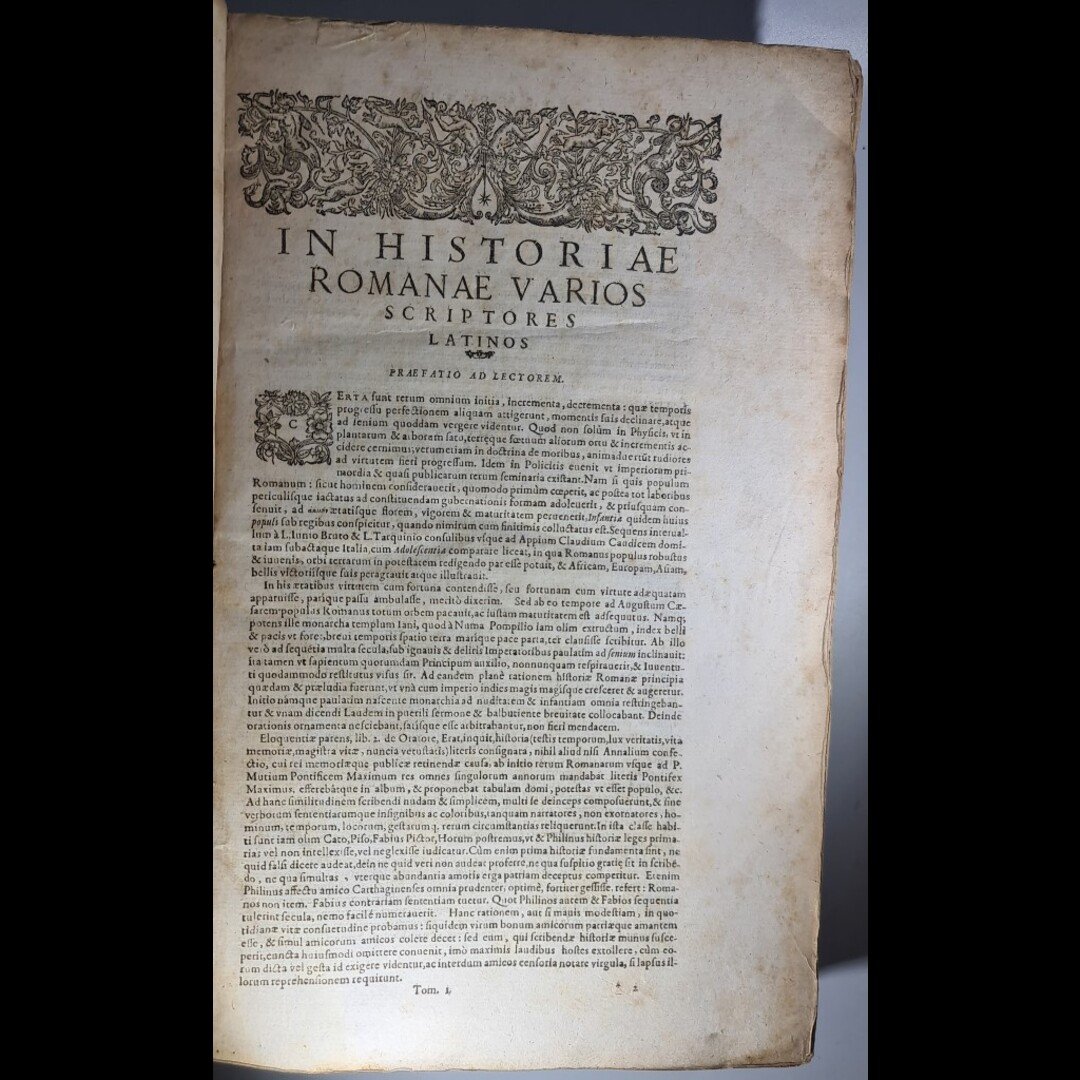
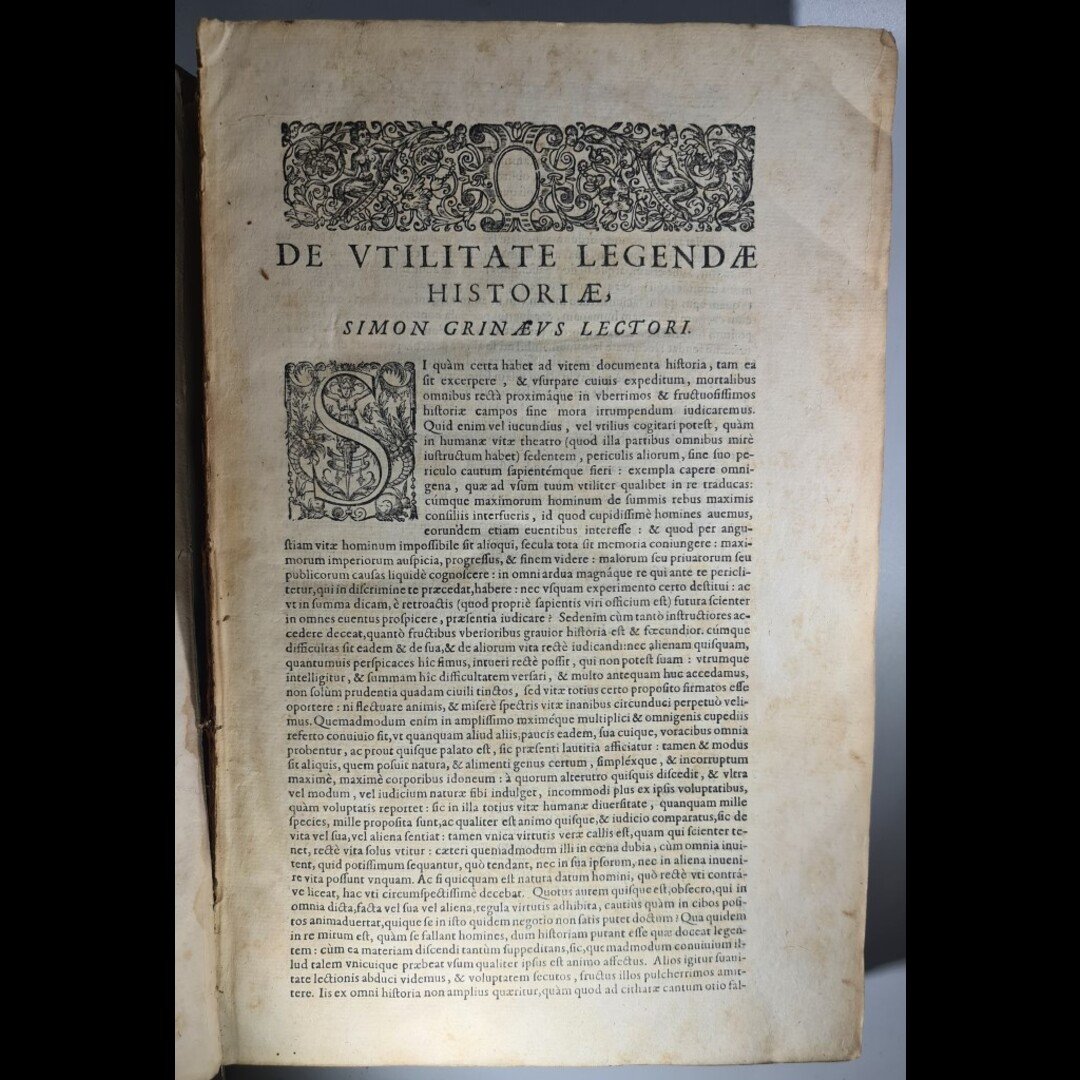
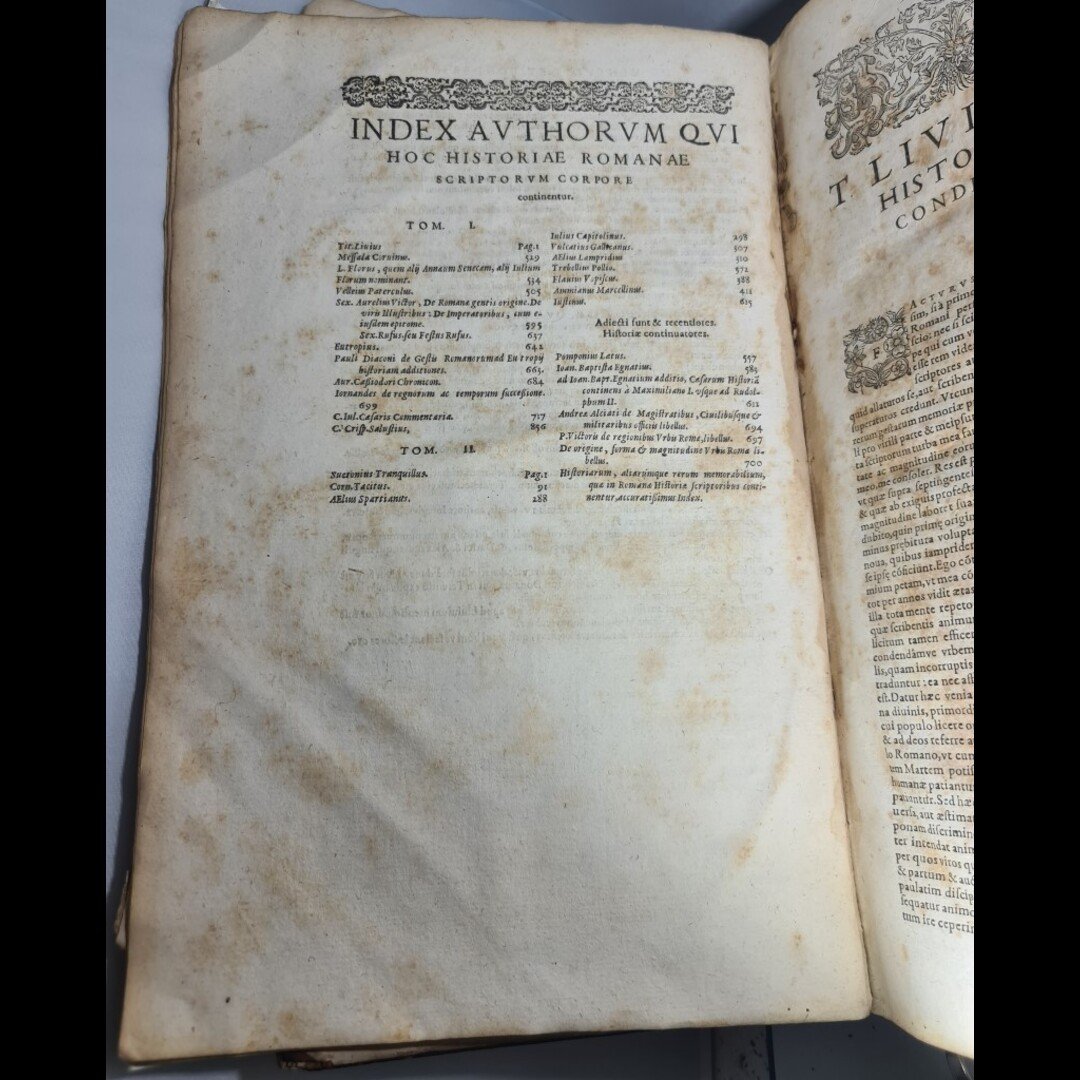
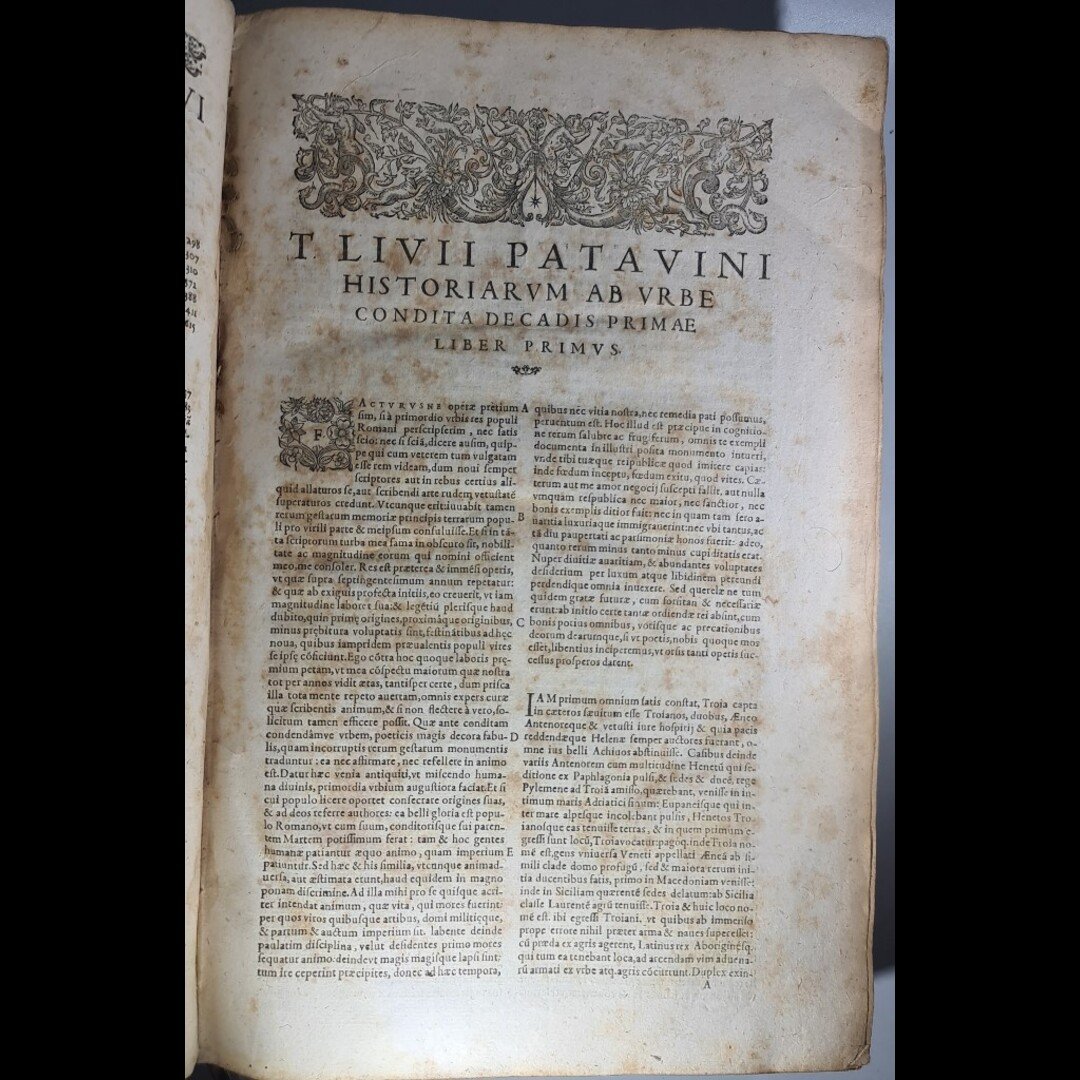
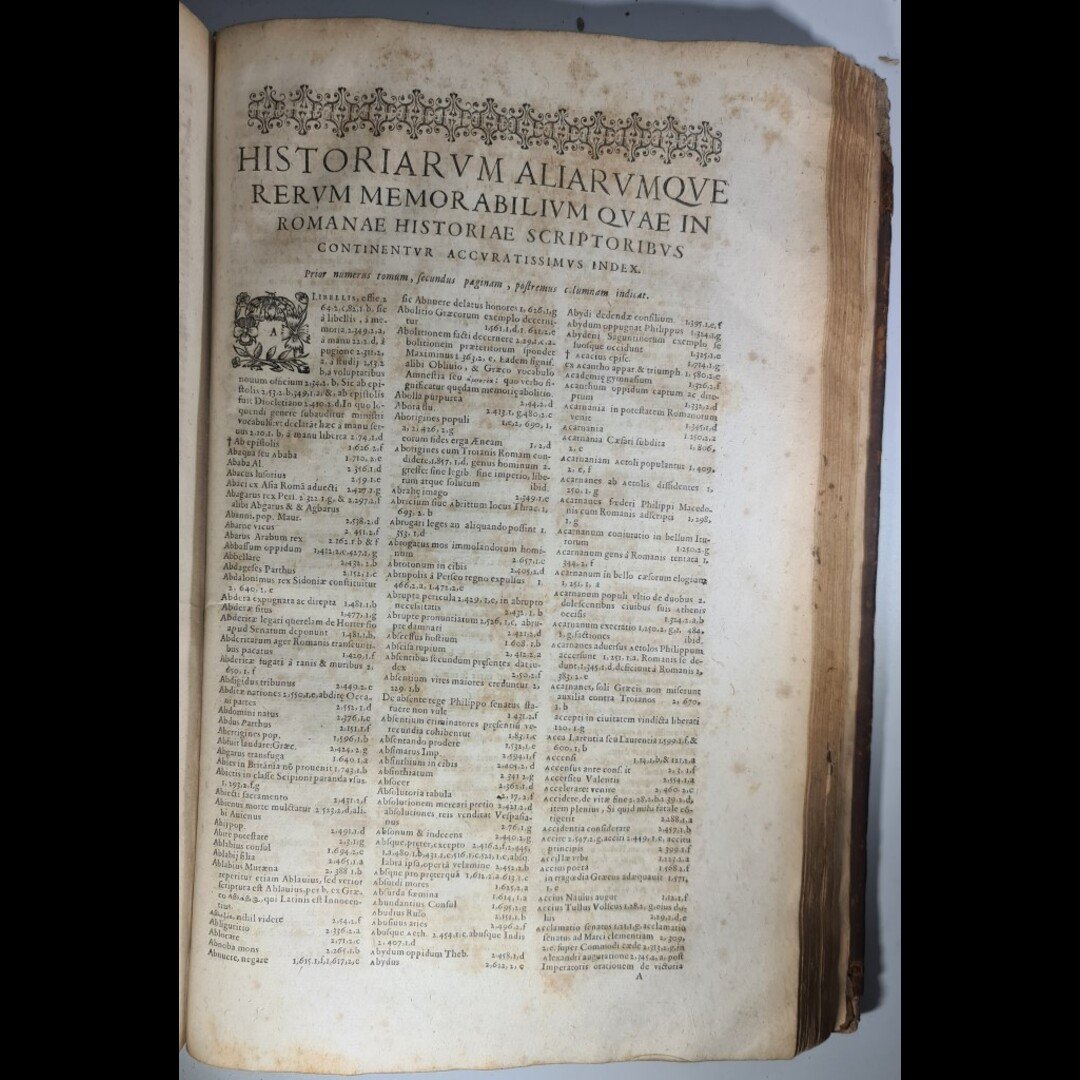
The separately signed Scholia Aldi Manutii, Libellus Variarum Lectionum and alphabetical index sequence A–R⁸ is bound before the principal 606-page Caesar text rather than in the position normally recorded after it.
The end of this supplementary sequence has been physically verified: the final printed index leaf ends “FINIS INDICIS”, followed by the retained terminal blank R8, after which the principal Caesar text begins at page 1.
Likewise, the principal A–2P⁸ text concludes at page 606, followed by its retained terminal blank 2P8.
Thus the unusual sequence results from historical binding rather than textual loss.
Bibliographical records for the 1609 edition differ somewhat in their counting of the unnumbered preliminary and supplementary pages — records include [184], 606, [272] and [192], 606, [274] — but agree on the substantial preliminary and supplementary matter, 606-page principal text, illustrations and folding maps. The present copy has therefore been assessed by physical signature and content audit rather than relying solely upon pagination totals.
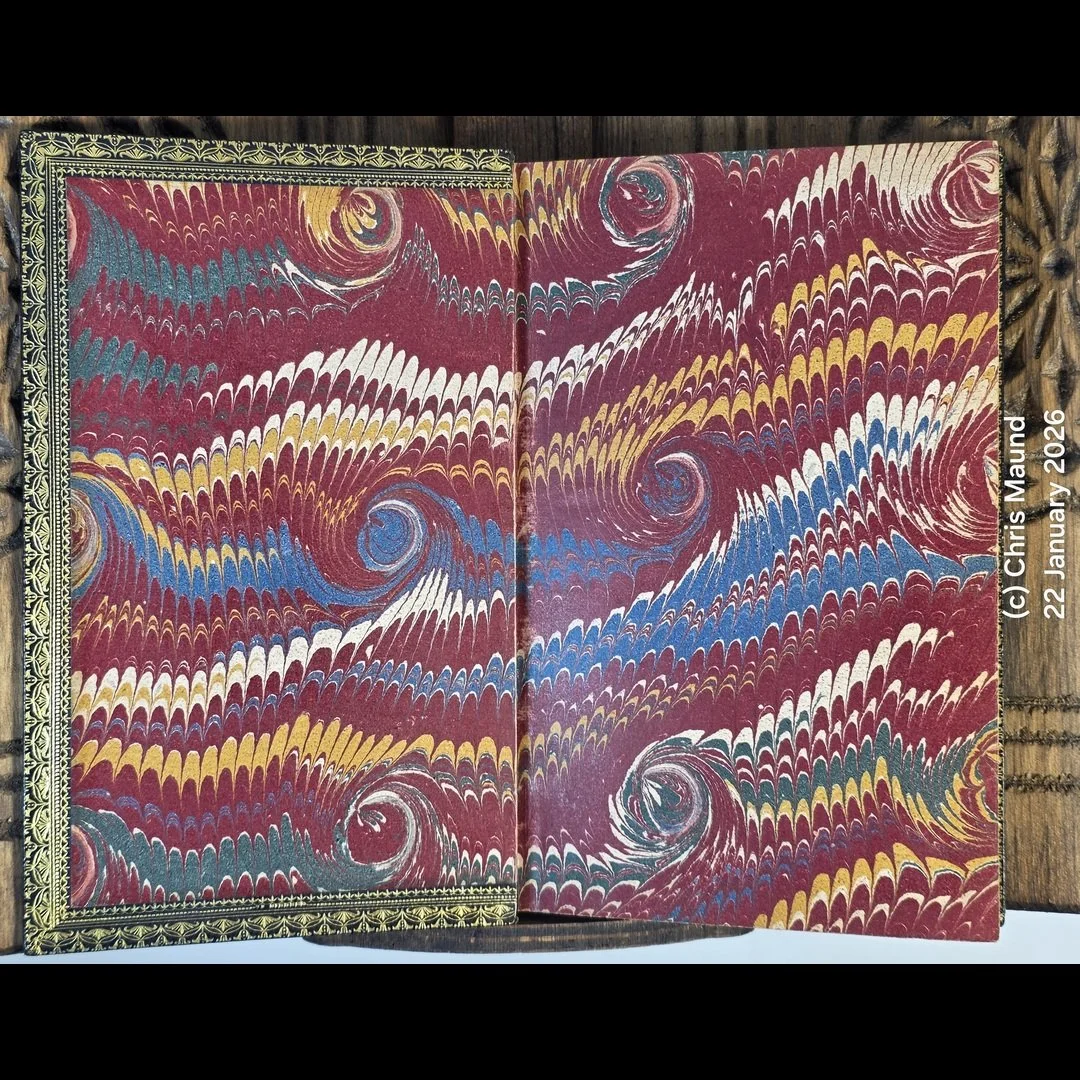
Please see Photos as part of condition report.
REFERENCES
ETH-Bibliothek Zürich, Rar 8161 — digitised copy of C. Iulii Caesaris commentarii, Venice, heirs of Pietro Ricciardi, 1609; e-rara 34175.
Biblioteca Provinciale dei Cappuccini di Messina, catalogue no. 498 — Caesar Caius Iulius, Commentarii, Venice, heirs of Pietro Ricciardi, 1609; records [184], 606, [272] pp., octavo, illustrated.
Finarte, Books, Autographs & Prints, Rome, 10 December 2018, lot 152 — exact 1609 edition; records eight woodcut illustrations, six full-page.
Forum Auctions, NO RESERVE Online Sale: Libri Antichi e Rari, 13 July 2017, lot 25 — exact 1609 edition; records [192], 606, [274] pp., eight woodcut figures and two folding maps.
SYNOPSIS
Julius Caesar’s Commentarii are among the most important surviving firsthand literary monuments of the Roman Republic.
The best known portion, the Commentarii de Bello Gallico, narrates Caesar’s campaigns in Gaul from 58 to 52 BC. Written with exceptional economy and apparent clarity, the work records military operations against and among peoples including the Helvetii, Belgae, Germans, Britons, Arverni and others, culminating in the great revolt under Vercingetorix and the siege of Alesia.
Although presented in a restrained documentary style and referring to Caesar in the third person, the Gallic War is also a carefully controlled presentation of events by one of their principal participants. Its accounts of marches, fortifications, logistics, diplomacy, ethnography and battle have made it fundamental both to classical literature and to the study of Roman warfare.
The Commentarii de Bello Civili recount Caesar’s conflict with Pompey and the senatorial faction from the crossing of the Rubicon in 49 BC through the campaigns that culminated in Pompey’s defeat at Pharsalus.
The traditional Caesarian corpus is extended by accounts of the Alexandrian, African and Spanish Wars, works transmitted alongside Caesar although their exact authorship has long been debated.
What distinguishes this edition is the extensive apparatus surrounding those texts. Aldus Manutius the Younger brought humanist textual criticism, geography and antiquarian scholarship to Caesar, while the woodcuts attempt to turn Caesar’s descriptions of cities, siegeworks, bridges and fortifications into visible form.
The folding maps of Gaul and Spain, together with the reconstructed military sites and engineering diagrams, transform the volume into a particularly attractive early modern interpretation of the Roman world — one situated at the intersection of classical literature, cartography, military history, architecture and Renaissance humanism.
AUTHOR BIO
Gaius Julius Caesar (100–44 BC) was a Roman general, statesman, orator and author whose military and political career transformed the final decades of the Roman Republic.
His conquest of Gaul greatly expanded Roman control in western Europe and provided the military power and reputation that underpinned his subsequent conflict with Pompey and the senatorial leadership. Victorious in the resulting civil wars, Caesar accumulated extraordinary political authority before his assassination in Rome on the Ides of March, 44 BC.
As an author, Caesar is celebrated particularly for the Commentarii de Bello Gallico and Commentarii de Bello Civili. Their controlled prose, clarity of narrative and detailed treatment of military operations established them among the canonical works of Latin literature and ensured their continuous study from antiquity through the Renaissance and into the modern period.
EDITOR BIO
Aldus Manutius the Younger (Aldo Manuzio il Giovane, 1547–1597) was the son of Paolo Manuzio and grandson of Aldus Manutius the Elder, founder of the celebrated Aldine Press.
A precocious Latin scholar, antiquarian and editor, he inherited both the intellectual traditions and printing interests of the Manuzio family. He managed the Venetian press, taught rhetoric at Bologna and Pisa, later moved to Rome, and in 1590 became director of the Vatican printing establishment.
His interests included Latin language, epigraphy, antiquity and textual scholarship. The wording on the present title page — “Paulli F. Aldi N.”, “son of Paolo, grandson of Aldus” — deliberately situates his editorial work within that famous humanist printing dynasty.
This edition was printed twelve years after his death and should therefore be understood as a Ricciardi printing of the Aldus Younger recension, rather than an Aldine Press publication.
ILLUSTRATOR
Anonymous Renaissance woodcut cutter(s).
The edition contains a substantial series of woodcut illustrations concerned principally with Roman geography, siegecraft and military engineering. Exact-edition records describe eight woodcut figures, six full-page, together with two separately inserted folding maps of Gaul and Spain.
Among the most compelling images are reconstructions of Avaricum, Alesia, Uxellodunum and Massilia, together with depictions associated with Caesar’s Rhine bridge. The accompanying apparatus reflects Renaissance attempts by architects and humanists — including Andrea Palladio and others — to reconcile Caesar’s Latin description with practicable ancient engineering.
1609
C. IULLI CAESARIS COMMENTARII
By Gaius Julius Caesar
KEY DETAILS
Condition: Good
Format: Hardcover, 8vo; Approximately 145 × 97 mm
Published By: Apud Haeredes Petri Ricciardi, Venetiis, 1609
Language: Latin
Illustrated By: Anonymous Renaissance woodcut cutter(s).
Provenance: Early ownership history remains unidentified.
Collation: complete; preliminary and illustrative apparatus; principal Caesar text A–2P⁸, pp.1–606 with 2P8 blank; separately signed Scholia and index A–R⁸ with R8 blank; 2 folding maps. Gatherings H and I of the principal text transposed in binding as described above.
Dust Jacket: None, as issued, No Jacket
SKU: BTETM0002580
Shipping Info: Approximate Package Dimensions H: 12.5, L: 30, W: 25 (Units: cm), W: 2Kg
Tracked Shipping, Insurance Coverage as per Customer Request
DESCRIPTION
C. Iulli Caesaris Commentarii
Ab Aldo Manutio Paulli F. Aldi N. emendati et scholiis illustrati
A handsome and intellectually rich early seventeenth-century Venetian edition of the traditional Caesarian corpus, printed by the heirs of Pietro Ricciardi in 1609 and preserving the influential recension, scholia and antiquarian apparatus of Aldus Manutius the Younger, grandson of the celebrated founder of the Aldine Press.
The title-page formula “Ab Aldo Manutio Paulli F. Aldi N.” is unusually explicit about the editor’s identity: Aldus, son of Paolo Manuzio and grandson of Aldus Manutius the Elder. This is therefore not itself an Aldine Press imprint, but a later Venetian edition transmitting the textual and scholarly work of the third generation of the Manuzio dynasty. ETH-Bibliothek catalogues this exact 1609 edition with Aldus Manutius the Younger, 1547–1597, as its editor.
The volume contains Caesar’s Commentaries, including the seven books of the Gallic War, the eighth book traditionally associated with Aulus Hirtius, the Civil War, and the traditional Caesarian continuations concerning the Alexandrian, African and Spanish campaigns, together with extensive geographical, textual and antiquarian apparatus.
Particularly notable is the book’s substantial programme of woodcut illustration. Contemporary descriptions of the exact edition record eight woodcut figures, six full-page, together with two folding maps of Gaul and Spain. Both folding maps are present in this copy.
The illustrations are not merely decorative. They reconstruct places, sieges and military engineering discussed by Caesar, including Avaricum, Alesia, Uxellodunum and Massilia, alongside the celebrated representation of the bison and material concerned with Caesar’s bridge across the Rhine.
Of particular interest is the Renaissance attempt to understand Caesar’s engineering through the work of later humanist and architectural scholars. The introductory list of figures names proposed reconstructions associated with figures including Giovanni Giocondo, Guillaume Budé, Adrianus Turnebus, Leon Battista Alberti and Andrea Palladio. One of the surviving illustrations in this copy is explicitly headed “EX PALLAD. LIB. III. CAP. 6.”, referring to Palladio’s discussion of Caesar’s Rhine bridge.
The result is considerably more than a straightforward school edition of Caesar: it is a compact illustrated witness to the Renaissance and early modern attempt to reconstruct the geography, fortification, siegecraft and military engineering of the ancient Roman world.
The title page bears the printer’s woodcut device, while decorative initials and woodcut illustrations enliven the text throughout.
PROVENANCE
Early ownership history remains unidentified.
The title page bears several old manuscript inscriptions, including inscriptions deliberately cancelled in ink by an early owner. Other surviving marginal inscriptions are presently undeciphered.
The front and rear endleaves carry extensive early manuscript writing in several hands, comprising pen trials, short Latin passages or exercises, repeated words and other informal annotations. These appear to represent prolonged early use of the volume rather than modern notes and form an attractive part of the copy’s history.
No secure personal or institutional provenance has presently been established from the surviving inscriptions, and no attribution is made here beyond the evidence visible in the book.
CONDITION, COLLATION & COPY NOTES
A complete and appealing copy in contemporary or near-contemporary full vellum over boards, with manuscript titling to the spine and later fabric ties.
Binding with substantial age-soiling, rubbing and surface marking, wear to edges and corners, local abrasion and other signs of prolonged historical use. The vellum and boards show the expected distortion and movement associated with a binding of this age. Later pink fabric ties have been fitted.
Internally substantially better preserved than the exterior might suggest. Paper generally sound and well printed, with normal age-toning, scattered spotting, occasional staining and handling marks. Woodcut impressions remain strong and attractive.
Title page complete with good margins, bearing several early manuscript inscriptions, some heavily cancelled in ink. The printer’s device remains clear.
Both folding maps are present — Gallia and Hispania — with their original folds and without observed material loss. The expected illustrated material is present, including the principal siege, topographical and military-engineering woodcuts. Exact-edition auction descriptions record eight woodcut illustrations, six full-page, plus these two folding maps.
The copy has been physically checked and is complete, but it contains two notable binding-order peculiarities.
Within the 606-page Caesar text, gatherings H and I have been transposed. The pagination therefore runs:
112 → 129–144 → 113–128 → 145
rather than the intended:
112 → 113–128 → 129–144 → 145.
All leaves of both gatherings are present; no text is missing.
The separately signed Scholia Aldi Manutii, Libellus Variarum Lectionum and alphabetical index sequence A–R⁸ is bound before the principal 606-page Caesar text rather than in the position normally recorded after it.
The end of this supplementary sequence has been physically verified: the final printed index leaf ends “FINIS INDICIS”, followed by the retained terminal blank R8, after which the principal Caesar text begins at page 1.
Likewise, the principal A–2P⁸ text concludes at page 606, followed by its retained terminal blank 2P8.
Thus the unusual sequence results from historical binding rather than textual loss.
Bibliographical records for the 1609 edition differ somewhat in their counting of the unnumbered preliminary and supplementary pages — records include [184], 606, [272] and [192], 606, [274] — but agree on the substantial preliminary and supplementary matter, 606-page principal text, illustrations and folding maps. The present copy has therefore been assessed by physical signature and content audit rather than relying solely upon pagination totals.
Please see Photos as part of condition report.
REFERENCES
ETH-Bibliothek Zürich, Rar 8161 — digitised copy of C. Iulii Caesaris commentarii, Venice, heirs of Pietro Ricciardi, 1609; e-rara 34175.
Biblioteca Provinciale dei Cappuccini di Messina, catalogue no. 498 — Caesar Caius Iulius, Commentarii, Venice, heirs of Pietro Ricciardi, 1609; records [184], 606, [272] pp., octavo, illustrated.
Finarte, Books, Autographs & Prints, Rome, 10 December 2018, lot 152 — exact 1609 edition; records eight woodcut illustrations, six full-page.
Forum Auctions, NO RESERVE Online Sale: Libri Antichi e Rari, 13 July 2017, lot 25 — exact 1609 edition; records [192], 606, [274] pp., eight woodcut figures and two folding maps.
SYNOPSIS
Julius Caesar’s Commentarii are among the most important surviving firsthand literary monuments of the Roman Republic.
The best known portion, the Commentarii de Bello Gallico, narrates Caesar’s campaigns in Gaul from 58 to 52 BC. Written with exceptional economy and apparent clarity, the work records military operations against and among peoples including the Helvetii, Belgae, Germans, Britons, Arverni and others, culminating in the great revolt under Vercingetorix and the siege of Alesia.
Although presented in a restrained documentary style and referring to Caesar in the third person, the Gallic War is also a carefully controlled presentation of events by one of their principal participants. Its accounts of marches, fortifications, logistics, diplomacy, ethnography and battle have made it fundamental both to classical literature and to the study of Roman warfare.
The Commentarii de Bello Civili recount Caesar’s conflict with Pompey and the senatorial faction from the crossing of the Rubicon in 49 BC through the campaigns that culminated in Pompey’s defeat at Pharsalus.
The traditional Caesarian corpus is extended by accounts of the Alexandrian, African and Spanish Wars, works transmitted alongside Caesar although their exact authorship has long been debated.
What distinguishes this edition is the extensive apparatus surrounding those texts. Aldus Manutius the Younger brought humanist textual criticism, geography and antiquarian scholarship to Caesar, while the woodcuts attempt to turn Caesar’s descriptions of cities, siegeworks, bridges and fortifications into visible form.
The folding maps of Gaul and Spain, together with the reconstructed military sites and engineering diagrams, transform the volume into a particularly attractive early modern interpretation of the Roman world — one situated at the intersection of classical literature, cartography, military history, architecture and Renaissance humanism.
AUTHOR BIO
Gaius Julius Caesar (100–44 BC) was a Roman general, statesman, orator and author whose military and political career transformed the final decades of the Roman Republic.
His conquest of Gaul greatly expanded Roman control in western Europe and provided the military power and reputation that underpinned his subsequent conflict with Pompey and the senatorial leadership. Victorious in the resulting civil wars, Caesar accumulated extraordinary political authority before his assassination in Rome on the Ides of March, 44 BC.
As an author, Caesar is celebrated particularly for the Commentarii de Bello Gallico and Commentarii de Bello Civili. Their controlled prose, clarity of narrative and detailed treatment of military operations established them among the canonical works of Latin literature and ensured their continuous study from antiquity through the Renaissance and into the modern period.
EDITOR BIO
Aldus Manutius the Younger (Aldo Manuzio il Giovane, 1547–1597) was the son of Paolo Manuzio and grandson of Aldus Manutius the Elder, founder of the celebrated Aldine Press.
A precocious Latin scholar, antiquarian and editor, he inherited both the intellectual traditions and printing interests of the Manuzio family. He managed the Venetian press, taught rhetoric at Bologna and Pisa, later moved to Rome, and in 1590 became director of the Vatican printing establishment.
His interests included Latin language, epigraphy, antiquity and textual scholarship. The wording on the present title page — “Paulli F. Aldi N.”, “son of Paolo, grandson of Aldus” — deliberately situates his editorial work within that famous humanist printing dynasty.
This edition was printed twelve years after his death and should therefore be understood as a Ricciardi printing of the Aldus Younger recension, rather than an Aldine Press publication.
ILLUSTRATOR
Anonymous Renaissance woodcut cutter(s).
The edition contains a substantial series of woodcut illustrations concerned principally with Roman geography, siegecraft and military engineering. Exact-edition records describe eight woodcut figures, six full-page, together with two separately inserted folding maps of Gaul and Spain.
Among the most compelling images are reconstructions of Avaricum, Alesia, Uxellodunum and Massilia, together with depictions associated with Caesar’s Rhine bridge. The accompanying apparatus reflects Renaissance attempts by architects and humanists — including Andrea Palladio and others — to reconcile Caesar’s Latin description with practicable ancient engineering.

 Image 1 of 28
 Image 2 of 28
 Image 3 of 28
 Image 4 of 28
 Image 5 of 28
 Image 6 of 28
 Image 7 of 28
 Image 8 of 28
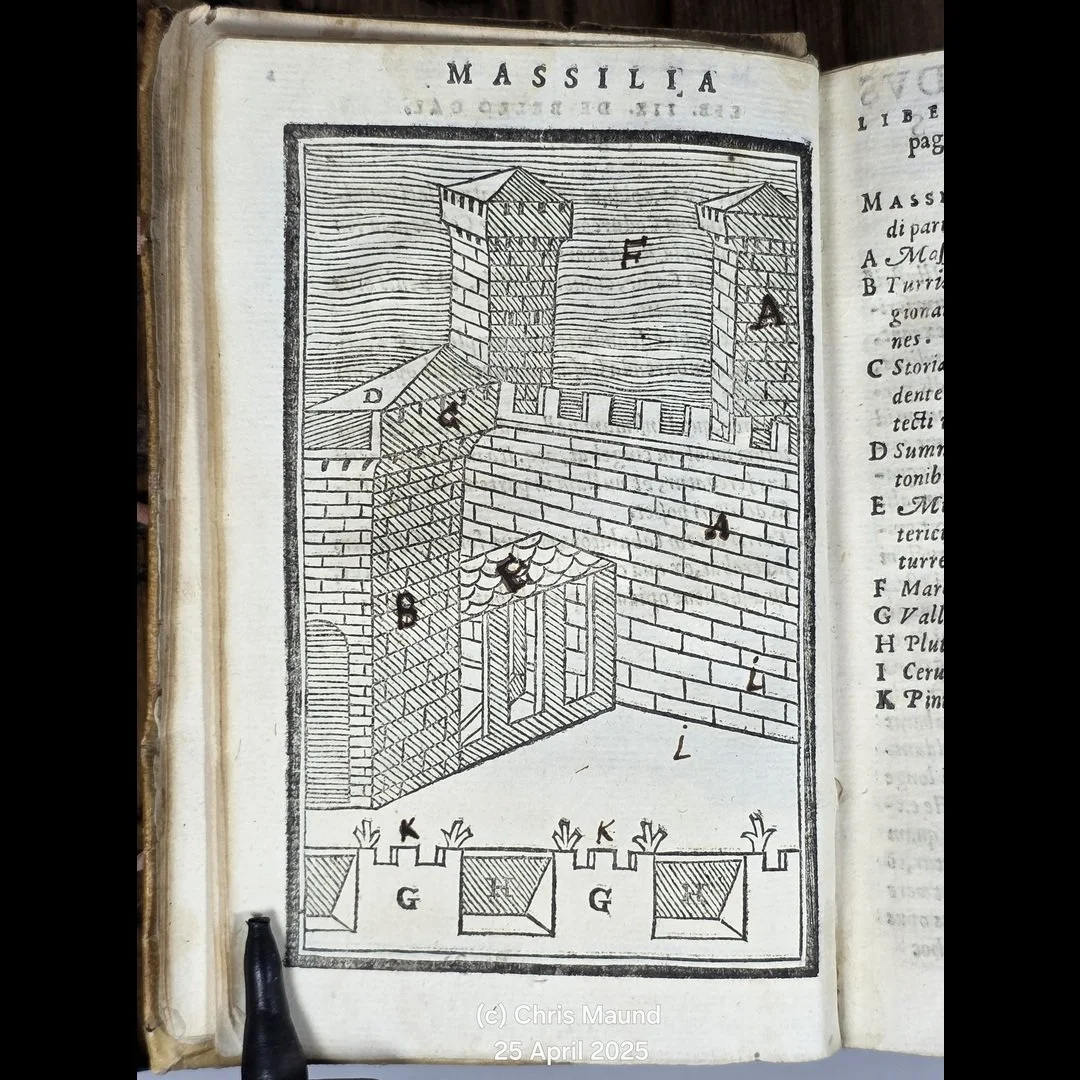 Image 9 of 28
 Image 10 of 28
 Image 11 of 28
 Image 12 of 28
 Image 13 of 28
 Image 14 of 28
 Image 15 of 28
 Image 16 of 28
 Image 17 of 28
 Image 18 of 28
 Image 19 of 28
 Image 20 of 28
 Image 21 of 28
 Image 22 of 28
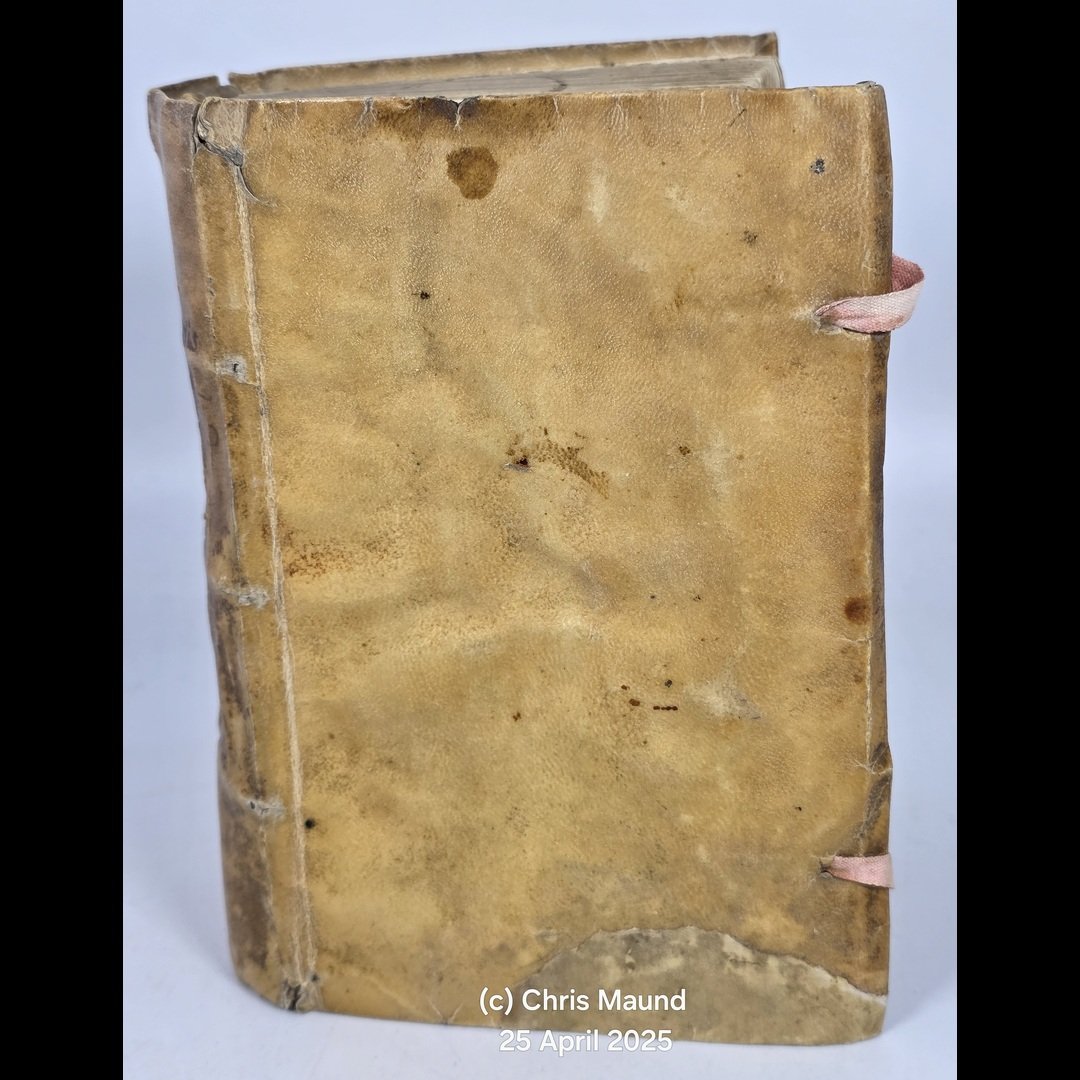 Image 23 of 28
 Image 24 of 28
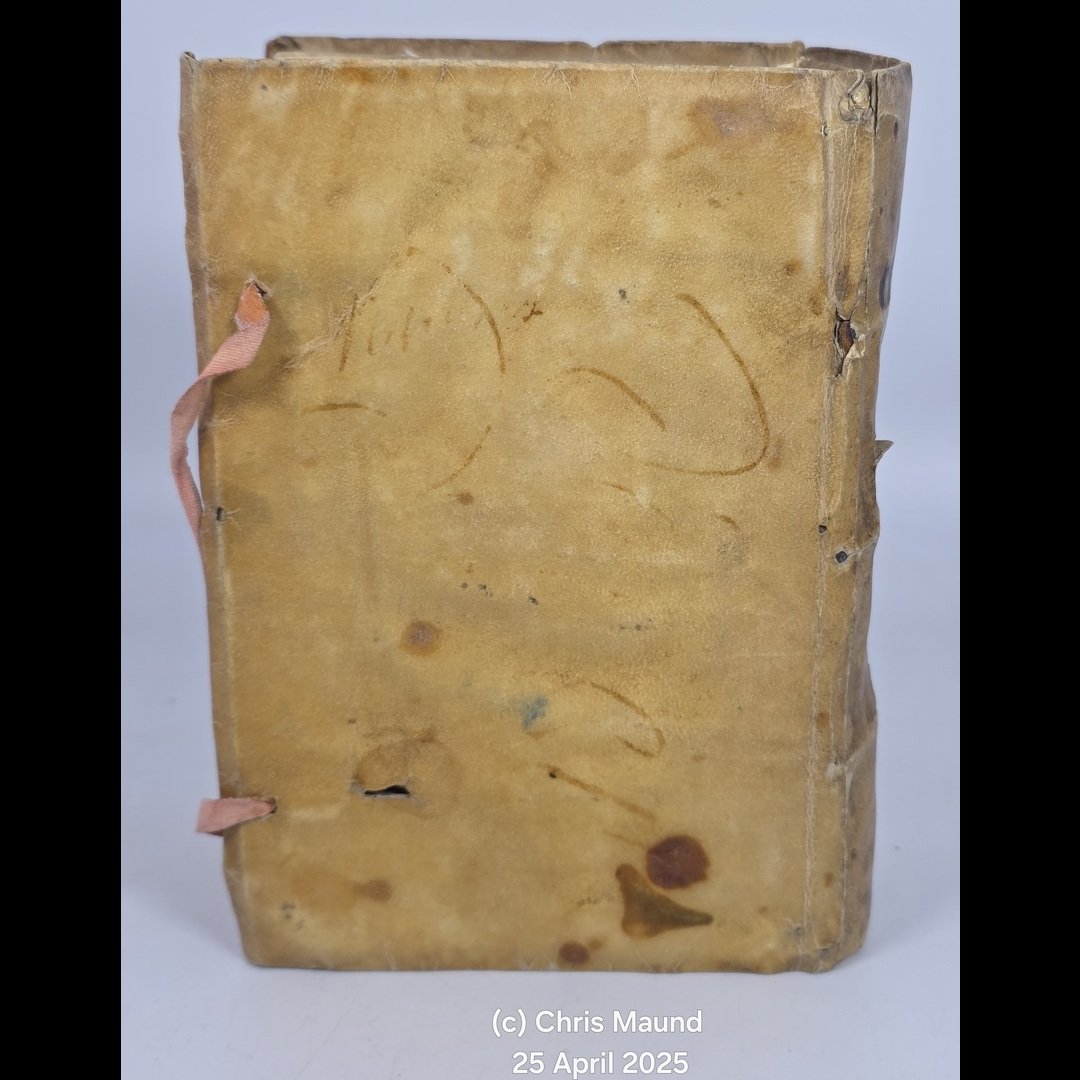 Image 25 of 28
 Image 26 of 28
 Image 27 of 28
 Image 28 of 28