1920 First Facsimile Edition With Provenance
A NEASTE OF WASPES
By William Goddard
KEY DETAILS
Condition: Very Good
Format: Softcover, 4to; Approx. 195 × 142 mm.
Published By: Clarendon Press, Oxford, 1920
Language: English
Provenance: General Theological Seminary Library, Chelsea Square, New York.
Collation: [5], 1, 1 (facsimile title page), [1], 2 (Prefatory Notes), 2 (Notes), 1 (To The Reader, signed A3), 1 (The Comission), 51 (concluding with An Epigram to my Epigrams), [3] blank pp.
Dust Jacket: None, as issued
SKU: BTETM0002588
Shipping Info: Approximate Package Dimensions H: 15, L: 30, W: 25 (Units: cm), W: 2Kg
Tracked Shipping, Insurance Coverage as per Customer Request
DESCRIPTION
A Neaste of Waspes
Latelie Found Out and Discouered in the Law-Countreys: Yealding as Sweete Hony as Some of Our English Bees
Undated. Institutional and scholarly references variously assign the Clarendon Press facsimile to 1920 or 1921. No evidence of separate impressions has been established.
An uncommon early twentieth-century facsimile of William Goddard's A Neaste of Waspes, a collection of satirical epigrams originally printed at Dordrecht in the Netherlands in 1615, during the reign of James I.
Reproduced at Oxford University Press from the original edition preserved in the library of Worcester College, Oxford, and issued by the Clarendon Press, with a bibliographical note by C. H. Wilkinson, Fellow and Librarian of Worcester College.
The facsimile faithfully reproduces the original seventeenth-century title page, typography, decorative ornaments, irregular spelling and printed signature marks, preserving the appearance and character of this scarce work of Jacobean satire.
An intriguing feature is the contemporary decorative binding, comprising cream-coloured stiff boards or card with ruled geometric ornamentation. The spine bears a manuscript title in black ink, including the original publication date, 1615.
Although the precise material and publisher-issued status of the binding have not been established, its decoration is noteworthy in relation to the similarly patterned cream-paper binding recorded on an example presented by Wilkinson himself to Eton College.
An attractive example of an early literary facsimile, combining a relatively obscure work of seventeenth-century English literature with documented American theological-library provenance.
PROVENANCE
General Theological Seminary Library, Chelsea Square, New York.
With the Seminary's institutional bookplate identifying the volume as belonging to its Rare Book Cases, together with a handwritten library classification.
The bookplate records that the volume was purchased from the fund bequeathed to the Seminary by Eugene Augustus Hoffman, D.D. (1829–1902), who served as Dean of the General Theological Seminary from 1879 until his death.
Hoffman was an influential American Episcopal clergyman and an important benefactor of the Seminary. His financial support helped develop its educational resources and library collections.
The bookplate provides a documented institutional ownership history, identifying both the Seminary's rare-book collection and the acquisition fund through which the volume was obtained.
No claim of personal ownership by Hoffman is implied.
CONDITION, COLLATION & COPY NOTES
COLLATION
[5], 1, 1 (facsimile title page), [1], 2 (Prefatory Notes), 2 (Notes), 1 (To The Reader, signed A3), 1 (The Comission), 51 (concluding with An Epigram to my Epigrams), [3] blank pp.
68 pages in total, including the terminal blanks, as physically verified.
The final reproduced signature is H. The original signature marks belong to the facsimile text and should not be taken as confirmation of the gathering structure of the twentieth-century reprint.
Very Good.
Contemporary cream-coloured decorated stiff boards or card, with ruled geometric ornamentation. Manuscript spine title in black ink reading Neaste of Waspes 1615. Age-related surface soiling, discolouration and minor rubbing, particularly towards the extremities. Both boards and hinges remain firmly attached.
Generally clean and well preserved, with clear reproduction of the original typography and decorative ornaments. General Theological Seminary Library bookplate present.
Please see photographs as part of the condition report.
REFERENCES
Eton College Library, B12916, shelfmark Bm.06.28: Oxford facsimile, catalogued [1921], [32] leaves, quarto. The example was presented by C. H. Wilkinson and is described as bound in cream paper with a scored pattern.
C. H. Wilkinson, bibliographical note accompanying the facsimile.
English Short Title Catalogue (ESTC), STC 11929: original 1615 edition.
Kathryn Perry, '"I do it onely for the Printers sake": Commercial Imperatives and Epigrams in the Early Seventeenth Century', EnterText, 3.1: scholarly discussion of Goddard and contemporary epigrammatic literature.
SYNOPSIS
First published at Dordrecht in 1615, William Goddard's A Neaste of Waspes is a collection of sharply observed satirical epigrams exposing the vanities, follies and moral shortcomings of early seventeenth-century society.
The title's wasp imagery is an apt metaphor for the nature of the verse: brief, pointed and frequently biting. Beneath its playful suggestion of sweetness lies a succession of literary stings aimed at hypocrisy, pretension, dishonesty and the absurdities of human behaviour.
Written during a period in which the English epigram was flourishing as a vehicle for social and moral criticism, Goddard's work belongs to a tradition associated with the satirical writings of Thomas Bastard, John Harington and other Elizabethan and Jacobean poets.
The collection is notable for its publication in the Low Countries, reflecting Goddard's association with the Netherlands and the movement of English literary works through Continental printing centres.
This Clarendon Press facsimile makes an otherwise difficult-to-obtain early Jacobean text accessible while preserving much of the visual character of the original printing.
Of interest to collectors and scholars of Renaissance literature, early English poetry, Jacobean satire, historical facsimiles and Anglo-Dutch literary connections.
AUTHOR BIO
William Goddard (fl. 1599–1615) was an English poet and satirist active during the late Elizabethan and early Jacobean periods.
Biographical details of his life remain relatively scarce. He is believed to have had connections with the Middle Temple and spent time in the Netherlands, where A Neaste of Waspes was published at Dordrecht in 1615.
His known writings include A Mastif Whelp with Other Ruff-Island-Lik Currs, a collection of satirical verse published around the turn of the seventeenth century, and A Neaste of Waspes, which continued his use of short, pointed poems to ridicule contemporary manners and moral failings.
Goddard's writings illustrate the often confrontational character of early Stuart satire, when epigrams provided writers with a compact and effective means of exposing social pretensions and challenging conventional behaviour.

 Image 1 of 16
 Image 2 of 16
 Image 3 of 16
 Image 4 of 16
 Image 5 of 16
 Image 6 of 16
 Image 7 of 16
 Image 8 of 16
 Image 9 of 16
 Image 10 of 16
 Image 11 of 16
 Image 12 of 16
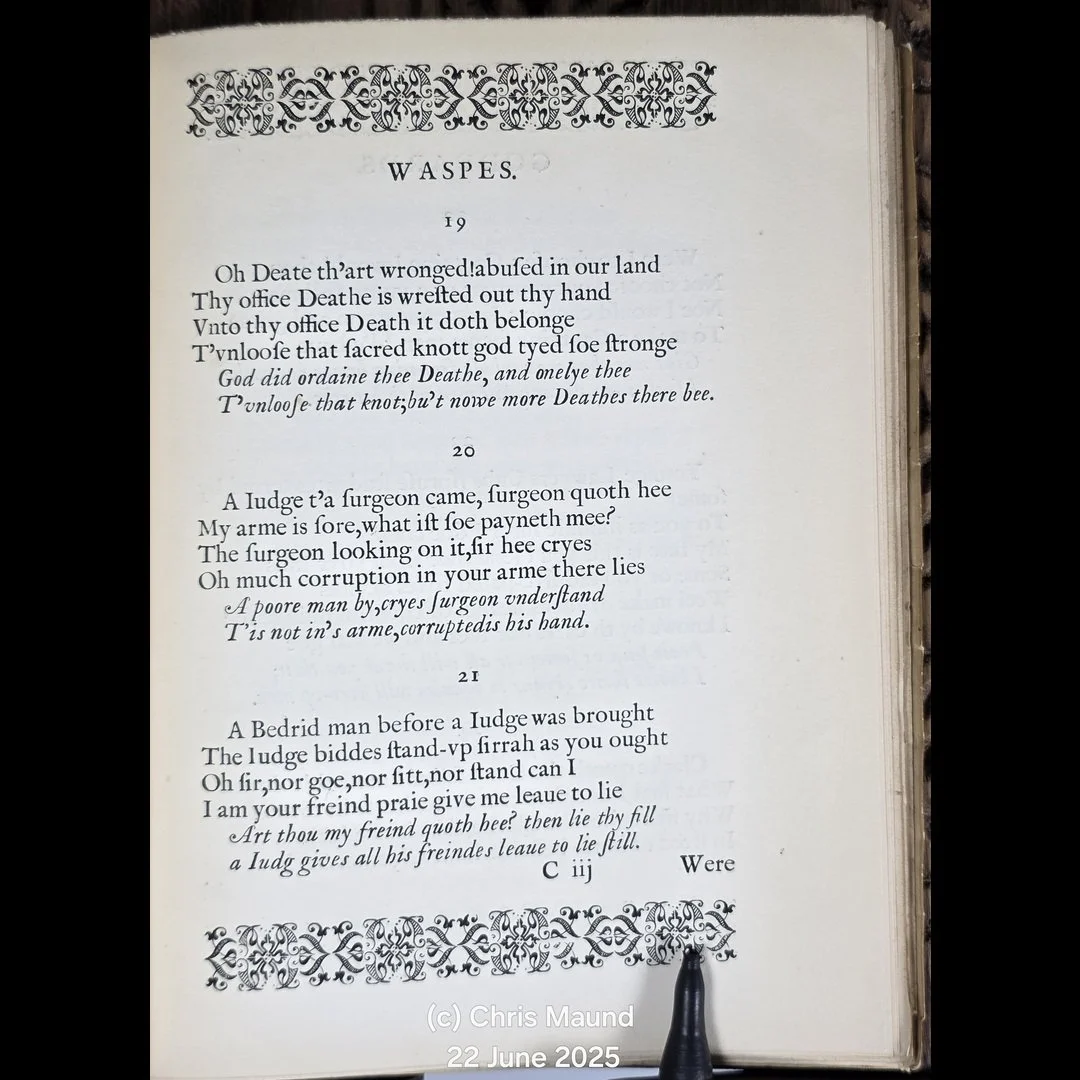 Image 13 of 16
 Image 14 of 16
 Image 15 of 16
 Image 16 of 16