1947 Limited Private Press Edition
SERMON OF THE PLOUGH
By Hugh Latimer
KEY DETAILS
Condition: Good
Format: Hardcover, Slim quarto (approx)
Published By: Designed & printed by Leonard Jay, Birmingham, England. Assisted by Vernon S. Ganderton (presswork) and Michael Fletcher (lettering / gold illumination)., Birmingham, 1947
Language: English
Limited Edition: One of 50 Ordinary Copies Copies
Illustrated By: Leonard Jay
Provenance: No ownership inscriptions, bookplates or other specific provenance have been identified in the present copy.
Collation: Approximately 20 pages, including title, text and colophon; institutional catalogues variously describe the extent as 19 or 20 pages depending upon bibliographical counting convention.
Dust Jacket: None, as issued
SKU: BTETM0002589
Shipping Info: Approximate Package Dimensions H: 12.5, L: 30, W: 25 (Units: cm), W: 2Kg
Tracked Shipping, Insurance Coverage as per Customer Request
DESCRIPTION
Sermon of the Plough
Edition: Limited private press edition. One of 50 copies in the ordinary state, from a total edition of only 65 copies. The remaining 15 copies were specially produced with the opening initial Q illuminated in gold.
Typography & Production: Set in eighteen-point Garamond and printed in red and black on handmade paper. Designed and printed by Leonard Jay, assisted by Vernon S. Ganderton for presswork, with lettering and gold illumination by Michael Fletcher.
A striking large-format private press edition of Hugh Latimer’s celebrated Sermon of the Plough, designed and printed in Birmingham by the influential printer and typographer Leonard Jay for private distribution only.
Printed in eighteen-point Garamond on substantial handmade paper, with text and decorative elements in red and black, the volume is characteristic of the fine-printing tradition fostered by Jay at the Birmingham School of Printing.
Only 65 copies were produced. Of these, 50 copies formed the ordinary issue, including the present copy, with the large opening initial Q printed in red. A further 15 special copies had the initial illuminated in gold.
The colophon credits Vernon S. Ganderton with assistance in presswork and Michael Fletcher with lettering and gold illumination.
The book is especially imposing in its folio format, with generous margins, strong typography and an unusually spacious treatment of Latimer’s text. Although sometimes catalogued by the book trade as a 1947 publication, institutional records distinguish this large-format edition from a separate, smaller Birmingham School of Printing edition issued in 1947. The present edition is undated in the book itself and is best described as n.d. [c.1940s].
Latimer’s title records the sermon as having been preached “in the Shrouds at Paul’s Church in London, on the eighteenth day of January, 1548.” Under modern dating convention this corresponds to 18 January 1549, England at the time having observed the year as beginning on 25 March.
An attractive and scarce piece of twentieth-century British fine printing, combining one of the most famous sermons of the English Reformation with the typographical ideals of Leonard Jay and the Birmingham School of Printing.
PROVENANCE
No ownership inscriptions, bookplates or other specific provenance have been identified in the present copy.
CONDITION, COLLATION & COPY NOTES
COLLATION
Approximately 20 pages, including title, text and colophon; institutional catalogues variously describe the extent as 19 or 20 pages depending upon bibliographical counting convention.
Original paper-covered boards with printed title label to the upper board.
Boards considerably dust-soiled, spotted and discoloured, with rubbing and general shelf wear to the extremities and corners. Spine covering rubbed and worn, with splitting, lifting and small areas of loss, particularly towards the head.
The binding nevertheless remains substantially intact.
Internally considerably better preserved than the exterior, the handmade paper remaining generally clean and fresh with occasional minor spotting and age-toning. Printing remains strong and bright throughout, including the red-and-black typography and large decorative opening initial.
Please see Photos as part of condition report.
REFERENCES
Birmingham Archives & Collections — William Ridler Collection: records the large-format edition as approximately 380 × 250 mm, 20 pages, printed in Garamond on handmade paper, comprising 50 ordinary copies and 15 special copies.
A separate Birmingham School of Printing edition of Sermon of the Plough, dated 1947, is recorded as a substantially smaller production of approximately 210 × 145 mm, 44 pages, printed in Granjon Old Face and issued in card wrappers. This confirms that the present large-format edition should not be identified simply as the 1947 edition.
Folger Shakespeare Library: records Leonard Jay’s edition of Latimer’s sermon and notes the original sermon date as 1548 [i.e. 1549].
SYNOPSIS
Hugh Latimer’s Sermon of the Plough is among the most celebrated sermons of the English Reformation and one of the finest examples of Latimer’s vigorous, direct and frequently satirical preaching style.
Latimer develops an extended metaphor in which the Christian preacher becomes a ploughman. The world is the field, Christian doctrine the seed and preaching the continual labour required to cultivate it.
The image enables Latimer to attack what he regarded as the laziness, corruption and neglect of sections of the contemporary clergy. A true preacher must work constantly, breaking difficult ground, sowing doctrine and tending his congregation rather than enjoying the privileges of ecclesiastical office without performing its duties.
Latimer gives the argument one of its most memorable turns by portraying the Devil as an exceptionally industrious preacher. While negligent clergy rest, the Devil never ceases to plough his own field, spreading vice, superstition and spiritual disorder.
Behind Latimer’s humour lies a serious Reformation argument concerning the central importance of preaching, scripture and active pastoral responsibility.
The sermon takes its familiar name from this sustained agricultural metaphor and remains one of Latimer’s best-known works.
The title states that it was delivered in “the Shrouds at Paul’s Church”, a covered preaching place associated with Old St Paul’s Cathedral in London, on 18 January 1548 according to the contemporary English calendar — 18 January 1549 by modern reckoning.
AUTHOR BIO
Hugh Latimer was one of the most prominent English Protestant reformers and preachers of the sixteenth century.
Educated at the University of Cambridge, Latimer initially defended traditional Catholic doctrine before becoming increasingly sympathetic to reformist theology. His reputation as an exceptionally forceful preacher brought him national prominence, and in 1535 he was appointed Bishop of Worcester.
Latimer became known for sermons delivered in vigorous, accessible English, frequently employing humour, everyday imagery and direct criticism of both ecclesiastical and social abuses.
His religious position placed him in increasing danger during the reign of Mary I. He was tried for heresy and burned at the stake at Oxford on 16 October 1555, together with Nicholas Ridley.
Latimer and Ridley subsequently became two of the best-known Protestant martyrs commemorated in John Foxe’s Acts and Monuments, popularly known as the Book of Martyrs.
His sermons remain important both as documents of the English Reformation and as major examples of sixteenth-century English prose.
ILLUSTRATOR
Leonard Jay
Leonard Jay (1888–1963) was an influential British printer, typographer and educator, best known for his association with the Birmingham School of Printing.
Appointed the School’s first head in 1925, Jay developed a programme strongly influenced by the ideals of the Arts and Crafts and private press movements. Under his direction the School became particularly noted for finely produced books, pamphlets, broadsides and experimental typography.
Jay emphasised the integration of typography, paper, presswork and book design, treating printing not merely as a mechanical trade but as a unified visual and craft discipline.
The productions of the Birmingham School of Printing under Jay are now collected as examples of twentieth-century British private and fine-press printing, with significant institutional holdings preserved by the University of Birmingham and Birmingham Archives.
The present edition of Sermon of the Plough, printed in eighteen-point Garamond on handmade paper in an edition of only 65 copies, is an excellent example of Jay’s approach to book design and typography.
1947 Limited Private Press Edition
SERMON OF THE PLOUGH
By Hugh Latimer
KEY DETAILS
Condition: Good
Format: Hardcover, Slim quarto (approx)
Published By: Designed & printed by Leonard Jay, Birmingham, England. Assisted by Vernon S. Ganderton (presswork) and Michael Fletcher (lettering / gold illumination)., Birmingham, 1947
Language: English
Limited Edition: One of 50 Ordinary Copies Copies
Illustrated By: Leonard Jay
Provenance: No ownership inscriptions, bookplates or other specific provenance have been identified in the present copy.
Collation: Approximately 20 pages, including title, text and colophon; institutional catalogues variously describe the extent as 19 or 20 pages depending upon bibliographical counting convention.
Dust Jacket: None, as issued
SKU: BTETM0002589
Shipping Info: Approximate Package Dimensions H: 12.5, L: 30, W: 25 (Units: cm), W: 2Kg
Tracked Shipping, Insurance Coverage as per Customer Request
DESCRIPTION
Sermon of the Plough
Edition: Limited private press edition. One of 50 copies in the ordinary state, from a total edition of only 65 copies. The remaining 15 copies were specially produced with the opening initial Q illuminated in gold.
Typography & Production: Set in eighteen-point Garamond and printed in red and black on handmade paper. Designed and printed by Leonard Jay, assisted by Vernon S. Ganderton for presswork, with lettering and gold illumination by Michael Fletcher.
A striking large-format private press edition of Hugh Latimer’s celebrated Sermon of the Plough, designed and printed in Birmingham by the influential printer and typographer Leonard Jay for private distribution only.
Printed in eighteen-point Garamond on substantial handmade paper, with text and decorative elements in red and black, the volume is characteristic of the fine-printing tradition fostered by Jay at the Birmingham School of Printing.
Only 65 copies were produced. Of these, 50 copies formed the ordinary issue, including the present copy, with the large opening initial Q printed in red. A further 15 special copies had the initial illuminated in gold.
The colophon credits Vernon S. Ganderton with assistance in presswork and Michael Fletcher with lettering and gold illumination.
The book is especially imposing in its folio format, with generous margins, strong typography and an unusually spacious treatment of Latimer’s text. Although sometimes catalogued by the book trade as a 1947 publication, institutional records distinguish this large-format edition from a separate, smaller Birmingham School of Printing edition issued in 1947. The present edition is undated in the book itself and is best described as n.d. [c.1940s].
Latimer’s title records the sermon as having been preached “in the Shrouds at Paul’s Church in London, on the eighteenth day of January, 1548.” Under modern dating convention this corresponds to 18 January 1549, England at the time having observed the year as beginning on 25 March.
An attractive and scarce piece of twentieth-century British fine printing, combining one of the most famous sermons of the English Reformation with the typographical ideals of Leonard Jay and the Birmingham School of Printing.
PROVENANCE
No ownership inscriptions, bookplates or other specific provenance have been identified in the present copy.
CONDITION, COLLATION & COPY NOTES
COLLATION
Approximately 20 pages, including title, text and colophon; institutional catalogues variously describe the extent as 19 or 20 pages depending upon bibliographical counting convention.
Original paper-covered boards with printed title label to the upper board.
Boards considerably dust-soiled, spotted and discoloured, with rubbing and general shelf wear to the extremities and corners. Spine covering rubbed and worn, with splitting, lifting and small areas of loss, particularly towards the head.
The binding nevertheless remains substantially intact.
Internally considerably better preserved than the exterior, the handmade paper remaining generally clean and fresh with occasional minor spotting and age-toning. Printing remains strong and bright throughout, including the red-and-black typography and large decorative opening initial.
Please see Photos as part of condition report.
REFERENCES
Birmingham Archives & Collections — William Ridler Collection: records the large-format edition as approximately 380 × 250 mm, 20 pages, printed in Garamond on handmade paper, comprising 50 ordinary copies and 15 special copies.
A separate Birmingham School of Printing edition of Sermon of the Plough, dated 1947, is recorded as a substantially smaller production of approximately 210 × 145 mm, 44 pages, printed in Granjon Old Face and issued in card wrappers. This confirms that the present large-format edition should not be identified simply as the 1947 edition.
Folger Shakespeare Library: records Leonard Jay’s edition of Latimer’s sermon and notes the original sermon date as 1548 [i.e. 1549].
SYNOPSIS
Hugh Latimer’s Sermon of the Plough is among the most celebrated sermons of the English Reformation and one of the finest examples of Latimer’s vigorous, direct and frequently satirical preaching style.
Latimer develops an extended metaphor in which the Christian preacher becomes a ploughman. The world is the field, Christian doctrine the seed and preaching the continual labour required to cultivate it.
The image enables Latimer to attack what he regarded as the laziness, corruption and neglect of sections of the contemporary clergy. A true preacher must work constantly, breaking difficult ground, sowing doctrine and tending his congregation rather than enjoying the privileges of ecclesiastical office without performing its duties.
Latimer gives the argument one of its most memorable turns by portraying the Devil as an exceptionally industrious preacher. While negligent clergy rest, the Devil never ceases to plough his own field, spreading vice, superstition and spiritual disorder.
Behind Latimer’s humour lies a serious Reformation argument concerning the central importance of preaching, scripture and active pastoral responsibility.
The sermon takes its familiar name from this sustained agricultural metaphor and remains one of Latimer’s best-known works.
The title states that it was delivered in “the Shrouds at Paul’s Church”, a covered preaching place associated with Old St Paul’s Cathedral in London, on 18 January 1548 according to the contemporary English calendar — 18 January 1549 by modern reckoning.
AUTHOR BIO
Hugh Latimer was one of the most prominent English Protestant reformers and preachers of the sixteenth century.
Educated at the University of Cambridge, Latimer initially defended traditional Catholic doctrine before becoming increasingly sympathetic to reformist theology. His reputation as an exceptionally forceful preacher brought him national prominence, and in 1535 he was appointed Bishop of Worcester.
Latimer became known for sermons delivered in vigorous, accessible English, frequently employing humour, everyday imagery and direct criticism of both ecclesiastical and social abuses.
His religious position placed him in increasing danger during the reign of Mary I. He was tried for heresy and burned at the stake at Oxford on 16 October 1555, together with Nicholas Ridley.
Latimer and Ridley subsequently became two of the best-known Protestant martyrs commemorated in John Foxe’s Acts and Monuments, popularly known as the Book of Martyrs.
His sermons remain important both as documents of the English Reformation and as major examples of sixteenth-century English prose.
ILLUSTRATOR
Leonard Jay
Leonard Jay (1888–1963) was an influential British printer, typographer and educator, best known for his association with the Birmingham School of Printing.
Appointed the School’s first head in 1925, Jay developed a programme strongly influenced by the ideals of the Arts and Crafts and private press movements. Under his direction the School became particularly noted for finely produced books, pamphlets, broadsides and experimental typography.
Jay emphasised the integration of typography, paper, presswork and book design, treating printing not merely as a mechanical trade but as a unified visual and craft discipline.
The productions of the Birmingham School of Printing under Jay are now collected as examples of twentieth-century British private and fine-press printing, with significant institutional holdings preserved by the University of Birmingham and Birmingham Archives.
The present edition of Sermon of the Plough, printed in eighteen-point Garamond on handmade paper in an edition of only 65 copies, is an excellent example of Jay’s approach to book design and typography.

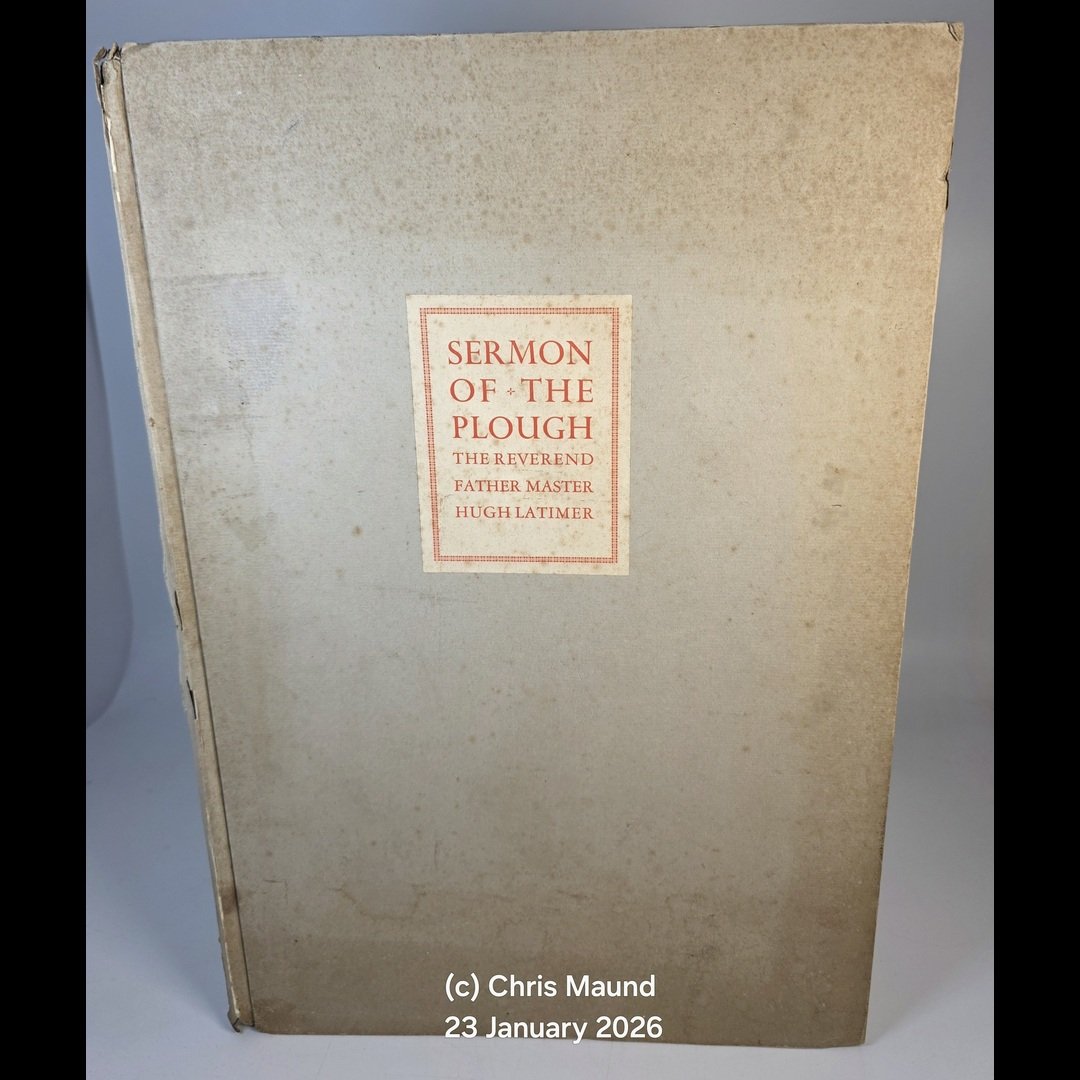 Image 1 of 9
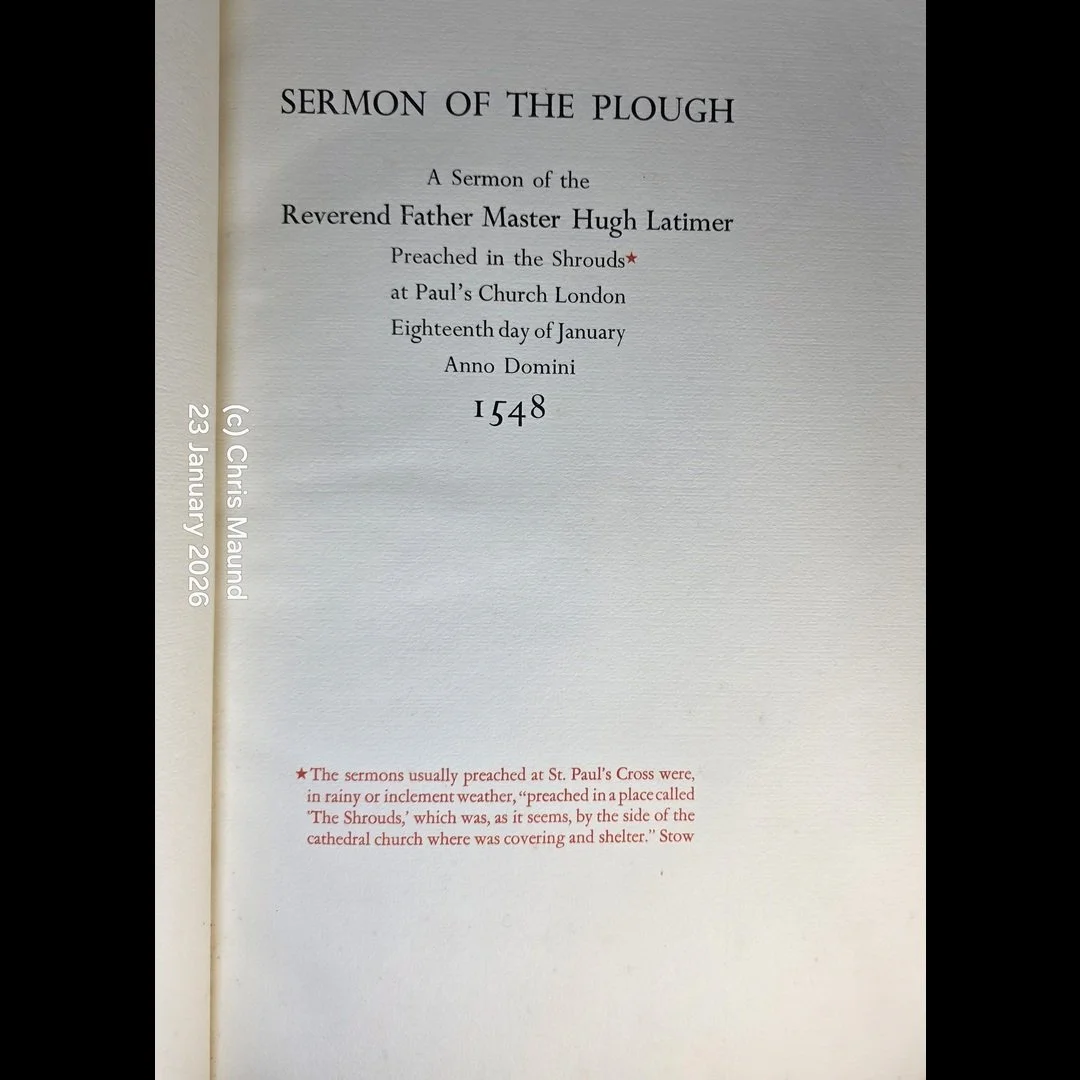 Image 3 of 9
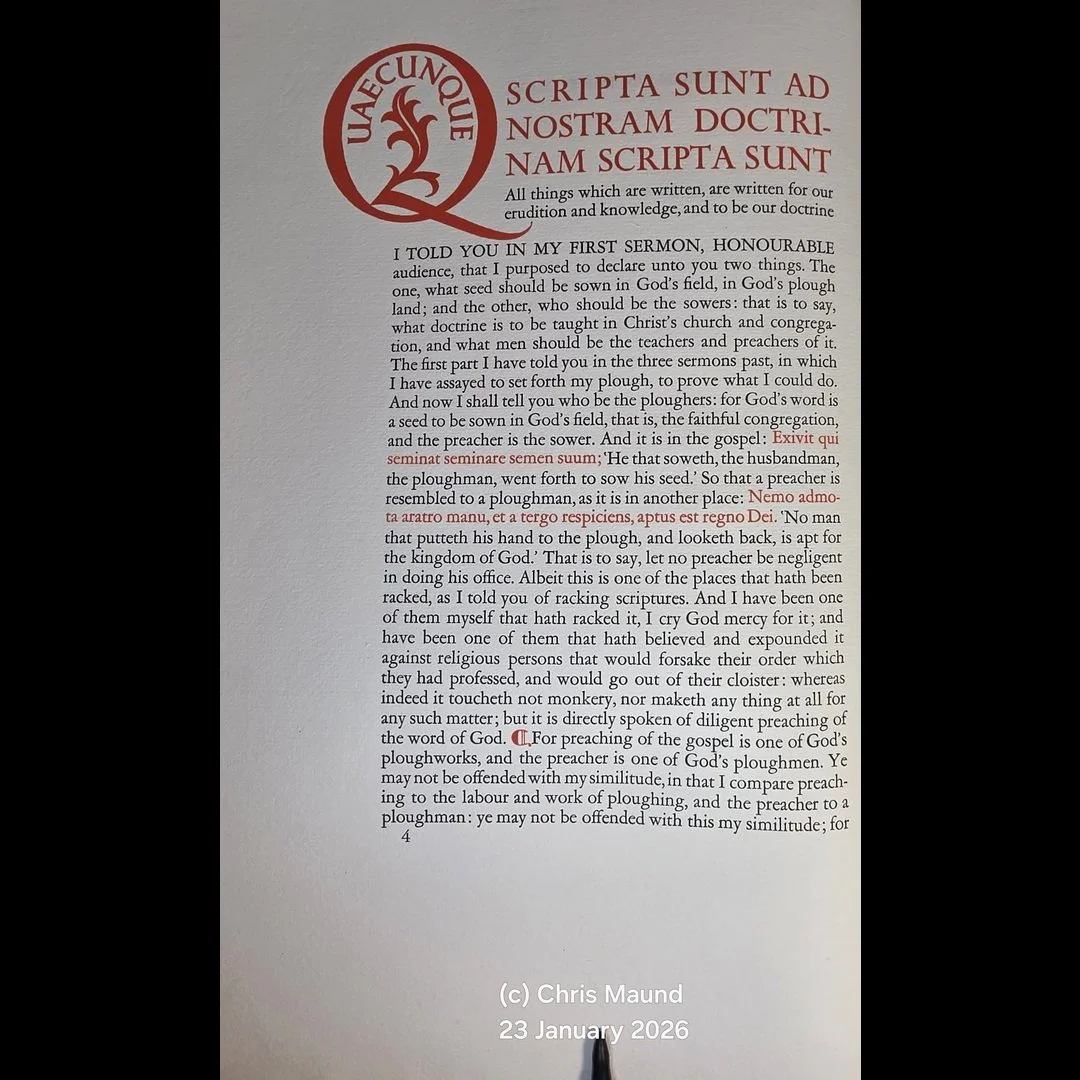 Image 4 of 9
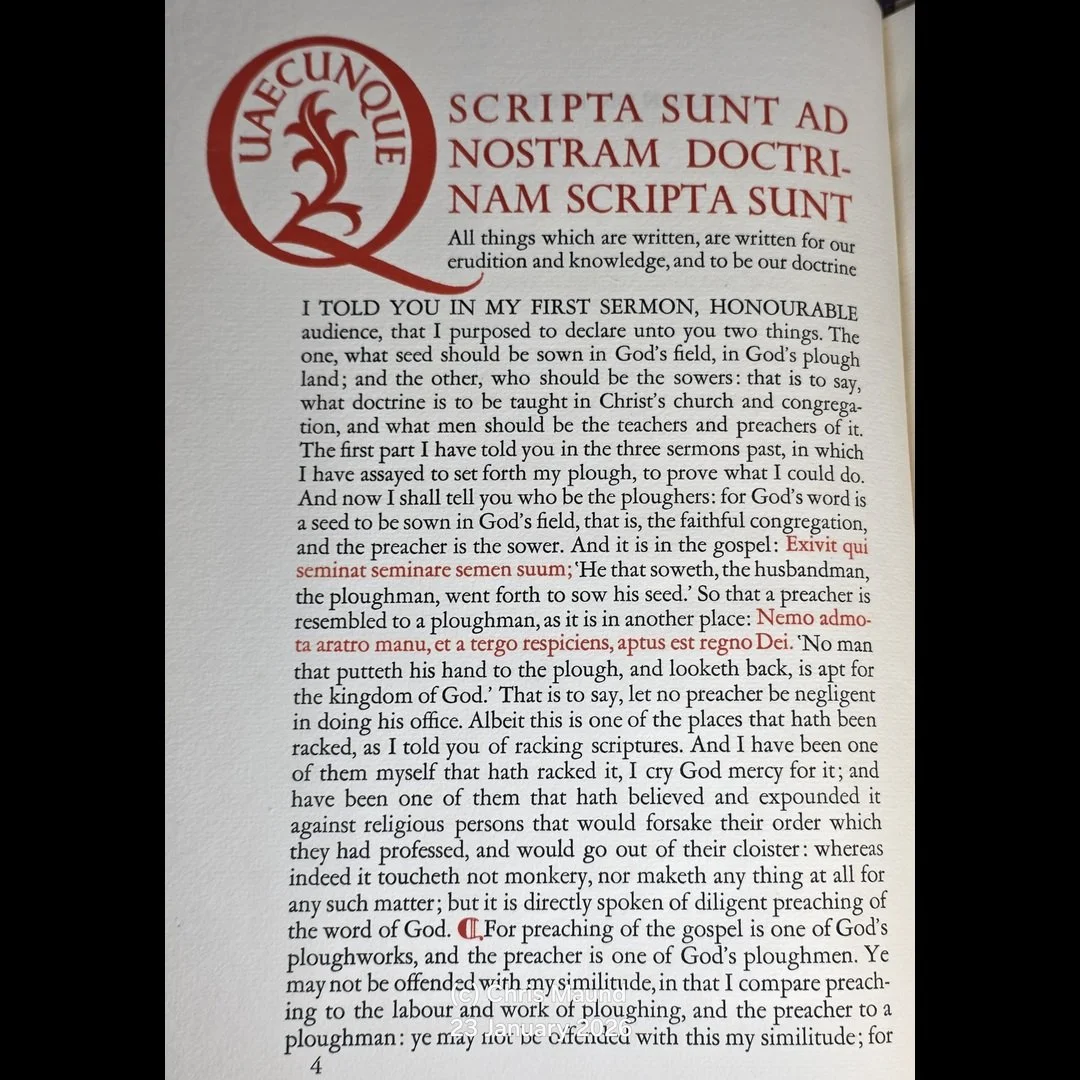 Image 5 of 9
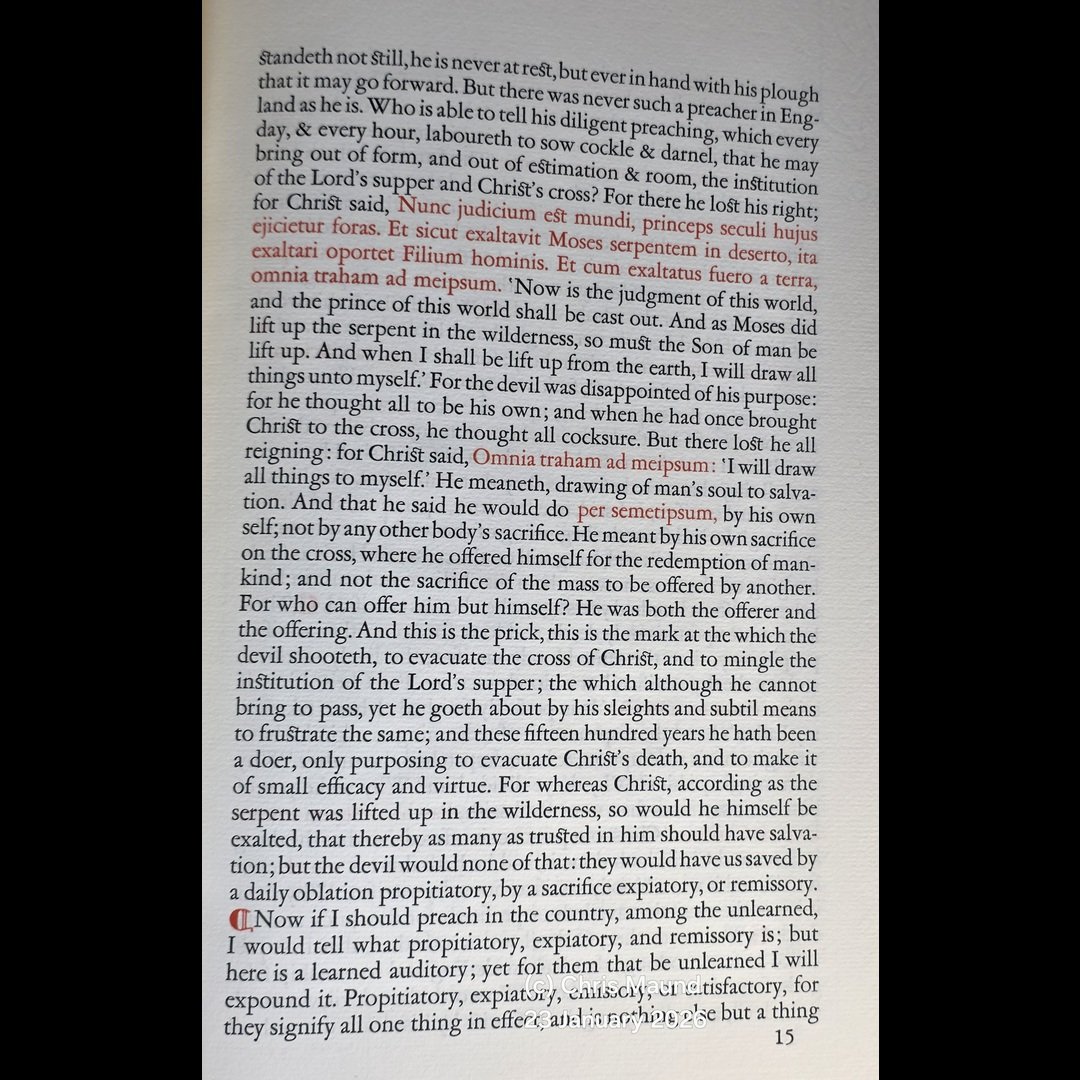 Image 6 of 9
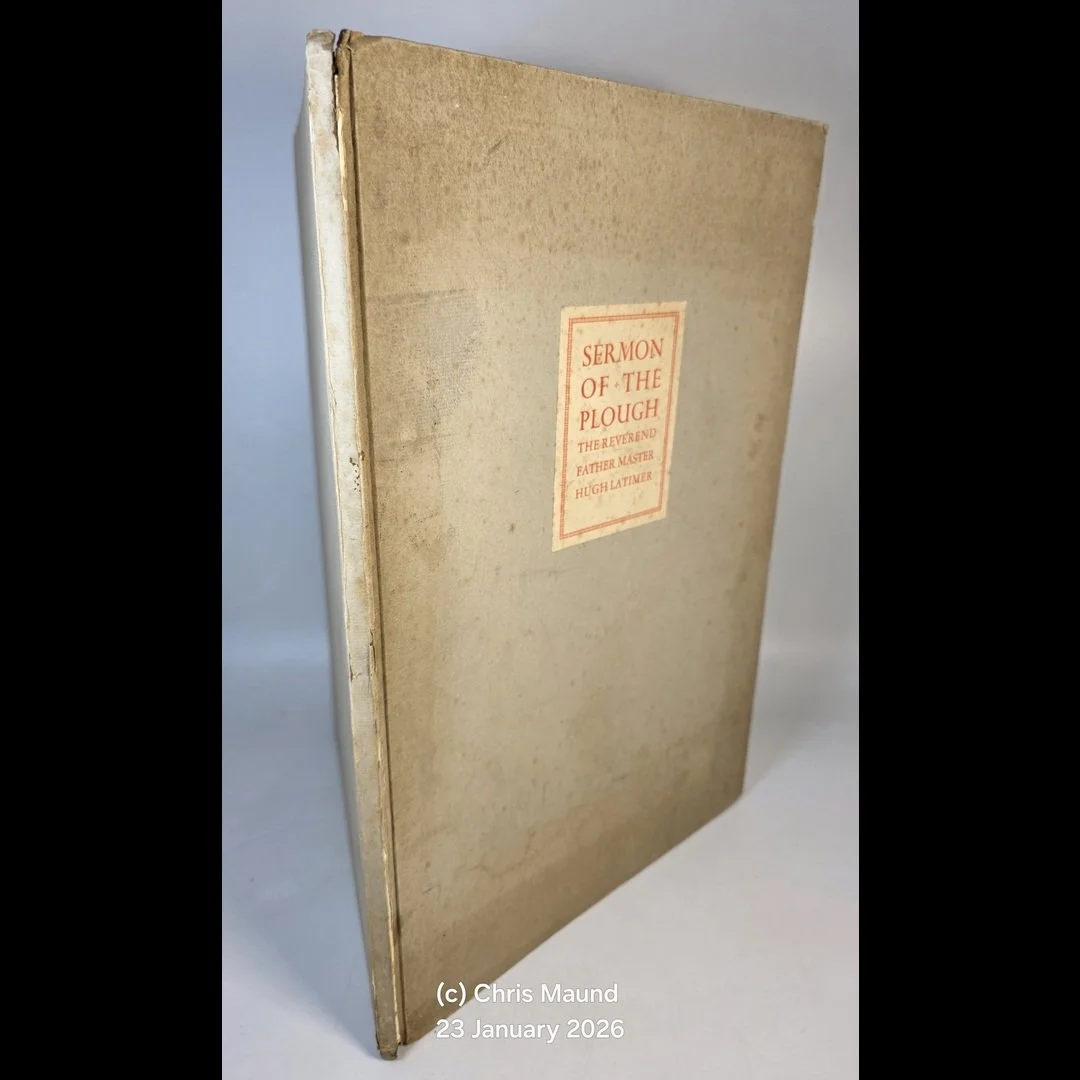 Image 7 of 9
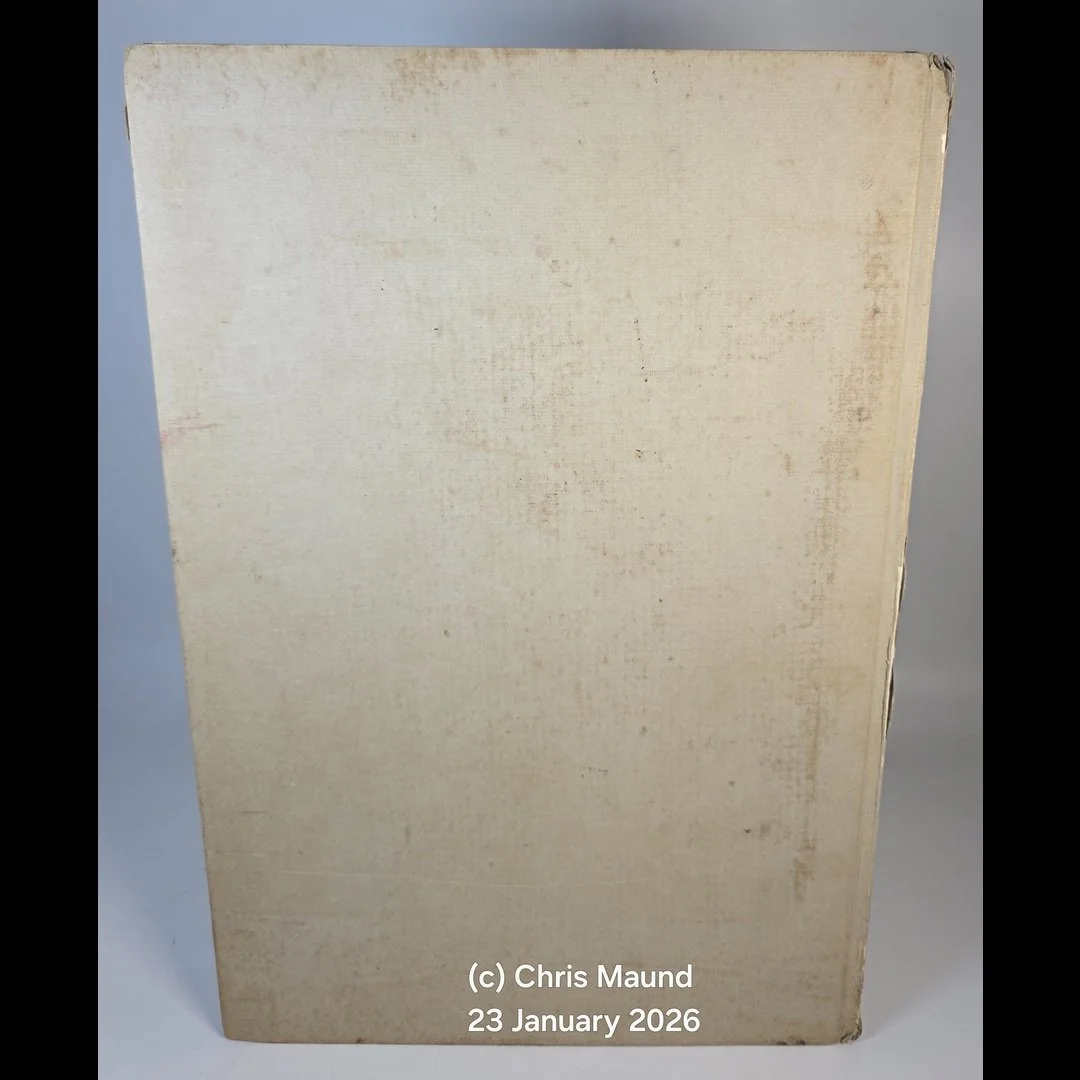 Image 8 of 9
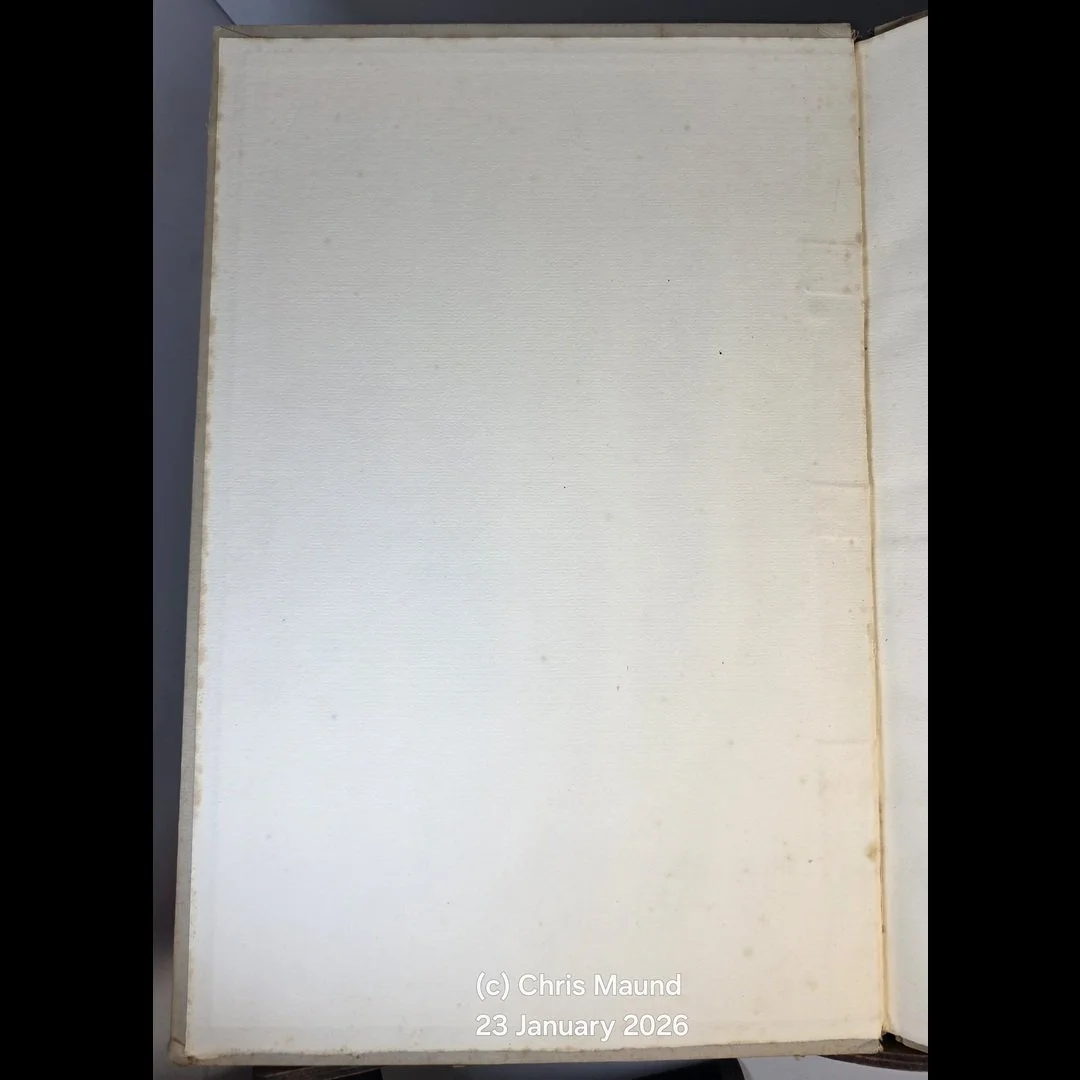 Image 9 of 9