1899 First Edition 1st Printing With Provenance
THE GREAT LAW
By William Williamson [William Scott-Elliot]
KEY DETAILS
Condition: Good
Format: Hardcover, Octavo (Standard) (8vo 6 × 9 in 152 × 229 mm )
Note: Binding/size selection follows standard bibliographic conventions and is approximate; exact measurements may vary.
Published By: Longmans, Green & Co, London, New York & Bombay, 1899
Language: English
Provenance: Hillingdon / Mills family library.
Collation: xx, 431 pp. Complete as called for.
SKU: BTETM0002618
Shipping Info: Approximate Package Dimensions H: 12.5, L: 30, W: 25 (Units: cm), W: 2Kg
Tracked Shipping, Insurance Coverage as per Customer Request
DESCRIPTION
The Great Law
A Study of Religious Origins and of the Unity Underlying Them
First edition of this substantial and increasingly scarce late-Victorian study of comparative religion and religious symbolism, published pseudonymously by the Scottish Theosophist William Scott-Elliot as “W. Williamson”.
The Great Law attempts to identify a common spiritual principle underlying the world's major religious traditions. Drawing upon Egyptian, Mesopotamian, Indian, Persian, Greek, Jewish and Christian material, Scott-Elliot examines recurring myths, rituals and symbols — among them sacred trinities, divine and miraculous births, death and resurrection, flood and ark traditions, solar symbolism, sacrifice, blood covenants, initiation and sacramental practice — as manifestations of what he regarded as a single underlying religious law.
The book occupies an interesting position between the developing nineteenth-century disciplines of comparative religion, mythology and folklore and the explicitly esoteric interpretation of religious history associated with the Theosophical movement. It appeared during a period of intense interest in supposed correspondences between ancient religions, when writers both within and outside occult circles were attempting to reconstruct the origins and development of religious belief from comparative mythology and ritual.
Although published simply under the name W. Williamson, the author was William Scott-Elliot (1849–1919), an early member of the London Lodge of the Theosophical Society and subsequently best known for The Story of Atlantis and The Lost Lemuria. His authorship of The Great Law is well established within contemporary and later Theosophical records.
The work attracted attention immediately within Theosophical circles. Annie Besant reviewed it in The Theosophical Review in October 1899, and another review appeared in The Theosophist that December. In the same year Scott-Elliot, identified as “W. Williamson”, was awarded the Theosophical Society's T. Subba Row Medal for The Great Law.
An appealing association copy in the original blue cloth, distinguished by its provenance from the library of the Mills family, Barons Hillingdon, with both an engraved armorial bookplate and a coroneted gilt ownership device to the upper board.
PROVENANCE
Hillingdon / Mills family library.
Engraved armorial bookplate to the front pastedown bearing the arms associated with Charles Henry Mills, 1st Baron Hillingdon (1830–1898): the Mills and Digby arms quartered and impaling Lascelles, beneath a baronial coronet, with supporters and the motto “Nil conscire sibi.”
The upper board is additionally blocked in gilt with a coroneted ownership cypher or device, giving the volume a particularly attractive and immediately visible association with the Hillingdon library.
Charles Henry Mills was a prominent nineteenth-century banker and politician, senior partner of Glyn, Mills, Currie & Co., and was created Baron Hillingdon in 1886. He died on 3 April 1898 and was succeeded by his eldest son, Charles William Mills, 2nd Baron Hillingdon.
As The Great Law was published in 1899, after the death of the 1st Baron, the armorial should not be interpreted as evidence that this particular volume was personally owned by Charles Henry Mills. Rather, its presence together with the coroneted gilt device indicates its continuation within the Mills/Hillingdon family library, where the earlier family armorial remained in use.
The Hillingdon library was substantial and included numerous books in fine and armorial bindings; a significant selection from it was dispersed by Sotheby's in 1932.
An attractive provenance for a work concerned with comparative religion and esotericism, and considerably more distinctive than the ordinary publisher's-cloth copies of the edition encountered on the market.
CONDITION, COLLATION & COPY NOTES
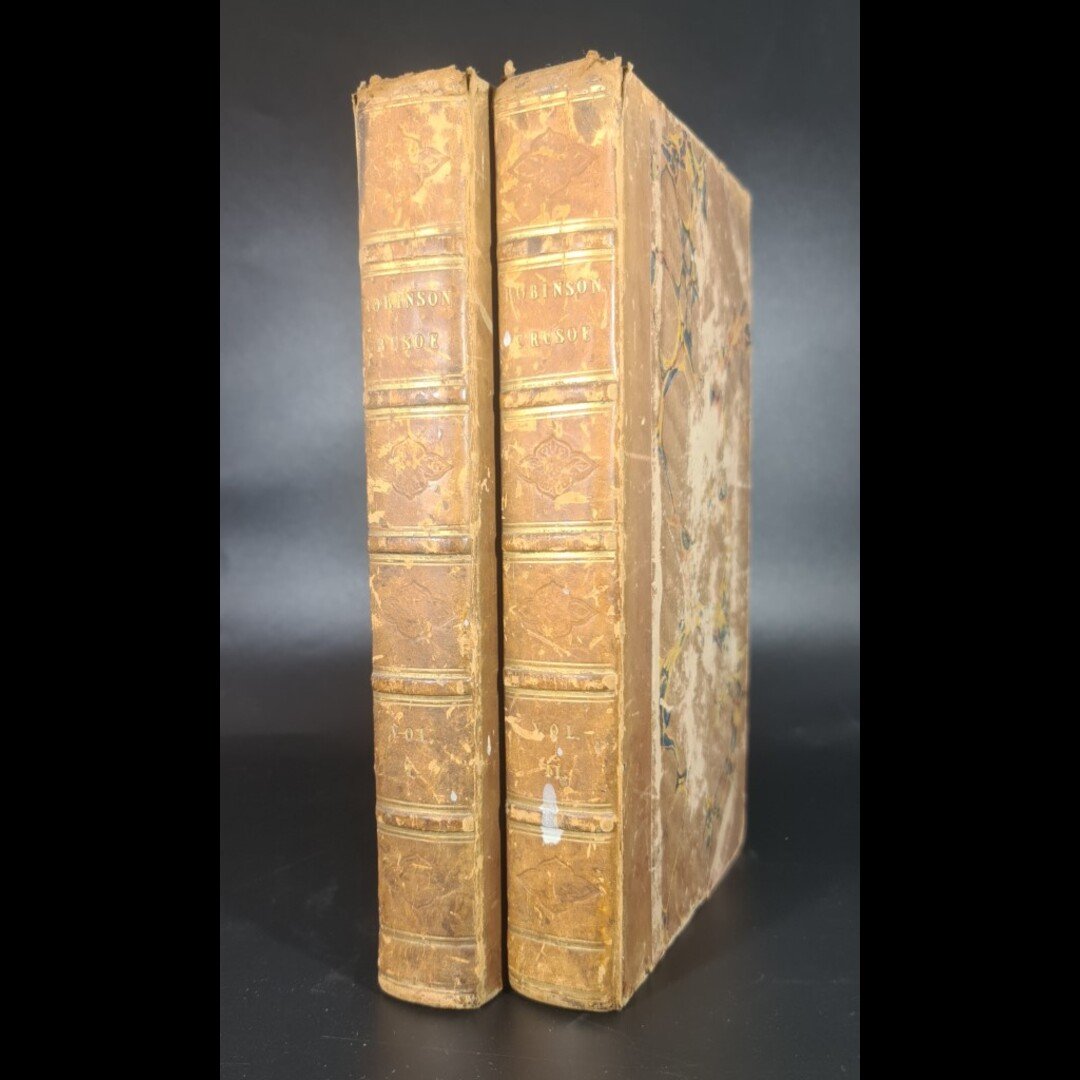
Publisher's original blue cloth, lettered in gilt, with coroneted gilt ownership device to the upper board. Binding generally sound, with rubbing, soiling and scuffing to the cloth, bumping and wear to the corners and extremities, and wear to the head and tail of the spine consistent with age and use.
Engraved Hillingdon/Mills armorial bookplate to the front pastedown.
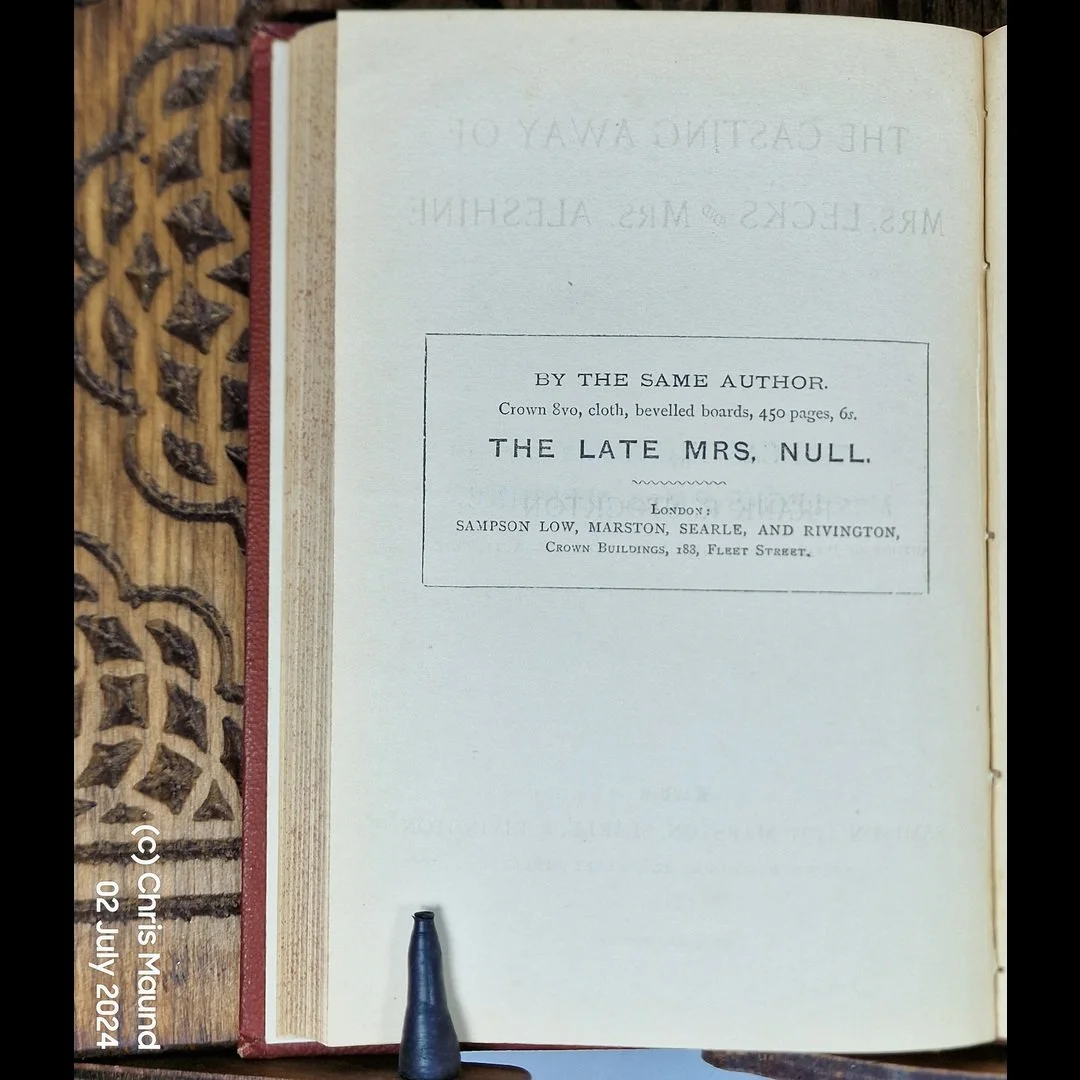
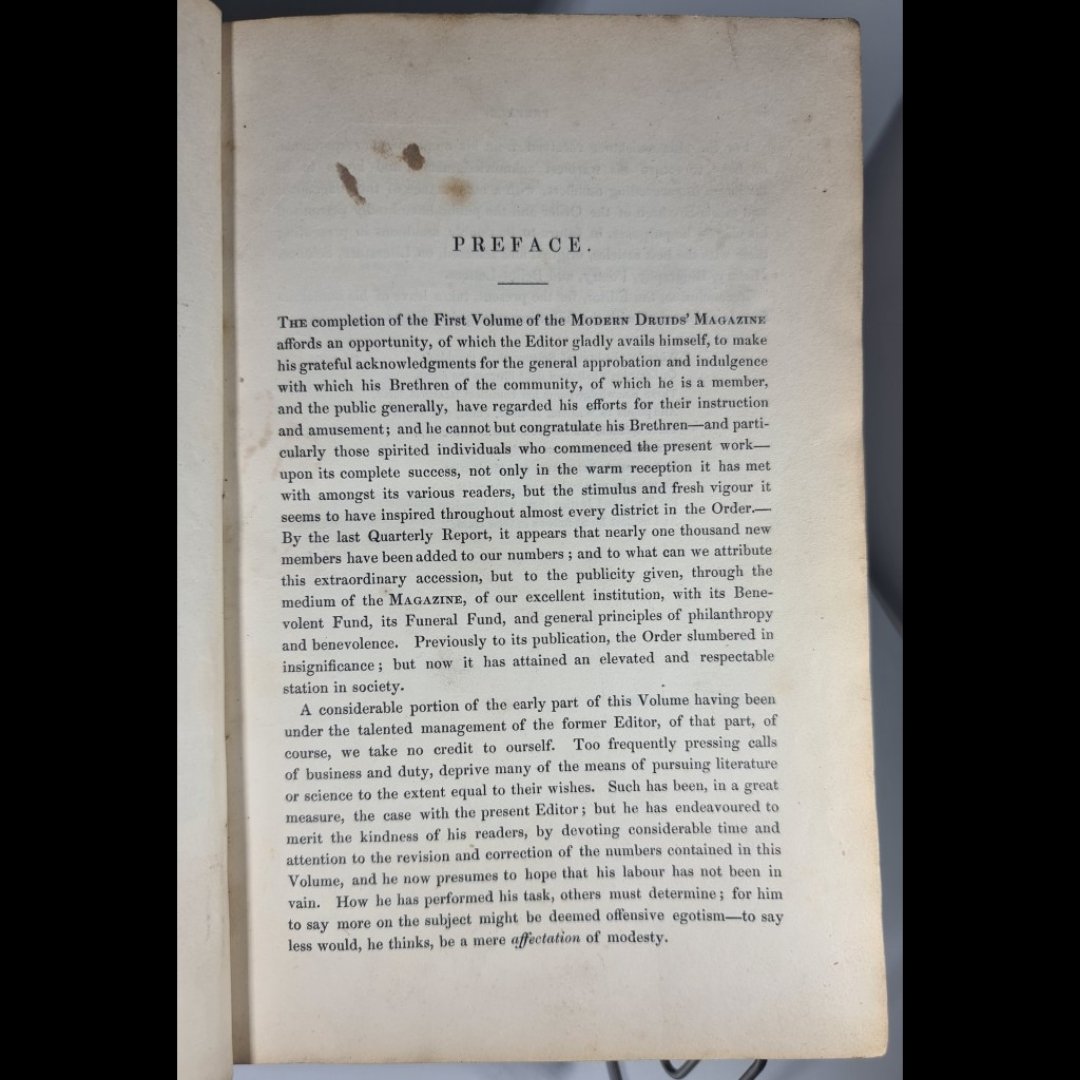
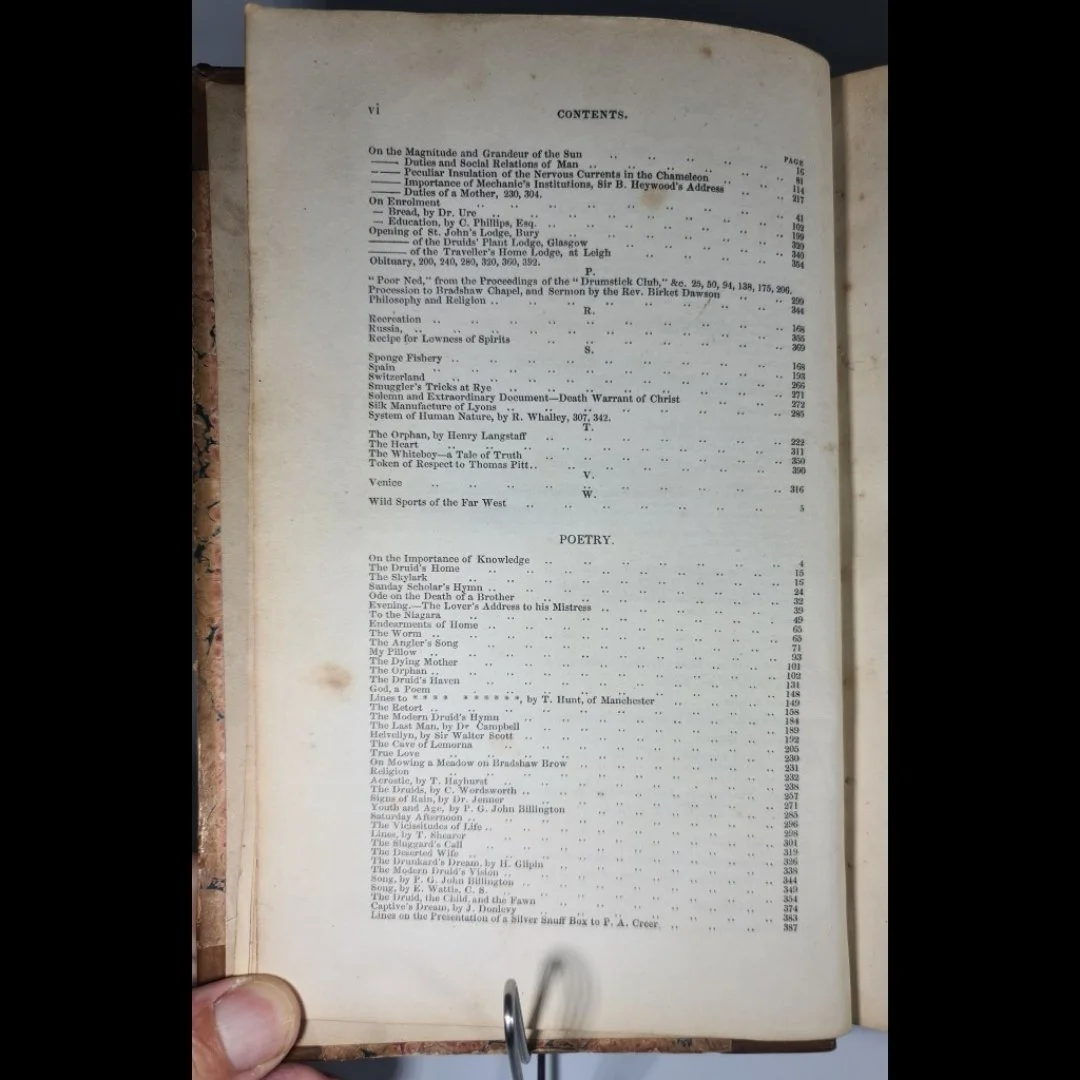
Edges uncut. Internally generally clean and well preserved, with occasional scattered spotting and minor signs of handling and age. No significant textual defect noted from the copy examined.
A sound and attractive copy, with the external wear offset by unusually interesting family-library provenance and the additional gilt ownership device to the binding.
Please see Photos as part of condition report.
REFERENCES
The Theosophical Review, Vol. XXV, October 1899, p. 186 — review of The Great Law by Annie Besant.
The Theosophist, Vol. XXI, December 1899, p. 175 — contemporary review of The Great Law.
C. Jinarājadāsa, The Golden Book of the Theosophical Society — record of the T. Subba Row Medal awarded in 1899 to “W. Scott-Elliot (W. Williamson), Author of The Great Law”.
British Armorial Bindings, Bibliographical Society — Charles Henry Mills, 1st Baron Hillingdon: Mills/Digby arms impaling Lascelles; motto Nil conscire sibi.
Theosophical Society Library catalogue — The Great Law, London, New York & Bombay: Longmans, Green & Co., 1899, xx, 431 pp.
Digitised copy available through the Internet Archive / Medical Heritage Library.
SYNOPSIS
The Great Law is an ambitious attempt to explain the similarities Scott-Elliot perceived across the religions and mythologies of widely separated cultures.
Beginning with symbolism and the recurring forms found within ancient religious traditions, the book examines such subjects as solar worship, divine birth, sacrificial death and resurrection, sacred trees and fires, flood narratives, arks, trinities, sacramental practices and systems of initiation. Scott-Elliot repeatedly sets examples from Christianity alongside Egyptian, Indian, Persian, Greek and other traditions, arguing that their structural similarities point towards something deeper than either coincidence or simple historical borrowing.
The argument develops into the proposition announced in the title: that behind the diversity of historical religions lies a single spiritual principle — the “Great Law” — expressed differently according to culture, period and stage of human development.
The result is characteristic of the intellectual borderland occupied by late nineteenth-century Theosophy. Contemporary anthropology, comparative mythology, Biblical criticism and the emerging academic study of religion are freely combined with esoteric interpretations of human history and spiritual evolution.
For the modern collector, the volume is therefore of interest not merely as a study of comparative religion, but as a document of the late-Victorian occult revival and of the attempt by Theosophical writers to reconcile contemporary scholarship with the idea of a primordial and universal religious tradition.
AUTHOR BIO
William Scott-Elliot (1849–1919) was a Scottish merchant banker, landowner and Theosophical writer, and an early member of the London Lodge of the Theosophical Society.
Writing in the intellectual environment created by Helena P. Blavatsky, A. P. Sinnett, Annie Besant and other leading figures of the Theosophical movement, Scott-Elliot became particularly associated with attempts to construct esoteric histories of humanity and of supposedly lost civilisations.
He is best remembered for The Story of Atlantis (1896) and The Lost Lemuria (1904), works which expanded upon Theosophical ideas concerning vanished continents, ancient races and spiritual evolution and which remained influential within occult literature throughout the twentieth century.
For The Great Law he adopted the pseudonym W. Williamson, under which the work was issued by the mainstream publishing house Longmans, Green & Co. Contemporary Theosophical records nevertheless identify Williamson as Scott-Elliot, and the connection was made explicit when he received the T. Subba Row Medal in 1899 for The Great Law.
In contrast to the geographical and speculative prehistory of his Atlantis and Lemuria books, The Great Law represents Scott-Elliot's sustained engagement with comparative religion, mythology and religious symbolism, and is consequently one of the more substantial and intellectually ambitious works associated with his Theosophical career.
1899 First Edition 1st Printing With Provenance
THE GREAT LAW
By William Williamson [William Scott-Elliot]
KEY DETAILS
Condition: Good
Format: Hardcover, Octavo (Standard) (8vo 6 × 9 in 152 × 229 mm )
Note: Binding/size selection follows standard bibliographic conventions and is approximate; exact measurements may vary.
Published By: Longmans, Green & Co, London, New York & Bombay, 1899
Language: English
Provenance: Hillingdon / Mills family library.
Collation: xx, 431 pp. Complete as called for.
SKU: BTETM0002618
Shipping Info: Approximate Package Dimensions H: 12.5, L: 30, W: 25 (Units: cm), W: 2Kg
Tracked Shipping, Insurance Coverage as per Customer Request
DESCRIPTION
The Great Law
A Study of Religious Origins and of the Unity Underlying Them
First edition of this substantial and increasingly scarce late-Victorian study of comparative religion and religious symbolism, published pseudonymously by the Scottish Theosophist William Scott-Elliot as “W. Williamson”.
The Great Law attempts to identify a common spiritual principle underlying the world's major religious traditions. Drawing upon Egyptian, Mesopotamian, Indian, Persian, Greek, Jewish and Christian material, Scott-Elliot examines recurring myths, rituals and symbols — among them sacred trinities, divine and miraculous births, death and resurrection, flood and ark traditions, solar symbolism, sacrifice, blood covenants, initiation and sacramental practice — as manifestations of what he regarded as a single underlying religious law.
The book occupies an interesting position between the developing nineteenth-century disciplines of comparative religion, mythology and folklore and the explicitly esoteric interpretation of religious history associated with the Theosophical movement. It appeared during a period of intense interest in supposed correspondences between ancient religions, when writers both within and outside occult circles were attempting to reconstruct the origins and development of religious belief from comparative mythology and ritual.
Although published simply under the name W. Williamson, the author was William Scott-Elliot (1849–1919), an early member of the London Lodge of the Theosophical Society and subsequently best known for The Story of Atlantis and The Lost Lemuria. His authorship of The Great Law is well established within contemporary and later Theosophical records.
The work attracted attention immediately within Theosophical circles. Annie Besant reviewed it in The Theosophical Review in October 1899, and another review appeared in The Theosophist that December. In the same year Scott-Elliot, identified as “W. Williamson”, was awarded the Theosophical Society's T. Subba Row Medal for The Great Law.
An appealing association copy in the original blue cloth, distinguished by its provenance from the library of the Mills family, Barons Hillingdon, with both an engraved armorial bookplate and a coroneted gilt ownership device to the upper board.
PROVENANCE
Hillingdon / Mills family library.
Engraved armorial bookplate to the front pastedown bearing the arms associated with Charles Henry Mills, 1st Baron Hillingdon (1830–1898): the Mills and Digby arms quartered and impaling Lascelles, beneath a baronial coronet, with supporters and the motto “Nil conscire sibi.”
The upper board is additionally blocked in gilt with a coroneted ownership cypher or device, giving the volume a particularly attractive and immediately visible association with the Hillingdon library.
Charles Henry Mills was a prominent nineteenth-century banker and politician, senior partner of Glyn, Mills, Currie & Co., and was created Baron Hillingdon in 1886. He died on 3 April 1898 and was succeeded by his eldest son, Charles William Mills, 2nd Baron Hillingdon.
As The Great Law was published in 1899, after the death of the 1st Baron, the armorial should not be interpreted as evidence that this particular volume was personally owned by Charles Henry Mills. Rather, its presence together with the coroneted gilt device indicates its continuation within the Mills/Hillingdon family library, where the earlier family armorial remained in use.
The Hillingdon library was substantial and included numerous books in fine and armorial bindings; a significant selection from it was dispersed by Sotheby's in 1932.
An attractive provenance for a work concerned with comparative religion and esotericism, and considerably more distinctive than the ordinary publisher's-cloth copies of the edition encountered on the market.
CONDITION, COLLATION & COPY NOTES
Publisher's original blue cloth, lettered in gilt, with coroneted gilt ownership device to the upper board. Binding generally sound, with rubbing, soiling and scuffing to the cloth, bumping and wear to the corners and extremities, and wear to the head and tail of the spine consistent with age and use.
Engraved Hillingdon/Mills armorial bookplate to the front pastedown.
Edges uncut. Internally generally clean and well preserved, with occasional scattered spotting and minor signs of handling and age. No significant textual defect noted from the copy examined.
A sound and attractive copy, with the external wear offset by unusually interesting family-library provenance and the additional gilt ownership device to the binding.
Please see Photos as part of condition report.
REFERENCES
The Theosophical Review, Vol. XXV, October 1899, p. 186 — review of The Great Law by Annie Besant.
The Theosophist, Vol. XXI, December 1899, p. 175 — contemporary review of The Great Law.
C. Jinarājadāsa, The Golden Book of the Theosophical Society — record of the T. Subba Row Medal awarded in 1899 to “W. Scott-Elliot (W. Williamson), Author of The Great Law”.
British Armorial Bindings, Bibliographical Society — Charles Henry Mills, 1st Baron Hillingdon: Mills/Digby arms impaling Lascelles; motto Nil conscire sibi.
Theosophical Society Library catalogue — The Great Law, London, New York & Bombay: Longmans, Green & Co., 1899, xx, 431 pp.
Digitised copy available through the Internet Archive / Medical Heritage Library.
SYNOPSIS
The Great Law is an ambitious attempt to explain the similarities Scott-Elliot perceived across the religions and mythologies of widely separated cultures.
Beginning with symbolism and the recurring forms found within ancient religious traditions, the book examines such subjects as solar worship, divine birth, sacrificial death and resurrection, sacred trees and fires, flood narratives, arks, trinities, sacramental practices and systems of initiation. Scott-Elliot repeatedly sets examples from Christianity alongside Egyptian, Indian, Persian, Greek and other traditions, arguing that their structural similarities point towards something deeper than either coincidence or simple historical borrowing.
The argument develops into the proposition announced in the title: that behind the diversity of historical religions lies a single spiritual principle — the “Great Law” — expressed differently according to culture, period and stage of human development.
The result is characteristic of the intellectual borderland occupied by late nineteenth-century Theosophy. Contemporary anthropology, comparative mythology, Biblical criticism and the emerging academic study of religion are freely combined with esoteric interpretations of human history and spiritual evolution.
For the modern collector, the volume is therefore of interest not merely as a study of comparative religion, but as a document of the late-Victorian occult revival and of the attempt by Theosophical writers to reconcile contemporary scholarship with the idea of a primordial and universal religious tradition.
AUTHOR BIO
William Scott-Elliot (1849–1919) was a Scottish merchant banker, landowner and Theosophical writer, and an early member of the London Lodge of the Theosophical Society.
Writing in the intellectual environment created by Helena P. Blavatsky, A. P. Sinnett, Annie Besant and other leading figures of the Theosophical movement, Scott-Elliot became particularly associated with attempts to construct esoteric histories of humanity and of supposedly lost civilisations.
He is best remembered for The Story of Atlantis (1896) and The Lost Lemuria (1904), works which expanded upon Theosophical ideas concerning vanished continents, ancient races and spiritual evolution and which remained influential within occult literature throughout the twentieth century.
For The Great Law he adopted the pseudonym W. Williamson, under which the work was issued by the mainstream publishing house Longmans, Green & Co. Contemporary Theosophical records nevertheless identify Williamson as Scott-Elliot, and the connection was made explicit when he received the T. Subba Row Medal in 1899 for The Great Law.
In contrast to the geographical and speculative prehistory of his Atlantis and Lemuria books, The Great Law represents Scott-Elliot's sustained engagement with comparative religion, mythology and religious symbolism, and is consequently one of the more substantial and intellectually ambitious works associated with his Theosophical career.

 Image 1 of 25
 Image 2 of 25
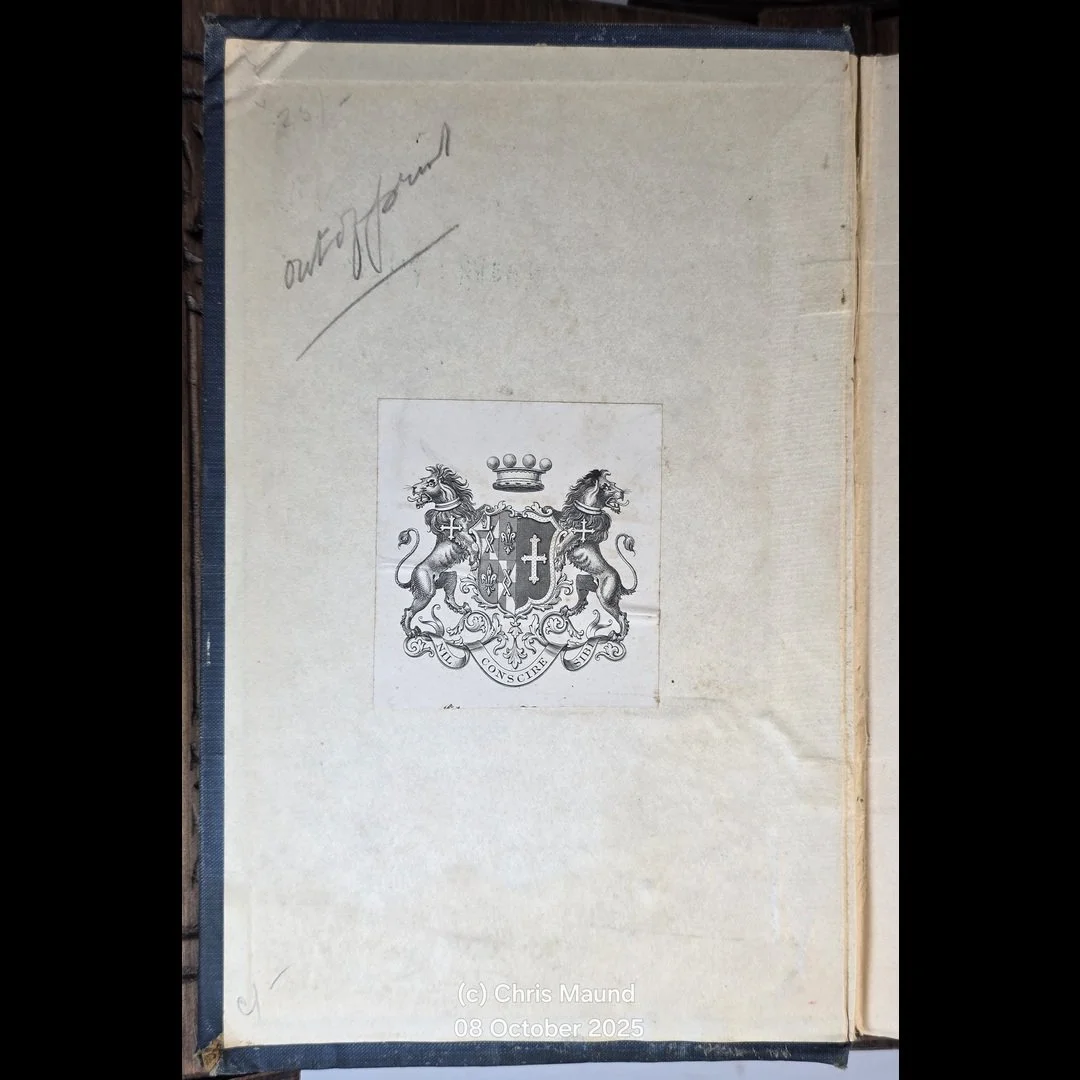 Image 3 of 25
 Image 4 of 25
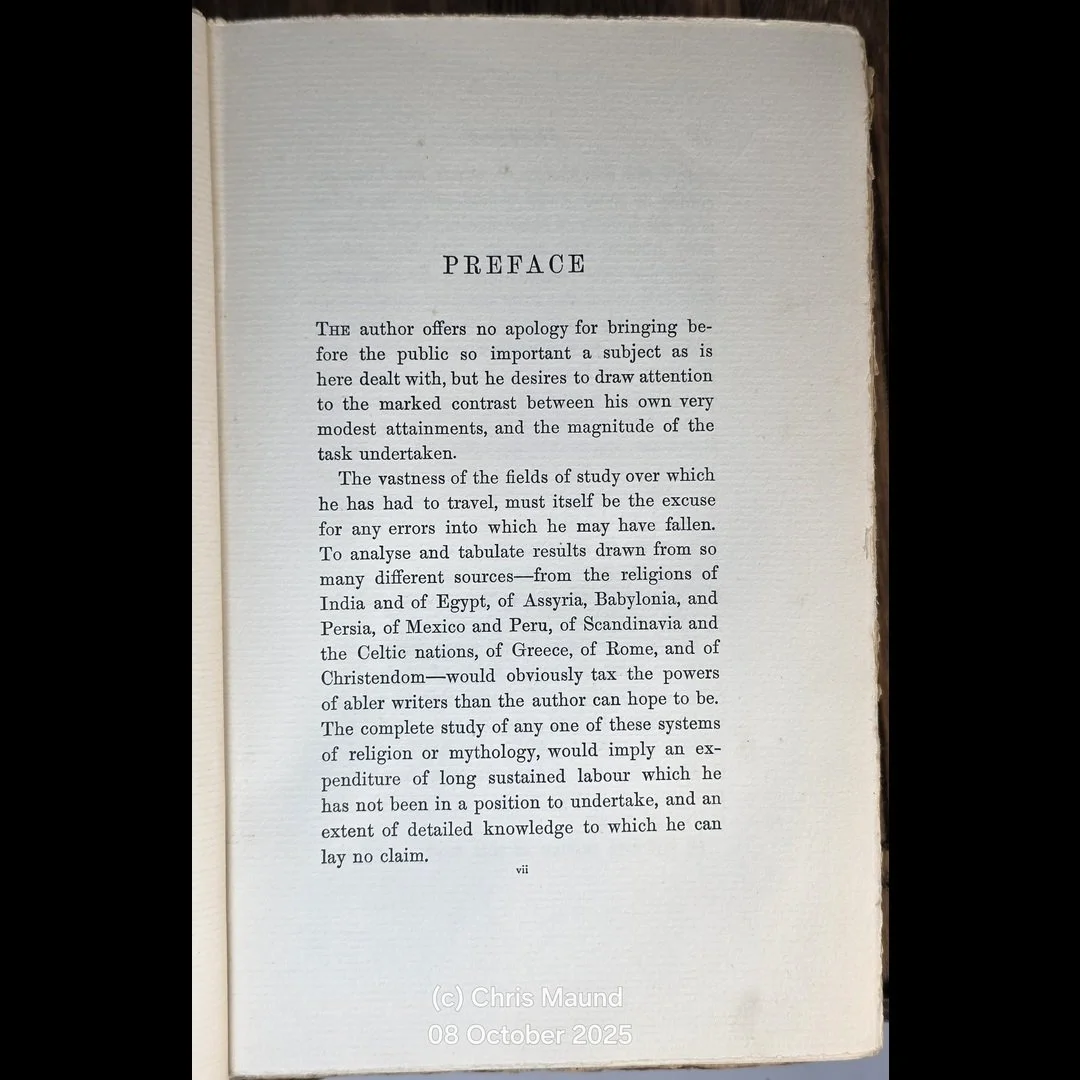 Image 5 of 25
 Image 6 of 25
 Image 7 of 25
 Image 8 of 25
 Image 9 of 25
 Image 10 of 25
 Image 11 of 25
 Image 12 of 25
 Image 13 of 25
 Image 14 of 25
 Image 15 of 25
 Image 16 of 25
 Image 17 of 25
 Image 18 of 25
 Image 19 of 25
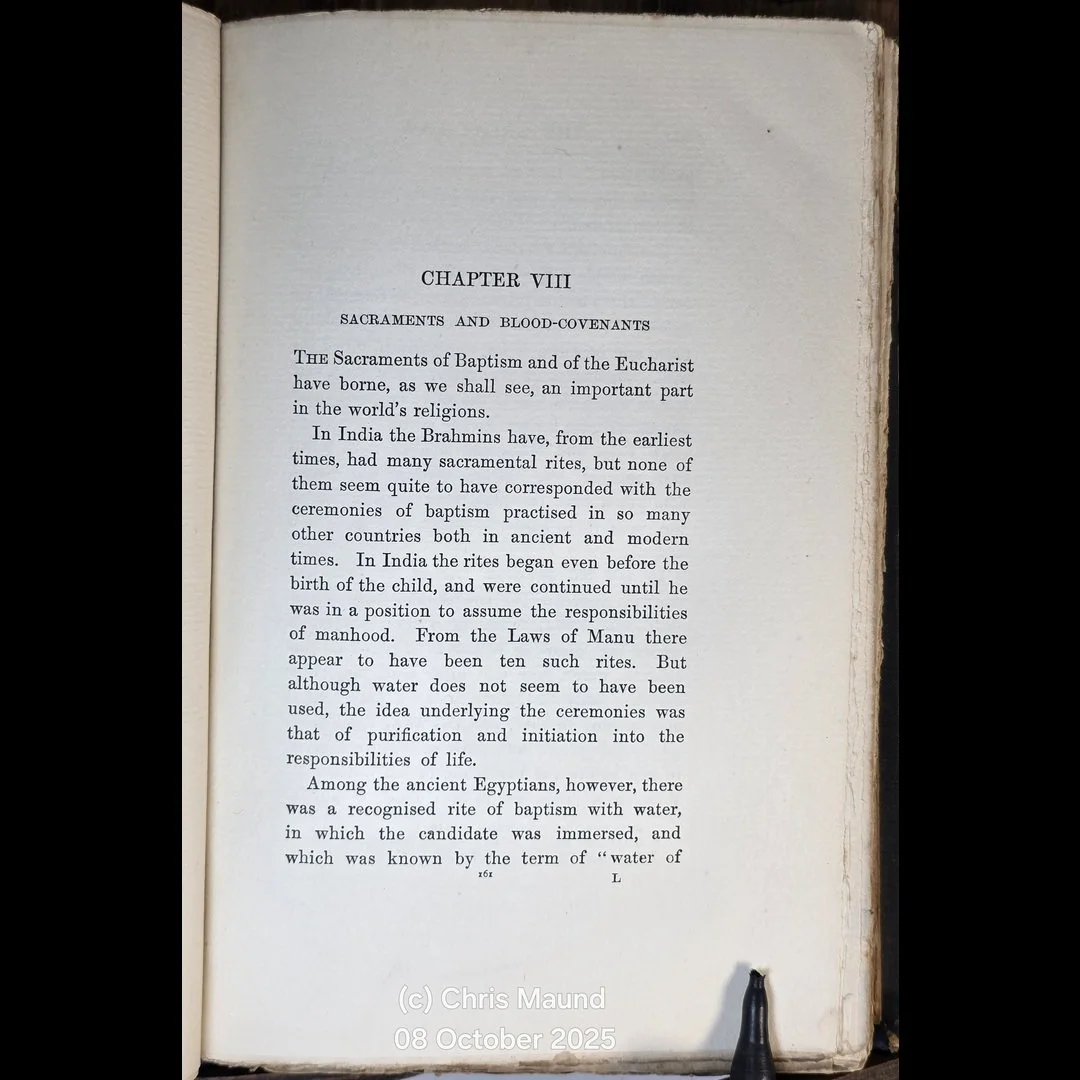 Image 20 of 25
 Image 21 of 25
 Image 22 of 25
 Image 23 of 25
 Image 24 of 25
 Image 25 of 25