1574 First Bilingual (Latin-French) Edition
ORI APOLLINIS NILIACI
By Horapollo
KEY DETAILS
Condition: Very Good
Format: Vellum, Contemporary or near-contemporary blind-tooled vellum over boards, 8vo, approximately 151 × 98 mm
Published By: Apud Galeotum à Prato, & Ioannem Ruellium, Via Iacobaea, Paris, 1574
Language: Latin/French
Illustrated By: Jehan (Jean) Cousin the Elder and Jean Goujon
Provenance: The volume contains a group of early ownership and accounting inscriptions which remain under investigation.
Collation: *⁸ A–N⁸ O⁴
Dust Jacket: None, as issued, No Jacket
SKU: BTETM0002619
Shipping Info: Approximate Package Dimensions H: 12.5, L: 30, W: 25 (Units: cm), W: 2Kg
Tracked Shipping, Insurance Coverage as per Customer Request
DESCRIPTION
ORI APOLLINIS NILIACI
ORI APOLLINIS NILIACI, DE SACRIS AEGYPTIORUM NOTIS, AEGYPTIACÈ EXPRESSIS LIBRI DUO, ICONIBUS ILLUSTRATI, & AUCTI
By Horapollo
Illustrated with 193 Renaissance woodcuts traditionally attributed to Jean Cousin the Elder and Jean Goujon
A particularly attractive and complete copy of the scarce 1574 Paris Horapollo, one of the most important illustrated books in the Renaissance reception of Egyptian hieroglyphs and a major source for the developing emblematic tradition.
Printed in parallel Latin and French, this edition presents the Hieroglyphica of Horapollo in the Latin translation traditionally associated with Bernardino Trebatius alongside an anonymous French version. It is generally regarded as the first edition to present the work in parallel Latin and French, although Christie’s more cautiously describes it as the “first(?) edition” of this anonymous French translation with parallel Latin text.
The work is illustrated with 193 woodcut emblems, each set within ornamental typographical borders, depicting animals, birds, human figures, plants, celestial and mythological subjects, implements and symbolic forms. These images derive from the celebrated woodcut cycle first used for Jacques Kerver’s 1543 French edition.
The illustrations have traditionally been attributed to Jean Cousin the Elder and Jean Goujon. Modern scholarship has treated the attribution with greater caution, and Baptiste Pellerin has also been proposed as a possible designer. The decorated title-page border itself is attributed to Cousin in the Folger catalogue.
The Latin and French text is arranged in parallel columns, making the symbolic interpretations immediately accessible to a Renaissance reader. The two books are followed by the additional material or Appendix ad veterem codicem, also present in this copy.
Of particular appeal is the survival of the volume in an early blind-tooled vellum binding, its boards decorated with ruled panels and ornamental centrepieces, retaining considerable period character. Together with its early inscriptions, account notations and complete suite of illustrations, this is a copy with considerably more historical individuality than examples rebound in later collector’s morocco.
PROVENANCE
The volume contains a group of early ownership and accounting inscriptions which remain under investigation.
An early inscription to the front flyleaf includes a repeated word which appears to read “Delvany” or a closely related spelling. The same or very similar word appears again amongst inscriptions at the rear.
This reading is of potential interest because Dalvany in Glenisla, Scotland, appears in sixteenth-century documentary records under numerous variant spellings. The National Records of Scotland records, for example, a 1565 transaction involving “Mr. Nicol Campbell of Dolwayne”, within the archive relating to the lands of Craigneatie and Dalvany. The similarity is intriguing but no connection between this book and Nicol Campbell, his family, or the Dalvany estate has yet been established, and the inscription should therefore presently be regarded as unidentified.
Further inscriptions to the rear include the clearly written words “Außgab” and “Summa”, accompanied by calculations and cancelled figures. These appear to represent an early accounting or expenditure memorandum, perhaps connected with the acquisition or ownership history of the volume. Portions of the accompanying German or German-Latin text remain only partially legible.
The title page also bears a very faint early inscription, apparently partially erased or faded.
Research into the inscriptions and possible provenance is continuing.
CONDITION, COLLATION & COPY NOTES
An attractive and substantially well-preserved copy in early vellum over boards, panelled in blind with ornamental centrepieces. Binding rubbed, darkened and spotted from age and use, with wear and small losses at the head and foot of the spine and at the extremities. Old manuscript title to spine. Despite the external wear, the binding remains firm and possesses considerable period character.
Internally very good. Paper generally strong with occasional age-toning, scattered browning and spotting, light staining and minor handling marks. A faint tide-mark is visible towards the upper portion of the title page. Occasional small early repairs or marginal defects, but without significant loss affecting the principal text or illustrations.
The woodcuts are generally strong, dark and well-defined, retaining excellent visual impact.
Early ink inscriptions and pen-work to the front and rear endpapers and title page as described under Provenance, including early accounting calculations to the rear.
Latin and French printed in parallel columns.
The tables to Books I and II are present in the preliminary leaves. Book II begins at numbered leaf 43. The Appendix and concluding FINIS are present.
Please see Photos as part of condition report.
REFERENCES
Adams H-852
Landwehr, Romanic Emblem Books, 389
Mortimer, Harvard College Library, French 16th Century Books, 316
BM STC French Books 1470–1600, p. 230
Fairfax Murray, French, 283
Praz, Studies in Seventeenth-Century Imagery
Folger Shakespeare Library, PJ1091 .L3 1574 Cage
SYNOPSIS
The Hieroglyphica is one of the most influential texts in the Western history of Egyptian symbolism.
Attributed to Horapollo, an Egyptian author traditionally placed in late antiquity, the work consists of two books interpreting Egyptian hieroglyphs and symbolic images. Rather than treating hieroglyphs primarily as elements of a phonetic writing system, Horapollo presents them as visual expressions of concepts, qualities and ideas.
Animals, plants, celestial bodies and human forms consequently become symbols: the lion, serpent, ibis, hawk, crocodile and many other figures are interpreted according to supposed properties of their appearance, behaviour or relationship with the natural world.
Although many of Horapollo’s explanations are fanciful by modern Egyptological standards, the work also preserves material which appears to derive from genuine Egyptian hieroglyphic traditions.
The Hieroglyphica acquired extraordinary importance after its rediscovery in the early fifteenth century. The Greek text was first printed by Aldus Manutius in 1505, and during the sixteenth century the work became fundamental to the Renaissance fascination with hieroglyphs as a supposedly universal language of symbols.
Its influence extended well beyond Egyptology. Horapollo contributed to the development of the Renaissance emblem book and to the symbolic vocabulary employed in painting, architecture, courtly pageantry, allegory and learned visual culture.
The Paris editions transformed the text particularly effectively by combining Horapollo’s descriptions with extensive woodcut illustration. The first French illustrated edition appeared in 1543; the present 1574 edition brings Latin and French together in parallel text and reuses the celebrated Parisian woodcut tradition, placing the ancient text firmly within the visual world of the Renaissance emblem book.
For collectors of emblem books, early Egyptology, Renaissance symbolism, iconography and the history of esoteric thought, Horapollo occupies a particularly important position: it stands at the point where the surviving intellectual traditions of ancient Egypt were transformed into one of the great symbolic languages of Renaissance Europe.
AUTHOR BIO
Horapollo, or Horus Apollo, is the name traditionally associated with the Hieroglyphica, a treatise on Egyptian hieroglyphic symbolism usually connected with an Egyptian grammarian of late antiquity.
The precise identity of the author — and whether both books of the Hieroglyphica originated with the same writer — remains uncertain. The surviving work is in Greek, although it reflects an Egyptian cultural and intellectual background.
After its rediscovery in the early fifteenth century, the Hieroglyphica became one of the principal sources through which Renaissance scholars and artists attempted to understand the symbolic writing of ancient Egypt.
Although Champollion’s nineteenth-century decipherment would ultimately demonstrate that Egyptian hieroglyphs operated very differently from the Renaissance conception of them, Horapollo’s influence on European art and intellectual history had by then been profound.
ILLUSTRATOR
Jehan (Jean) Cousin the Elder and Jean Goujon
Traditionally attributed to Jean Cousin the Elder and Jean Goujon; attribution remains debated
The 193 woodcuts in this edition derive from the influential Parisian series originally created for the 1543 French Horapollo.
The designs have traditionally been divided between Jean Cousin the Elder and Jean Goujon, two of the leading artistic figures of the French Renaissance. This attribution has a long bibliographical history but is not secure.
More recent scholarship has proposed Baptiste Pellerin as a possible designer for at least part of the series. Sotheby’s notes that the traditional Cousin/Goujon attribution remains uncertain and specifically records the more recent arguments in favour of Pellerin.
Whoever was responsible for them, the illustrations rank amongst the most memorable products of sixteenth-century French emblematic book illustration, combining classical, biblical, natural-historical and fantastical imagery into a visual vocabulary ideally suited to Horapollo’s symbolic text.
The elaborate illustrated title-page border is separately attributed to Jean Cousin by the Folger Shakespeare Library.
1574 First Bilingual (Latin-French) Edition
ORI APOLLINIS NILIACI
By Horapollo
KEY DETAILS
Condition: Very Good
Format: Vellum, Contemporary or near-contemporary blind-tooled vellum over boards, 8vo, approximately 151 × 98 mm
Published By: Apud Galeotum à Prato, & Ioannem Ruellium, Via Iacobaea, Paris, 1574
Language: Latin/French
Illustrated By: Jehan (Jean) Cousin the Elder and Jean Goujon
Provenance: The volume contains a group of early ownership and accounting inscriptions which remain under investigation.
Collation: *⁸ A–N⁸ O⁴
Dust Jacket: None, as issued, No Jacket
SKU: BTETM0002619
Shipping Info: Approximate Package Dimensions H: 12.5, L: 30, W: 25 (Units: cm), W: 2Kg
Tracked Shipping, Insurance Coverage as per Customer Request
DESCRIPTION
ORI APOLLINIS NILIACI
ORI APOLLINIS NILIACI, DE SACRIS AEGYPTIORUM NOTIS, AEGYPTIACÈ EXPRESSIS LIBRI DUO, ICONIBUS ILLUSTRATI, & AUCTI
By Horapollo
Illustrated with 193 Renaissance woodcuts traditionally attributed to Jean Cousin the Elder and Jean Goujon
A particularly attractive and complete copy of the scarce 1574 Paris Horapollo, one of the most important illustrated books in the Renaissance reception of Egyptian hieroglyphs and a major source for the developing emblematic tradition.
Printed in parallel Latin and French, this edition presents the Hieroglyphica of Horapollo in the Latin translation traditionally associated with Bernardino Trebatius alongside an anonymous French version. It is generally regarded as the first edition to present the work in parallel Latin and French, although Christie’s more cautiously describes it as the “first(?) edition” of this anonymous French translation with parallel Latin text.
The work is illustrated with 193 woodcut emblems, each set within ornamental typographical borders, depicting animals, birds, human figures, plants, celestial and mythological subjects, implements and symbolic forms. These images derive from the celebrated woodcut cycle first used for Jacques Kerver’s 1543 French edition.
The illustrations have traditionally been attributed to Jean Cousin the Elder and Jean Goujon. Modern scholarship has treated the attribution with greater caution, and Baptiste Pellerin has also been proposed as a possible designer. The decorated title-page border itself is attributed to Cousin in the Folger catalogue.
The Latin and French text is arranged in parallel columns, making the symbolic interpretations immediately accessible to a Renaissance reader. The two books are followed by the additional material or Appendix ad veterem codicem, also present in this copy.
Of particular appeal is the survival of the volume in an early blind-tooled vellum binding, its boards decorated with ruled panels and ornamental centrepieces, retaining considerable period character. Together with its early inscriptions, account notations and complete suite of illustrations, this is a copy with considerably more historical individuality than examples rebound in later collector’s morocco.
PROVENANCE
The volume contains a group of early ownership and accounting inscriptions which remain under investigation.
An early inscription to the front flyleaf includes a repeated word which appears to read “Delvany” or a closely related spelling. The same or very similar word appears again amongst inscriptions at the rear.
This reading is of potential interest because Dalvany in Glenisla, Scotland, appears in sixteenth-century documentary records under numerous variant spellings. The National Records of Scotland records, for example, a 1565 transaction involving “Mr. Nicol Campbell of Dolwayne”, within the archive relating to the lands of Craigneatie and Dalvany. The similarity is intriguing but no connection between this book and Nicol Campbell, his family, or the Dalvany estate has yet been established, and the inscription should therefore presently be regarded as unidentified.
Further inscriptions to the rear include the clearly written words “Außgab” and “Summa”, accompanied by calculations and cancelled figures. These appear to represent an early accounting or expenditure memorandum, perhaps connected with the acquisition or ownership history of the volume. Portions of the accompanying German or German-Latin text remain only partially legible.
The title page also bears a very faint early inscription, apparently partially erased or faded.
Research into the inscriptions and possible provenance is continuing.
CONDITION, COLLATION & COPY NOTES
An attractive and substantially well-preserved copy in early vellum over boards, panelled in blind with ornamental centrepieces. Binding rubbed, darkened and spotted from age and use, with wear and small losses at the head and foot of the spine and at the extremities. Old manuscript title to spine. Despite the external wear, the binding remains firm and possesses considerable period character.
Internally very good. Paper generally strong with occasional age-toning, scattered browning and spotting, light staining and minor handling marks. A faint tide-mark is visible towards the upper portion of the title page. Occasional small early repairs or marginal defects, but without significant loss affecting the principal text or illustrations.
The woodcuts are generally strong, dark and well-defined, retaining excellent visual impact.
Early ink inscriptions and pen-work to the front and rear endpapers and title page as described under Provenance, including early accounting calculations to the rear.
Latin and French printed in parallel columns.
The tables to Books I and II are present in the preliminary leaves. Book II begins at numbered leaf 43. The Appendix and concluding FINIS are present.
Please see Photos as part of condition report.
REFERENCES
Adams H-852
Landwehr, Romanic Emblem Books, 389
Mortimer, Harvard College Library, French 16th Century Books, 316
BM STC French Books 1470–1600, p. 230
Fairfax Murray, French, 283
Praz, Studies in Seventeenth-Century Imagery
Folger Shakespeare Library, PJ1091 .L3 1574 Cage
SYNOPSIS
The Hieroglyphica is one of the most influential texts in the Western history of Egyptian symbolism.
Attributed to Horapollo, an Egyptian author traditionally placed in late antiquity, the work consists of two books interpreting Egyptian hieroglyphs and symbolic images. Rather than treating hieroglyphs primarily as elements of a phonetic writing system, Horapollo presents them as visual expressions of concepts, qualities and ideas.
Animals, plants, celestial bodies and human forms consequently become symbols: the lion, serpent, ibis, hawk, crocodile and many other figures are interpreted according to supposed properties of their appearance, behaviour or relationship with the natural world.
Although many of Horapollo’s explanations are fanciful by modern Egyptological standards, the work also preserves material which appears to derive from genuine Egyptian hieroglyphic traditions.
The Hieroglyphica acquired extraordinary importance after its rediscovery in the early fifteenth century. The Greek text was first printed by Aldus Manutius in 1505, and during the sixteenth century the work became fundamental to the Renaissance fascination with hieroglyphs as a supposedly universal language of symbols.
Its influence extended well beyond Egyptology. Horapollo contributed to the development of the Renaissance emblem book and to the symbolic vocabulary employed in painting, architecture, courtly pageantry, allegory and learned visual culture.
The Paris editions transformed the text particularly effectively by combining Horapollo’s descriptions with extensive woodcut illustration. The first French illustrated edition appeared in 1543; the present 1574 edition brings Latin and French together in parallel text and reuses the celebrated Parisian woodcut tradition, placing the ancient text firmly within the visual world of the Renaissance emblem book.
For collectors of emblem books, early Egyptology, Renaissance symbolism, iconography and the history of esoteric thought, Horapollo occupies a particularly important position: it stands at the point where the surviving intellectual traditions of ancient Egypt were transformed into one of the great symbolic languages of Renaissance Europe.
AUTHOR BIO
Horapollo, or Horus Apollo, is the name traditionally associated with the Hieroglyphica, a treatise on Egyptian hieroglyphic symbolism usually connected with an Egyptian grammarian of late antiquity.
The precise identity of the author — and whether both books of the Hieroglyphica originated with the same writer — remains uncertain. The surviving work is in Greek, although it reflects an Egyptian cultural and intellectual background.
After its rediscovery in the early fifteenth century, the Hieroglyphica became one of the principal sources through which Renaissance scholars and artists attempted to understand the symbolic writing of ancient Egypt.
Although Champollion’s nineteenth-century decipherment would ultimately demonstrate that Egyptian hieroglyphs operated very differently from the Renaissance conception of them, Horapollo’s influence on European art and intellectual history had by then been profound.
ILLUSTRATOR
Jehan (Jean) Cousin the Elder and Jean Goujon
Traditionally attributed to Jean Cousin the Elder and Jean Goujon; attribution remains debated
The 193 woodcuts in this edition derive from the influential Parisian series originally created for the 1543 French Horapollo.
The designs have traditionally been divided between Jean Cousin the Elder and Jean Goujon, two of the leading artistic figures of the French Renaissance. This attribution has a long bibliographical history but is not secure.
More recent scholarship has proposed Baptiste Pellerin as a possible designer for at least part of the series. Sotheby’s notes that the traditional Cousin/Goujon attribution remains uncertain and specifically records the more recent arguments in favour of Pellerin.
Whoever was responsible for them, the illustrations rank amongst the most memorable products of sixteenth-century French emblematic book illustration, combining classical, biblical, natural-historical and fantastical imagery into a visual vocabulary ideally suited to Horapollo’s symbolic text.
The elaborate illustrated title-page border is separately attributed to Jean Cousin by the Folger Shakespeare Library.

 Image 1 of 32
 Image 2 of 32
 Image 3 of 32
 Image 4 of 32
 Image 5 of 32
 Image 6 of 32
 Image 7 of 32
 Image 8 of 32
 Image 9 of 32
 Image 10 of 32
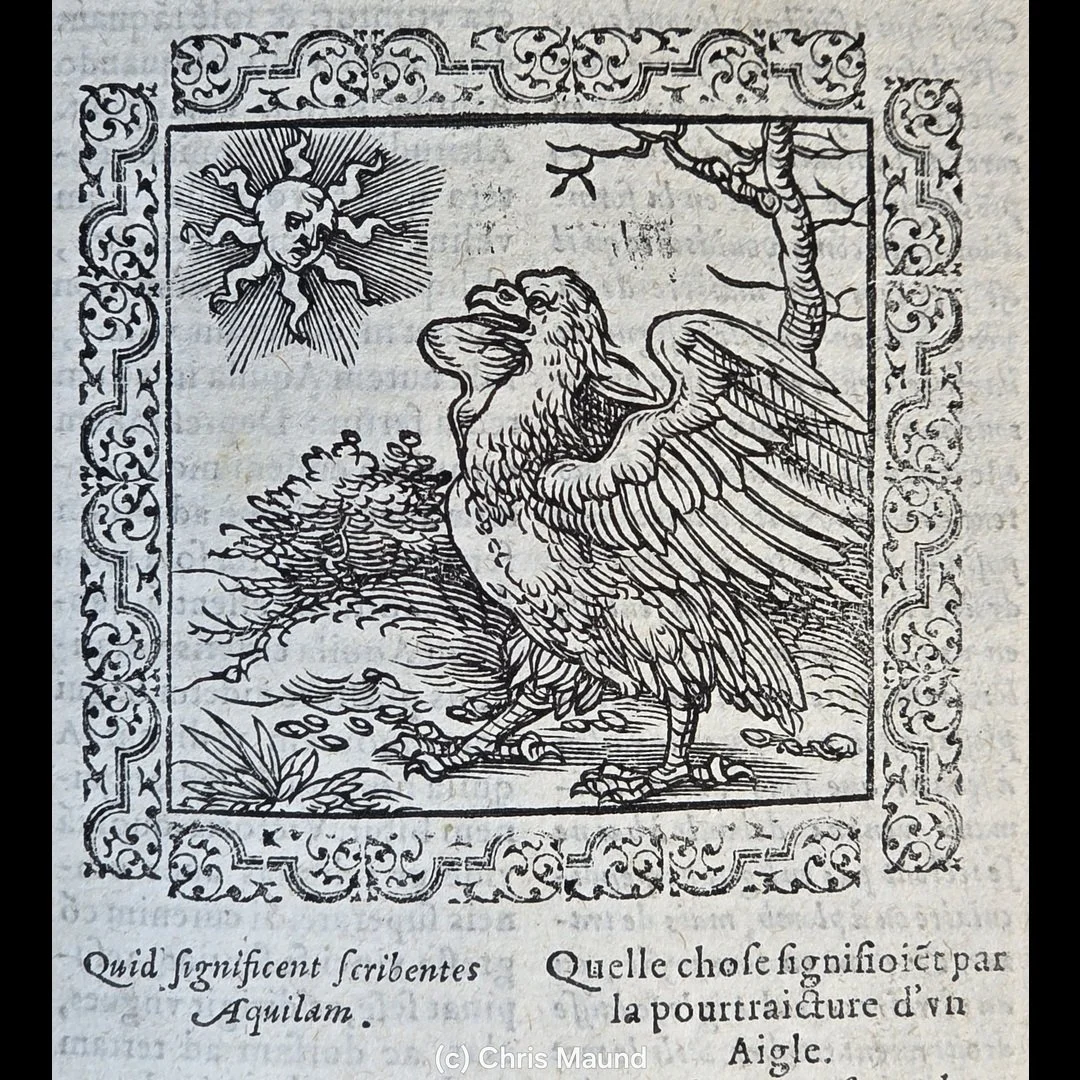 Image 11 of 32
 Image 12 of 32
 Image 13 of 32
 Image 14 of 32
 Image 15 of 32
 Image 16 of 32
 Image 17 of 32
 Image 18 of 32
 Image 19 of 32
 Image 20 of 32
 Image 21 of 32
 Image 22 of 32
 Image 23 of 32
 Image 24 of 32
 Image 25 of 32
 Image 26 of 32
 Image 27 of 32
 Image 28 of 32
 Image 29 of 32
 Image 30 of 32
 Image 31 of 32
 Image 32 of 32