1527 First Toscolano Edition 1st Printing With 6 Woodcuts & MS Binding
P. OVIDII NASONIS FASTORUM LIBRI
By Publius Ovidius Naso (Ovid)
KEY DETAILS
Condition: Very Good
Format: Limp Vellum, quarto (4to 9 1⁄2 × 12 in 241 × 305 mm )
Note: Binding/size selection follows standard bibliographic conventions and is approximate; exact measurements may vary.
Published By: Alessandro Paganini, Toscolano sul Garda, Italy, 1527
Language: Latin
Illustrated By: Anonymous
Collation: AA¹⁰ A–S¹² T–V⁸ = 242 leaves; Comprising:
Dust Jacket: None, as issued, No Jacket
SKU: BTETM0002664
Shipping Info: Approximate Package Dimensions H: 12.5, L: 30, W: 25 (Units: cm), W: 2Kg
Tracked Shipping, Insurance Coverage as per Customer Request
DESCRIPTION
P. Ovidii Nasonis Fastorum libri
Diligenti emendatione, typis impressi aptissimisque figuris ornati
With the Commentaries of Antonio Costanzi and Paolo Marso
A highly attractive and uncommon Renaissance edition of Ovid’s Fasti, printed at Toscolano on Lake Garda by Alessandro Paganini in 1527, preserving the important humanist commentaries of Antonio Costanzi of Fano and Paolo Marso of Pescina.
The Fasti is one of Ovid’s most fascinating antiquarian works: an extraordinary poetic exploration of the Roman religious calendar, combining mythology, ritual, astronomy, temple history, festivals, sacrifice and the origins of Roman customs.
Only the first six books survive, corresponding to January through June, the projected twelve-book work having remained unfinished following Ovid’s exile.
This edition belongs to the sophisticated programme of Renaissance classical printing undertaken by Alessandro Paganini at Toscolano. Ovid’s verse is presented within an extensive scholarly apparatus, surrounded by the commentaries of Costanzi and Marso, with printed marginal notes and six woodcut illustrations introducing the individual books. The title page is enclosed within a handsome white-on-black woodcut border.
Of particular interest in this copy is its early binding: limp vellum formed from a reused sixteenth-century Dutch-language Netherlandish legal manuscript, probably dating from approximately 1550–1600.
Study of the surviving manuscript text indicates that the parent document was most probably a procuration or power of attorney, employing characteristic legal formulae relating to general and special authority, representation, ratification and binding obligations. The manuscript writing continues beneath the folds and turn-ins, demonstrating that the document predates its reuse by the binder.
The binding therefore provides unusual material evidence for the later circulation and rebinding of this Italian Renaissance Ovid in the Low Countries.
An apparently early silk ribbon bookmark remains attached at the head of the spine, an appealing survival contributing further to the integrity and historical character of the copy.
Binding Note:
The binding is one of the most distinctive features of this individual copy.
The limp vellum wrapper was cut from a previously written sixteenth-century Dutch-language Netherlandish legal manuscript, probably dating from approximately 1550–1600.
The visible text employs formulae characteristic of a procuration or power of attorney, including terminology relating to general and special authority, representation, acts undertaken on behalf of another party, ratification and legal obligation.
Among the surviving formulaic language are expressions corresponding to:
“generally and specially”
acts performed by or on behalf of a comparant / constituent
promises to regard such acts as “good, valid and of worth”
and concluding language of legal obligation or binding.
The manuscript text continues beneath the fore-edge folds and turn-ins, conclusively demonstrating that the legal document existed before it was cut and repurposed by the binder.
The original principal, appointed agent and precise place of execution have not yet been securely identified.
The handwriting, language and legal terminology are consistent with the Netherlandish documentary tradition of the later sixteenth century.
The binding therefore adds an unusual second historical narrative to the volume: an Italian humanist edition of Ovid printed beside Lake Garda in 1527, subsequently circulating north of the Alps and rebound using discarded legal parchment from the Low Countries.
An apparently early silk ribbon bookmark remains attached at the head of the spine, providing an additional and attractive survival from the book’s binding history.
CONDITION, COLLATION & COPY NOTES
An attractive and complete copy of the first Toscolano edition and first Paganini printing of Ovid’s Fasti.
Bound in early limp vellum formed from a reused sixteenth-century Netherlandish manuscript legal document written in Dutch in brown ink. The manuscript text remains clearly visible across both boards and continues beneath the folds and turn-ins, demonstrating that the document was written before being cut and reused as binding material.
The vellum shows expected age-soiling, staining, darkening, creasing and handling wear consistent with an early utilitarian binding of this type, with rubbing and wear at the extremities.
An apparently early silk ribbon bookmark remains attached at the head of the spine.
The title page is present and retains the striking white-on-black woodcut border.
Text printed in semi-cursive Roman type, with Ovid’s verse surrounded by the extensive commentaries of Antonio Costanzi and Paolo Marso. Six woodcut illustrations introduce the six surviving books of the Fasti, together with decorative initials, shoulder notes and marginal scholarly apparatus.
Internally with general age-toning, occasional spotting, staining and handling marks consistent with a working Renaissance classical text. Some leaves show marginal soiling and localised discoloration. Printing remains generally strong and legible, with the woodcut material presenting well.
Final colophon and register present.
Complete.
Please see Photos as part of condition report.
REFERENCES
EDIT16 CNCE 27976
Sander 5306
Graesse V, 78
The edition is recorded in institutional and specialist bibliographies as the 1527 Toscolano printing of Ovid’s Fasti by Alessandro Paganini, with the commentaries of Antonio Costanzi and Paolo Marso.
The standard bibliographic collation is:
AA¹⁰ A–S¹² T–V⁸ = 242 leaves
Other recorded copies of the edition have appeared at major European auction houses including Reiss & Sohn and Finarte, as well as in specialist rare-book catalogues.
SYNOPSIS
Ovid’s Fasti is an elegiac poem structured around the Roman calendar.
Each surviving book corresponds to one month:
Book I — January
Book II — February
Book III — March
Book IV — April
Book V — May
Book VI — June
Ovid moves through the calendar day by day, explaining festivals, rites, sacrifices, anniversaries, astronomical phenomena, temple foundations and the mythological origins of Roman customs.
The poem ranges across the religious imagination of ancient Rome, treating gods and goddesses including Janus, Mars, Vesta, Ceres and Flora, together with festivals and rites such as the Lupercalia, Parilia, Lemuria and Vestalia.
Frequently Ovid allows gods, priests or legendary figures to explain the origins of ceremonies directly, creating a work that is simultaneously poetry, mythology, folklore, antiquarian history and religious ethnography.
The Fasti therefore remains one of the most important literary sources for the study of Roman religion, ritual and the sacred calendar, while retaining Ovid’s characteristic wit, elegance and fascination with competing versions of myth.
The Renaissance commentaries of Costanzi and Marso add another layer of intellectual history, interpreting Ovid through the antiquarian scholarship of fifteenth-century Italy and reconstructing the ancient world for an early-modern readership.
AUTHOR BIO
Publius Ovidius Naso (43 BCE – c.17/18 CE), better known as Ovid, was one of the greatest poets of Augustan Rome, alongside Virgil and Horace.
Born at Sulmo, Ovid became celebrated for works including the Amores, Ars Amatoria, Metamorphoses, Heroides and Fasti.
His poetry combines technical brilliance with wit, mythological learning and an abiding fascination with transformation, ritual, desire, power and the instability of human fortune.
In AD 8 Ovid was abruptly exiled by the Emperor Augustus to Tomis on the Black Sea. The precise reason remains uncertain, Ovid famously referring only to a carmen et error — “a poem and a mistake.”
His exile permanently altered the course of his literary career.
The Fasti was probably begun before his exile and subsequently revised, but only six books survive.
Commentator Bio — Antonio Costanzi
Antonio Costanzi, or Antonius Constantius Fanensis (1436–1490), was an Italian humanist, poet and classical scholar associated with Fano.
His commentary on Ovid’s Fasti reflects the characteristic interests of Renaissance humanism: close philological reading, reconstruction of ancient religious practice, explanation of mythology and clarification of obscure historical and antiquarian references.
Costanzi’s commentary became an important component of the printed reception of the Fasti and continued to circulate in sixteenth-century editions.
Commentator Bio — Paolo Marso
Paolo Marso of Pescina, or Paulus Marsus Piscinas (1440–1484), was an Italian humanist scholar, poet and commentator associated with the intellectual circles of Renaissance Rome and the Roman Academy of Pomponio Leto.
Marso had a particular interest in the reconstruction of ancient Roman religion, mythology and civic ritual, making the Fasti especially suited to his antiquarian scholarship.
His commentary became one of the principal Renaissance exegetical traditions attached to Ovid’s poem and was repeatedly printed alongside the text.
ILLUSTRATOR
Anonymous
The edition contains a richly ornamental white-on-black woodcut title border and six woodcut illustrations, one introducing each surviving book of the Fasti.
The illustrations belong to the established Renaissance visual tradition surrounding illustrated editions of Ovid and derive from earlier Venetian designs employed for the poem.
Their inclusion gives the volume a strong visual dimension, complementing the extensive humanist commentary and helping to interpret Ovid’s mythology and Roman ritual for a sixteenth-century readership.
Printer Bio
Alessandro Paganini was one of the more distinctive Italian printers of the early sixteenth century.
Originally active in Venice, Paganini later established printing operations at Toscolano on Lake Garda, where he produced a notable series of classical, religious and vernacular works.
His press is particularly associated with elegant typography, compact scholarly editions and experimentation with unusual typefaces and formats.
The Paganini family is also famously associated with the earliest printed Arabic Qur’an, produced in Venice during the sixteenth century.
The present Fasti is characteristic of Alessandro Paganini’s refined Toscolano production: scholarly, attractively illustrated and typographically ambitious.
1527 First Toscolano Edition 1st Printing With 6 Woodcuts & MS Binding
P. OVIDII NASONIS FASTORUM LIBRI
By Publius Ovidius Naso (Ovid)
KEY DETAILS
Condition: Very Good
Format: Limp Vellum, quarto (4to 9 1⁄2 × 12 in 241 × 305 mm )
Note: Binding/size selection follows standard bibliographic conventions and is approximate; exact measurements may vary.
Published By: Alessandro Paganini, Toscolano sul Garda, Italy, 1527
Language: Latin
Illustrated By: Anonymous
Collation: AA¹⁰ A–S¹² T–V⁸ = 242 leaves; Comprising:
Dust Jacket: None, as issued, No Jacket
SKU: BTETM0002664
Shipping Info: Approximate Package Dimensions H: 12.5, L: 30, W: 25 (Units: cm), W: 2Kg
Tracked Shipping, Insurance Coverage as per Customer Request
DESCRIPTION
P. Ovidii Nasonis Fastorum libri
Diligenti emendatione, typis impressi aptissimisque figuris ornati
With the Commentaries of Antonio Costanzi and Paolo Marso
A highly attractive and uncommon Renaissance edition of Ovid’s Fasti, printed at Toscolano on Lake Garda by Alessandro Paganini in 1527, preserving the important humanist commentaries of Antonio Costanzi of Fano and Paolo Marso of Pescina.
The Fasti is one of Ovid’s most fascinating antiquarian works: an extraordinary poetic exploration of the Roman religious calendar, combining mythology, ritual, astronomy, temple history, festivals, sacrifice and the origins of Roman customs.
Only the first six books survive, corresponding to January through June, the projected twelve-book work having remained unfinished following Ovid’s exile.
This edition belongs to the sophisticated programme of Renaissance classical printing undertaken by Alessandro Paganini at Toscolano. Ovid’s verse is presented within an extensive scholarly apparatus, surrounded by the commentaries of Costanzi and Marso, with printed marginal notes and six woodcut illustrations introducing the individual books. The title page is enclosed within a handsome white-on-black woodcut border.
Of particular interest in this copy is its early binding: limp vellum formed from a reused sixteenth-century Dutch-language Netherlandish legal manuscript, probably dating from approximately 1550–1600.
Study of the surviving manuscript text indicates that the parent document was most probably a procuration or power of attorney, employing characteristic legal formulae relating to general and special authority, representation, ratification and binding obligations. The manuscript writing continues beneath the folds and turn-ins, demonstrating that the document predates its reuse by the binder.
The binding therefore provides unusual material evidence for the later circulation and rebinding of this Italian Renaissance Ovid in the Low Countries.
An apparently early silk ribbon bookmark remains attached at the head of the spine, an appealing survival contributing further to the integrity and historical character of the copy.
Binding Note:
The binding is one of the most distinctive features of this individual copy.
The limp vellum wrapper was cut from a previously written sixteenth-century Dutch-language Netherlandish legal manuscript, probably dating from approximately 1550–1600.
The visible text employs formulae characteristic of a procuration or power of attorney, including terminology relating to general and special authority, representation, acts undertaken on behalf of another party, ratification and legal obligation.
Among the surviving formulaic language are expressions corresponding to:
“generally and specially”
acts performed by or on behalf of a comparant / constituent
promises to regard such acts as “good, valid and of worth”
and concluding language of legal obligation or binding.
The manuscript text continues beneath the fore-edge folds and turn-ins, conclusively demonstrating that the legal document existed before it was cut and repurposed by the binder.
The original principal, appointed agent and precise place of execution have not yet been securely identified.
The handwriting, language and legal terminology are consistent with the Netherlandish documentary tradition of the later sixteenth century.
The binding therefore adds an unusual second historical narrative to the volume: an Italian humanist edition of Ovid printed beside Lake Garda in 1527, subsequently circulating north of the Alps and rebound using discarded legal parchment from the Low Countries.
An apparently early silk ribbon bookmark remains attached at the head of the spine, providing an additional and attractive survival from the book’s binding history.
CONDITION, COLLATION & COPY NOTES
An attractive and complete copy of the first Toscolano edition and first Paganini printing of Ovid’s Fasti.
Bound in early limp vellum formed from a reused sixteenth-century Netherlandish manuscript legal document written in Dutch in brown ink. The manuscript text remains clearly visible across both boards and continues beneath the folds and turn-ins, demonstrating that the document was written before being cut and reused as binding material.
The vellum shows expected age-soiling, staining, darkening, creasing and handling wear consistent with an early utilitarian binding of this type, with rubbing and wear at the extremities.
An apparently early silk ribbon bookmark remains attached at the head of the spine.
The title page is present and retains the striking white-on-black woodcut border.
Text printed in semi-cursive Roman type, with Ovid’s verse surrounded by the extensive commentaries of Antonio Costanzi and Paolo Marso. Six woodcut illustrations introduce the six surviving books of the Fasti, together with decorative initials, shoulder notes and marginal scholarly apparatus.
Internally with general age-toning, occasional spotting, staining and handling marks consistent with a working Renaissance classical text. Some leaves show marginal soiling and localised discoloration. Printing remains generally strong and legible, with the woodcut material presenting well.
Final colophon and register present.
Complete.
Please see Photos as part of condition report.
REFERENCES
EDIT16 CNCE 27976
Sander 5306
Graesse V, 78
The edition is recorded in institutional and specialist bibliographies as the 1527 Toscolano printing of Ovid’s Fasti by Alessandro Paganini, with the commentaries of Antonio Costanzi and Paolo Marso.
The standard bibliographic collation is:
AA¹⁰ A–S¹² T–V⁸ = 242 leaves
Other recorded copies of the edition have appeared at major European auction houses including Reiss & Sohn and Finarte, as well as in specialist rare-book catalogues.
SYNOPSIS
Ovid’s Fasti is an elegiac poem structured around the Roman calendar.
Each surviving book corresponds to one month:
Book I — January
Book II — February
Book III — March
Book IV — April
Book V — May
Book VI — June
Ovid moves through the calendar day by day, explaining festivals, rites, sacrifices, anniversaries, astronomical phenomena, temple foundations and the mythological origins of Roman customs.
The poem ranges across the religious imagination of ancient Rome, treating gods and goddesses including Janus, Mars, Vesta, Ceres and Flora, together with festivals and rites such as the Lupercalia, Parilia, Lemuria and Vestalia.
Frequently Ovid allows gods, priests or legendary figures to explain the origins of ceremonies directly, creating a work that is simultaneously poetry, mythology, folklore, antiquarian history and religious ethnography.
The Fasti therefore remains one of the most important literary sources for the study of Roman religion, ritual and the sacred calendar, while retaining Ovid’s characteristic wit, elegance and fascination with competing versions of myth.
The Renaissance commentaries of Costanzi and Marso add another layer of intellectual history, interpreting Ovid through the antiquarian scholarship of fifteenth-century Italy and reconstructing the ancient world for an early-modern readership.
AUTHOR BIO
Publius Ovidius Naso (43 BCE – c.17/18 CE), better known as Ovid, was one of the greatest poets of Augustan Rome, alongside Virgil and Horace.
Born at Sulmo, Ovid became celebrated for works including the Amores, Ars Amatoria, Metamorphoses, Heroides and Fasti.
His poetry combines technical brilliance with wit, mythological learning and an abiding fascination with transformation, ritual, desire, power and the instability of human fortune.
In AD 8 Ovid was abruptly exiled by the Emperor Augustus to Tomis on the Black Sea. The precise reason remains uncertain, Ovid famously referring only to a carmen et error — “a poem and a mistake.”
His exile permanently altered the course of his literary career.
The Fasti was probably begun before his exile and subsequently revised, but only six books survive.
Commentator Bio — Antonio Costanzi
Antonio Costanzi, or Antonius Constantius Fanensis (1436–1490), was an Italian humanist, poet and classical scholar associated with Fano.
His commentary on Ovid’s Fasti reflects the characteristic interests of Renaissance humanism: close philological reading, reconstruction of ancient religious practice, explanation of mythology and clarification of obscure historical and antiquarian references.
Costanzi’s commentary became an important component of the printed reception of the Fasti and continued to circulate in sixteenth-century editions.
Commentator Bio — Paolo Marso
Paolo Marso of Pescina, or Paulus Marsus Piscinas (1440–1484), was an Italian humanist scholar, poet and commentator associated with the intellectual circles of Renaissance Rome and the Roman Academy of Pomponio Leto.
Marso had a particular interest in the reconstruction of ancient Roman religion, mythology and civic ritual, making the Fasti especially suited to his antiquarian scholarship.
His commentary became one of the principal Renaissance exegetical traditions attached to Ovid’s poem and was repeatedly printed alongside the text.
ILLUSTRATOR
Anonymous
The edition contains a richly ornamental white-on-black woodcut title border and six woodcut illustrations, one introducing each surviving book of the Fasti.
The illustrations belong to the established Renaissance visual tradition surrounding illustrated editions of Ovid and derive from earlier Venetian designs employed for the poem.
Their inclusion gives the volume a strong visual dimension, complementing the extensive humanist commentary and helping to interpret Ovid’s mythology and Roman ritual for a sixteenth-century readership.
Printer Bio
Alessandro Paganini was one of the more distinctive Italian printers of the early sixteenth century.
Originally active in Venice, Paganini later established printing operations at Toscolano on Lake Garda, where he produced a notable series of classical, religious and vernacular works.
His press is particularly associated with elegant typography, compact scholarly editions and experimentation with unusual typefaces and formats.
The Paganini family is also famously associated with the earliest printed Arabic Qur’an, produced in Venice during the sixteenth century.
The present Fasti is characteristic of Alessandro Paganini’s refined Toscolano production: scholarly, attractively illustrated and typographically ambitious.

 Image 1 of 15
 Image 2 of 15
 Image 3 of 15
 Image 4 of 15
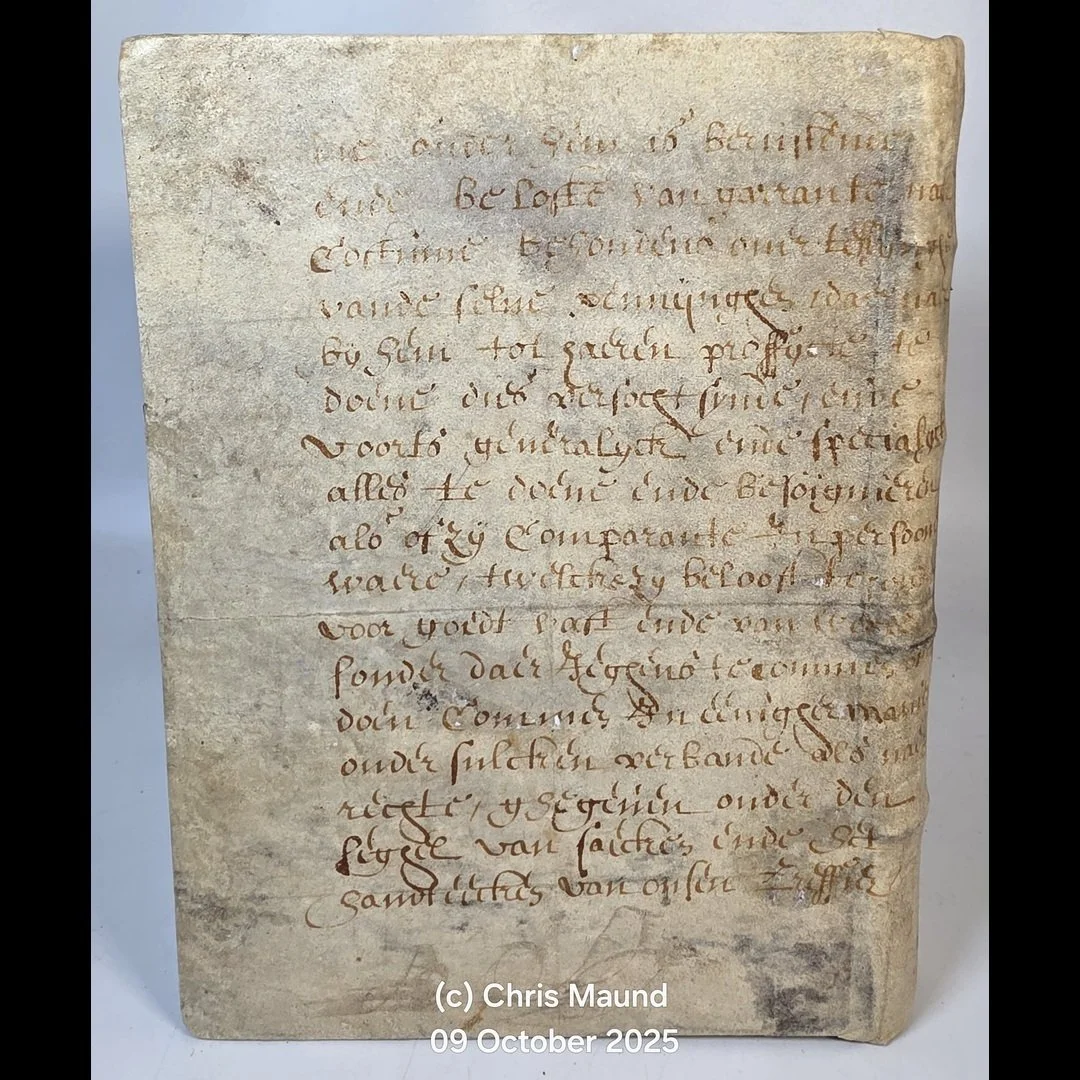 Image 5 of 15
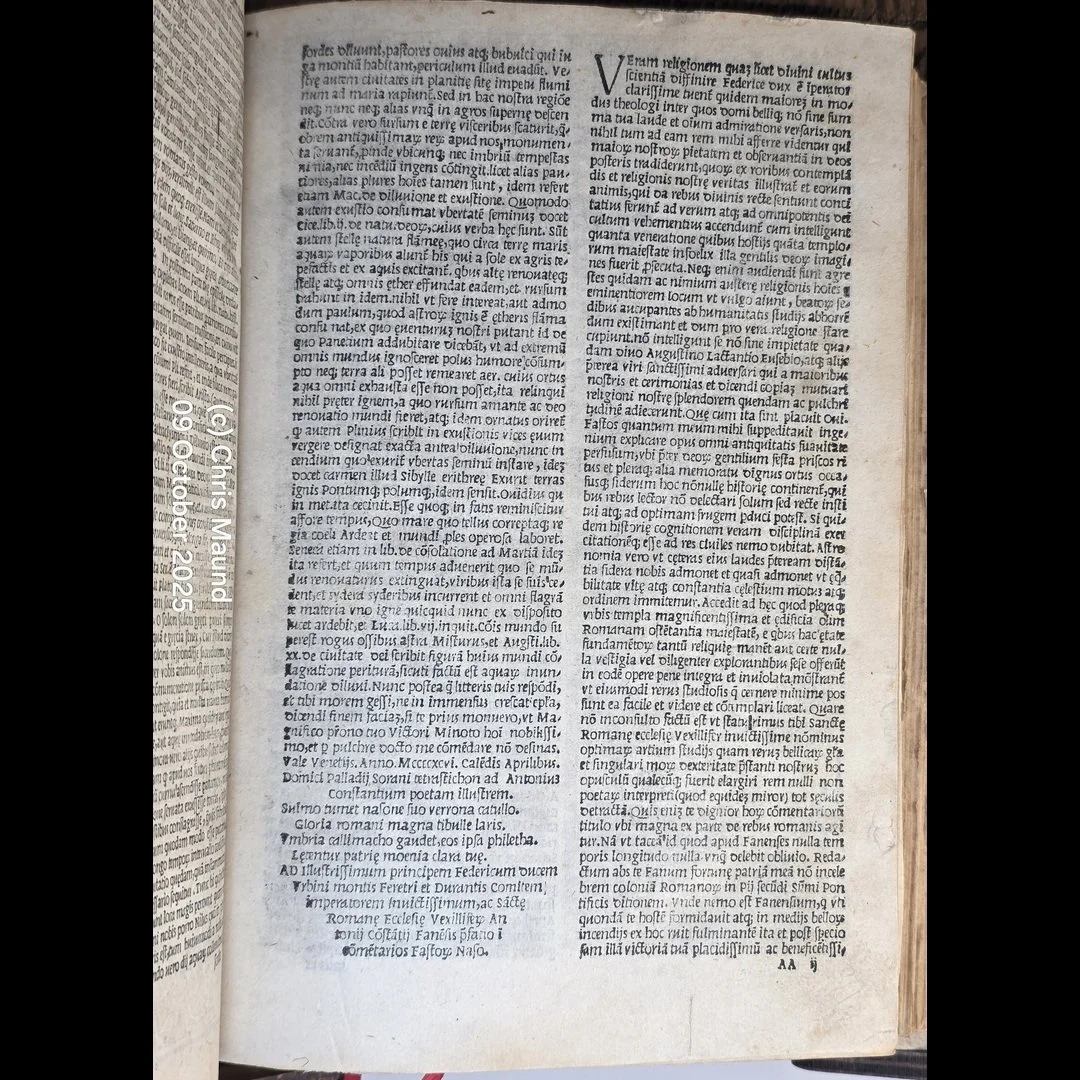 Image 6 of 15
 Image 7 of 15
 Image 8 of 15
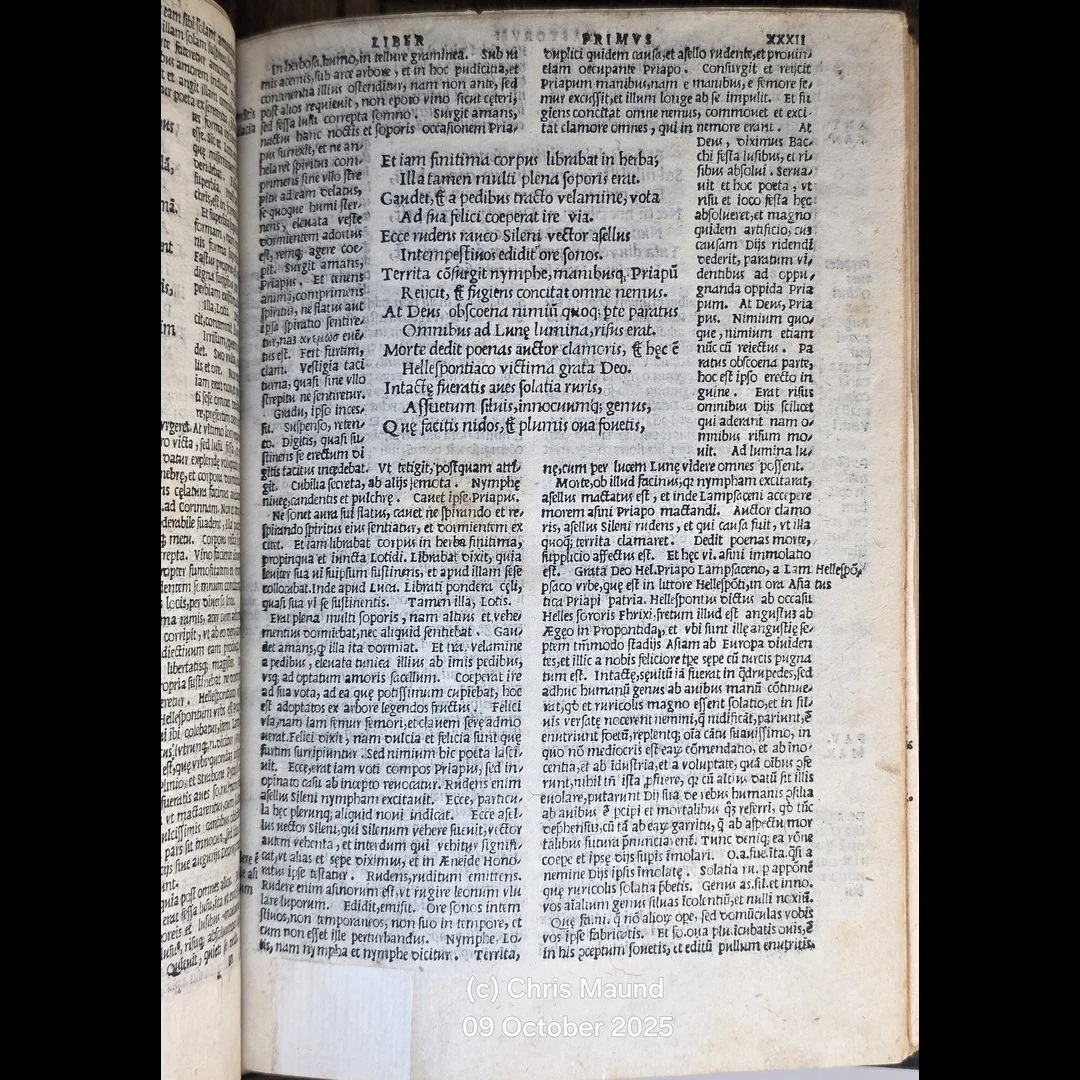 Image 9 of 15
 Image 10 of 15
 Image 11 of 15
 Image 12 of 15
 Image 13 of 15
 Image 14 of 15
 Image 15 of 15