1797 Second Edition Illuminati Freemasonry
PROOFS OF A CONSPIRACY
By John Robison
KEY DETAILS
Condition: Good
Format: Hardcover, Octavo (Standard) (8vo 6 × 9 in 152 × 229 mm )
Note: Binding/size selection follows standard bibliographic conventions and is approximate; exact measurements may vary.
Published By: T. Cadell jun and W. Davies and W. Creech, London, 1797
Language: English
Collation: [4], 531, [1] blank pp.
Dust Jacket: None, as issued, No Jacket
SKU: BTETM0002680
Shipping Info: Approximate Package Dimensions H: 12.5, L: 30, W: 25 (Units: cm), W: 2Kg
Tracked Shipping, Insurance Coverage as per Customer Request
DESCRIPTION
Proofs of a Conspiracy
Against all the Religions and Governments of Europe, Carried on in the Secret Meetings of Free Masons, Illuminati, and Reading Societies
The scarce second edition, corrected, with the newly added Postscript, of John Robison's celebrated Proofs of a Conspiracy — one of the best-known British works of late eighteenth-century anti-Illuminati and anti-revolutionary literature, published at the height of European anxiety over the French Revolution, Freemasonry and secret political societies.
Issued in the same year as the first edition, this second edition is bibliographically significant. The first edition comprised [8], 496 pages; the present corrected edition extends to 531 pages and adds Robison's substantial Postscript, beginning here at p. 499. Contemporary bibliographical records identify this second edition as ESTC T100161.
Robison himself explains in the Postscript that the first impression had been exhausted within only a few days and that the publisher was already calling for another edition, accounting for the unusually rapid appearance of this corrected second edition during 1797.
The work is divided into an Introduction and four substantial chapters — Schisms in Free Masonry; The Illuminati; The German Union; and The French Revolution — followed by the Postscript. Robison attempts to trace a network of secret intellectual and political organisations through continental Freemasonry, Adam Weishaupt's Bavarian Illuminati, German reading societies and the revolutionary clubs of France.
Particularly attractive from a collecting perspective is the appearance of “ILLUMINATI” prominently on the title page of a book printed in 1797, only twelve years after the Bavarian authorities had suppressed Weishaupt's organisation.
The book rapidly became part of the international debate surrounding the Illuminati. In 1798 the Reverend G. W. Snyder sent a copy to George Washington. Washington's surviving reply acknowledges receipt of Robison's book, states that he had heard much about the Illuminati but had not yet had time to read it, and importantly adds that he did not believe American Masonic lodges had been contaminated by the principles attributed to the Illuminati. The correspondence survives among the George Washington Papers at the Library of Congress.
An appealing and internally notably clean copy in an unrestored-looking period binding, preserving considerably more historical character than the frequently rebacked or rebound copies encountered in the trade.
CONDITION, COLLATION & COPY NOTES
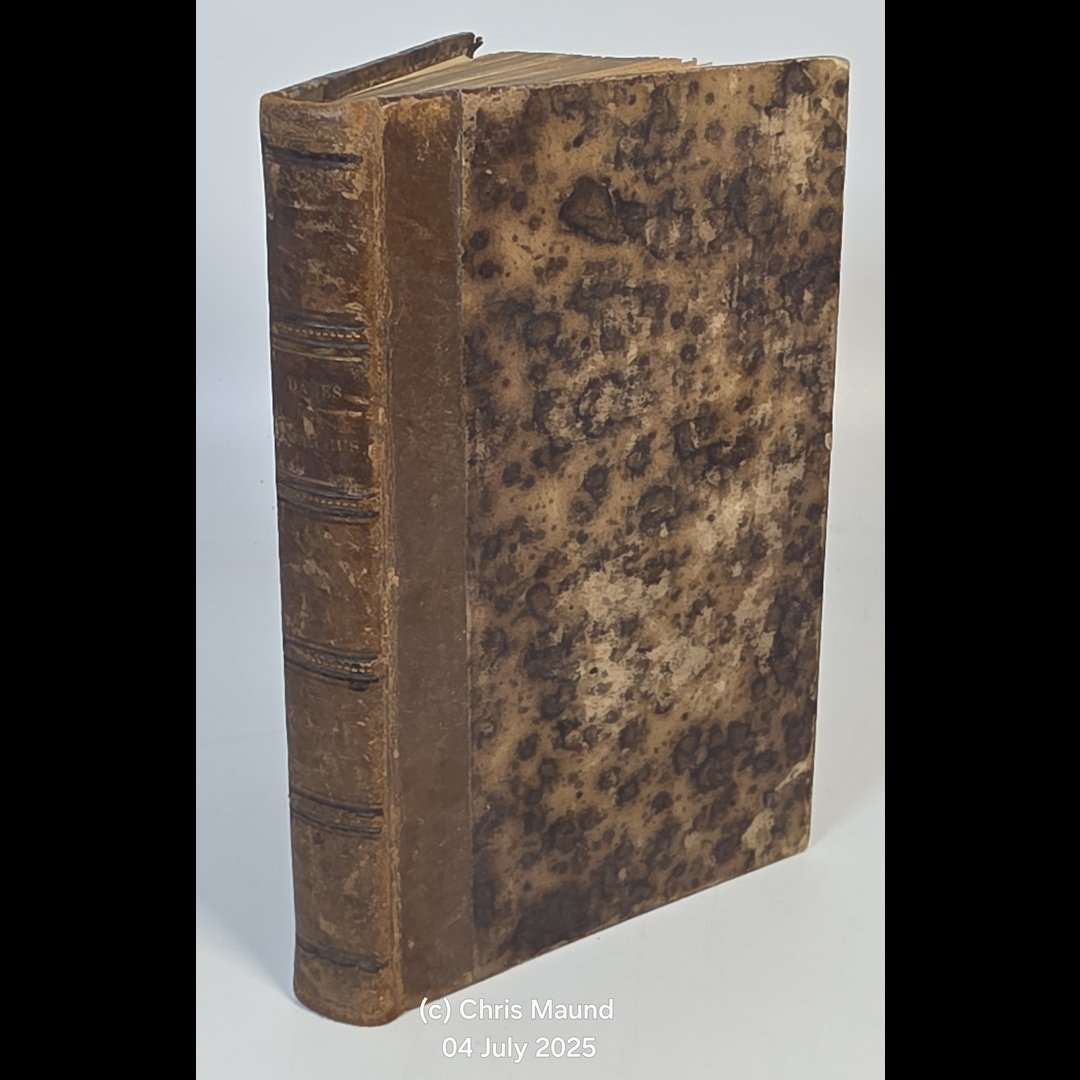
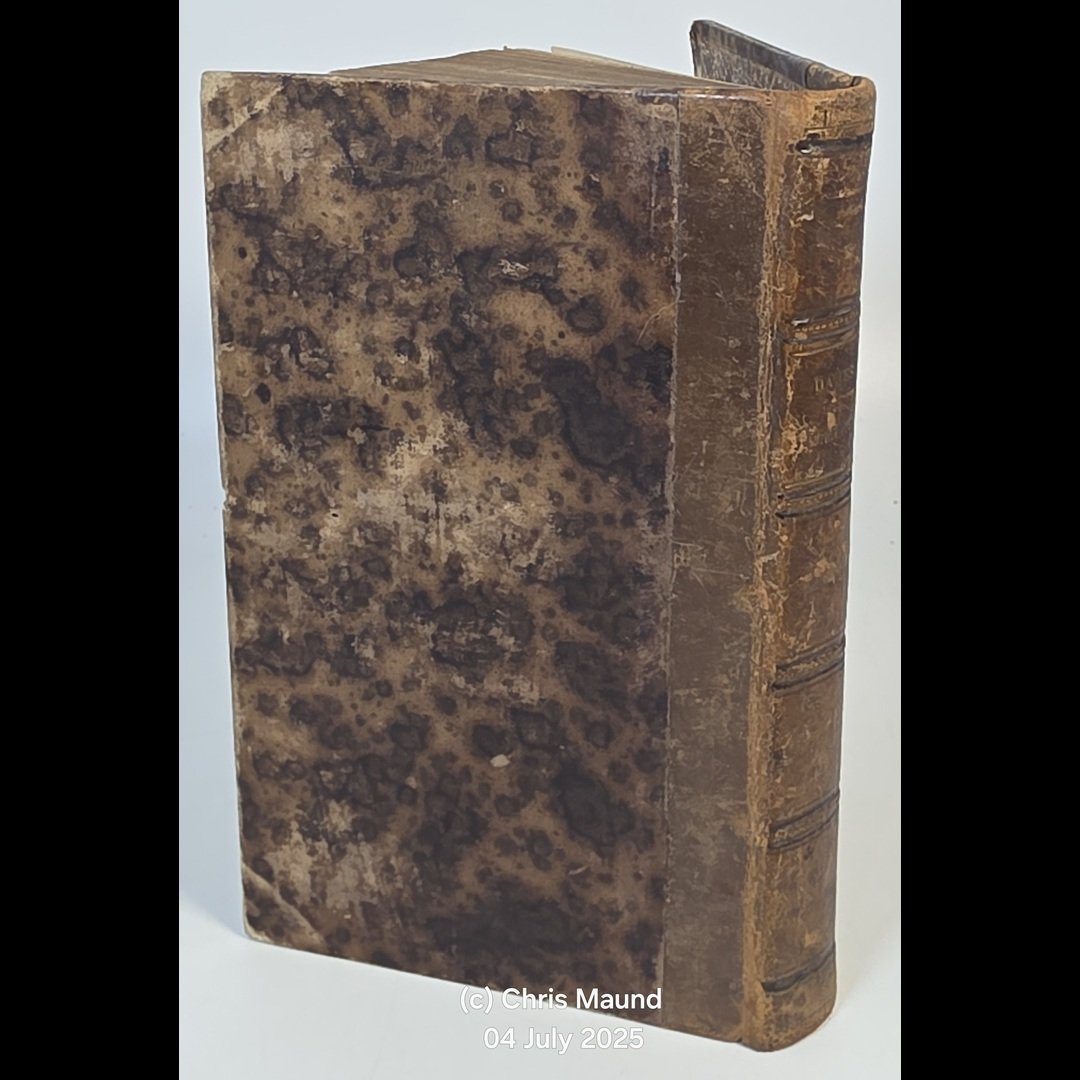
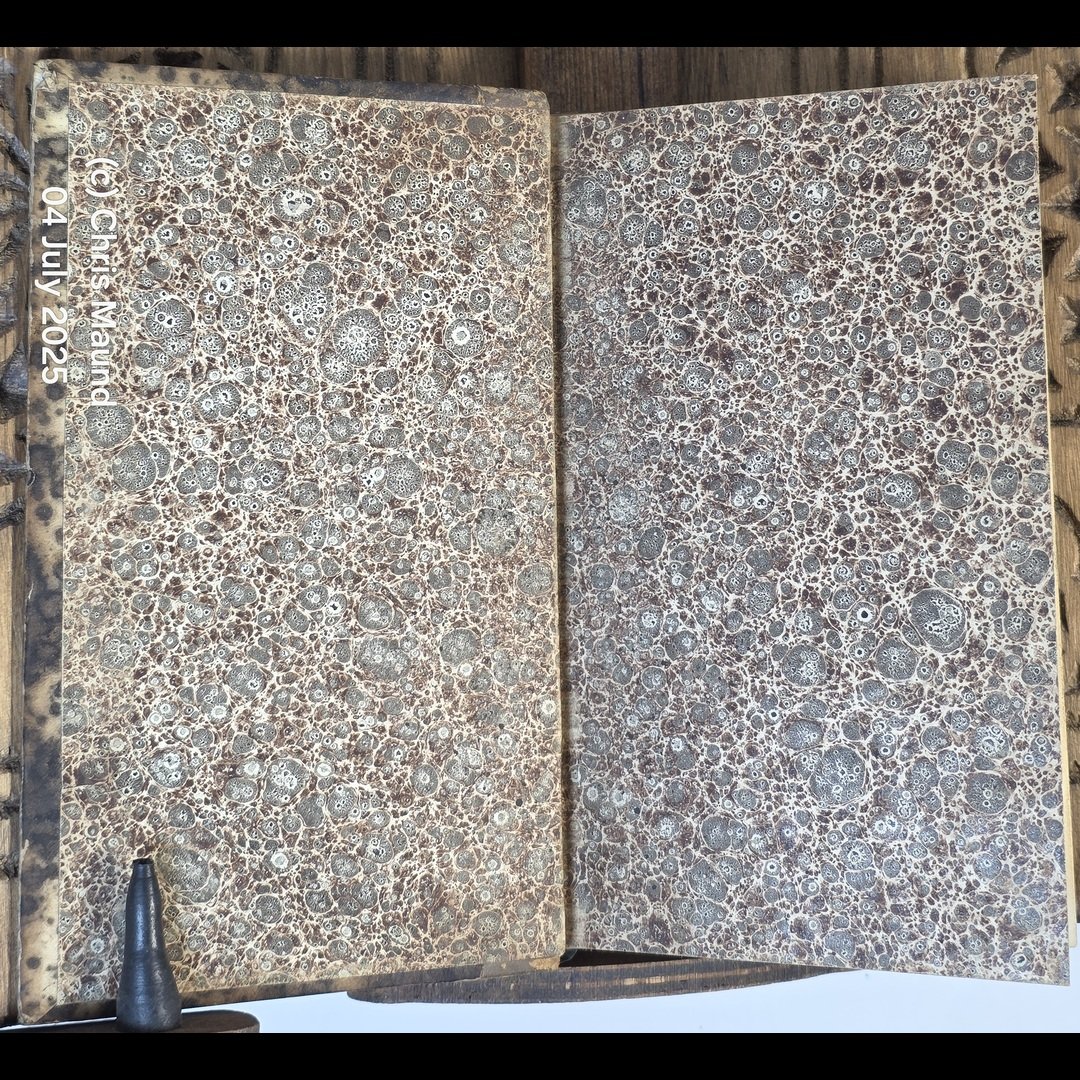
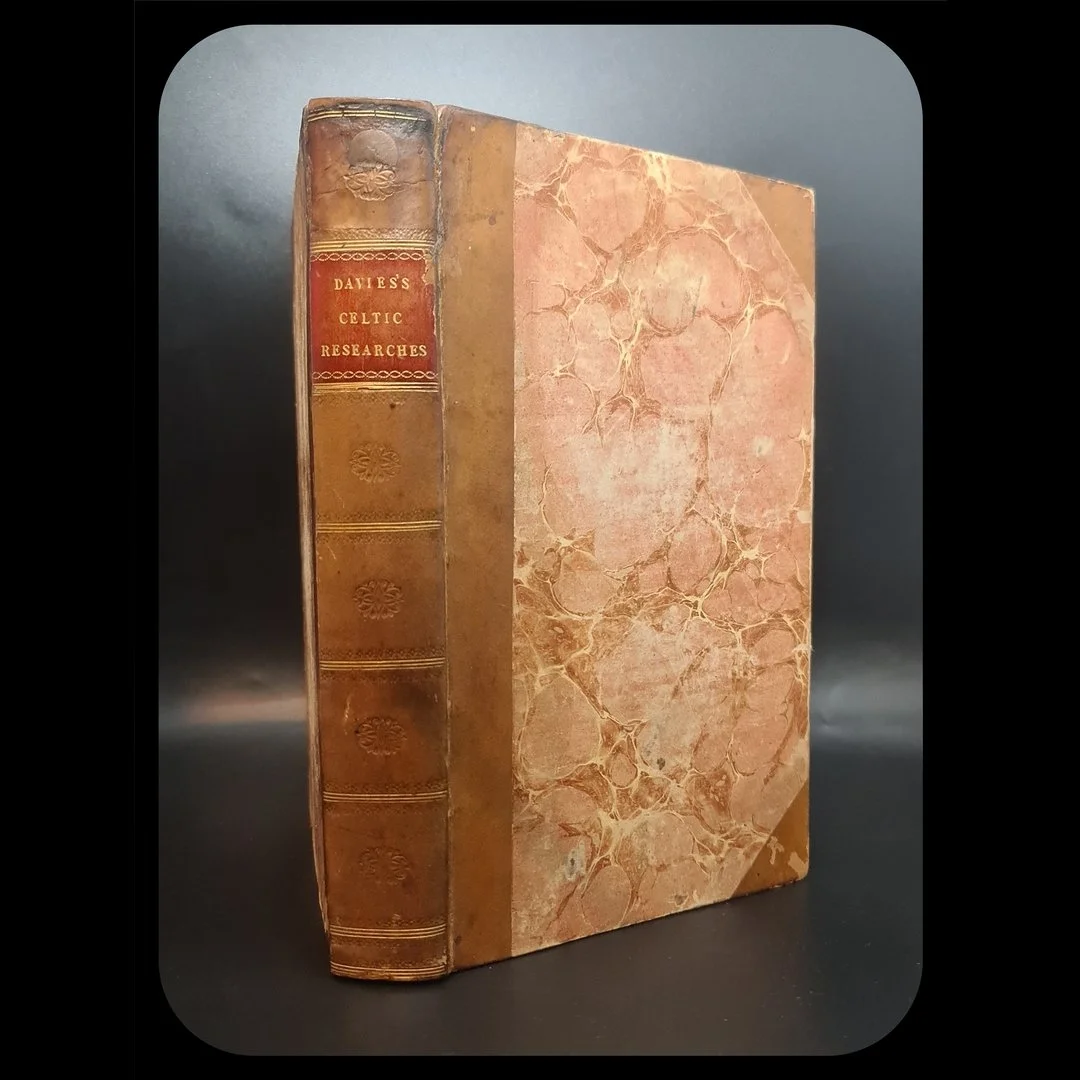
Contemporary half calf over blue marbled paper-covered boards, with calf corners, smooth spine ruled and decorated in gilt and retaining the original-style red morocco lettering-piece.
Binding considerably rubbed and worn from age and use, with abrasion and surface loss to the marbled paper, rubbing to the calf and wear to the corners and extremities. The red morocco spine label remains present, although rubbed and chipped. The leather backstrip has a long vertical crack, with further wear and small losses at head and foot. Despite the external wear, both boards remain attached and the text block is firm.
Internally much stronger than the exterior condition might suggest. Pages are notably clean for a late eighteenth-century copy, with light general age-toning and occasional minor spotting or handling marks but no significant staining or intrusive annotation apparent. Margins remain generous and the printing is clear throughout.
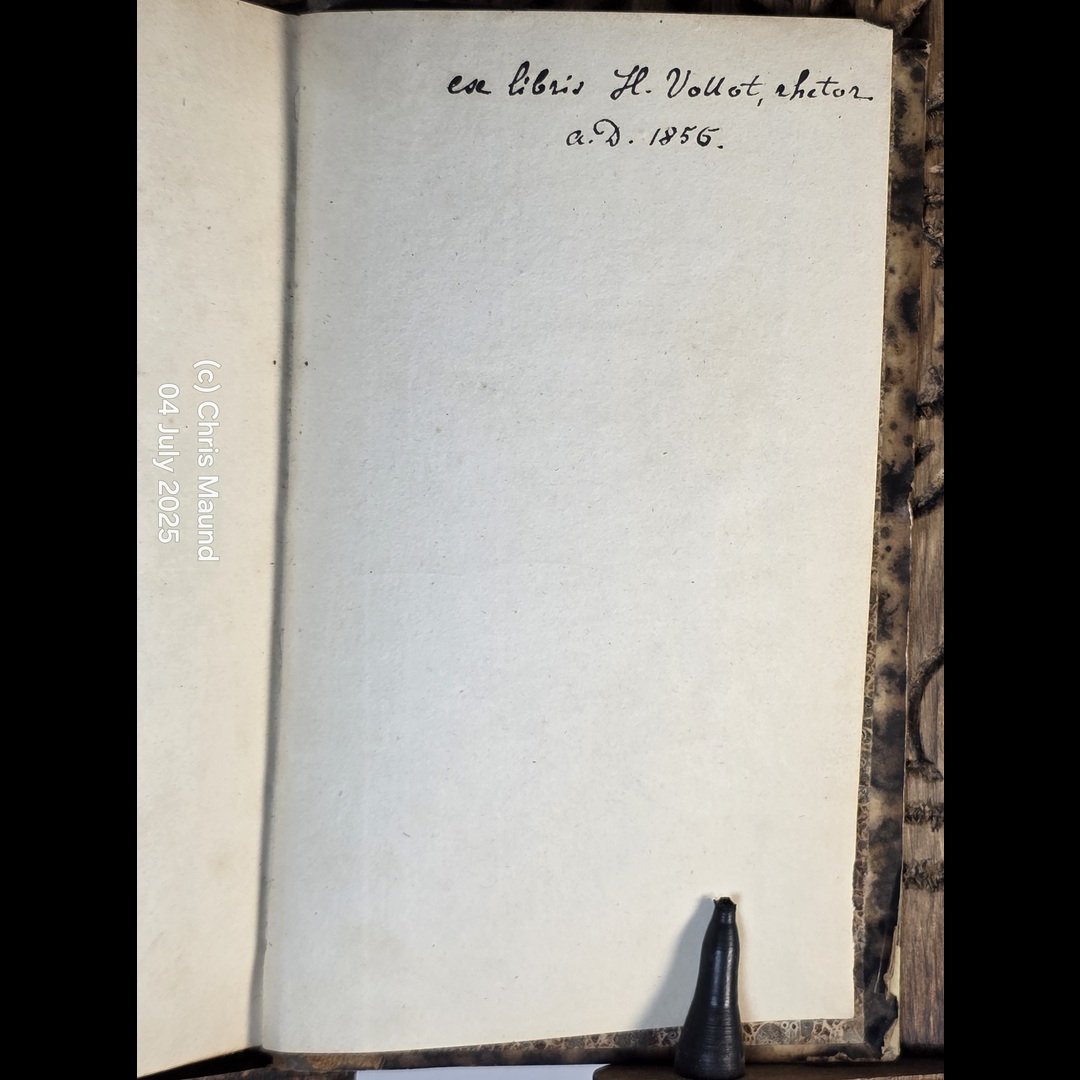
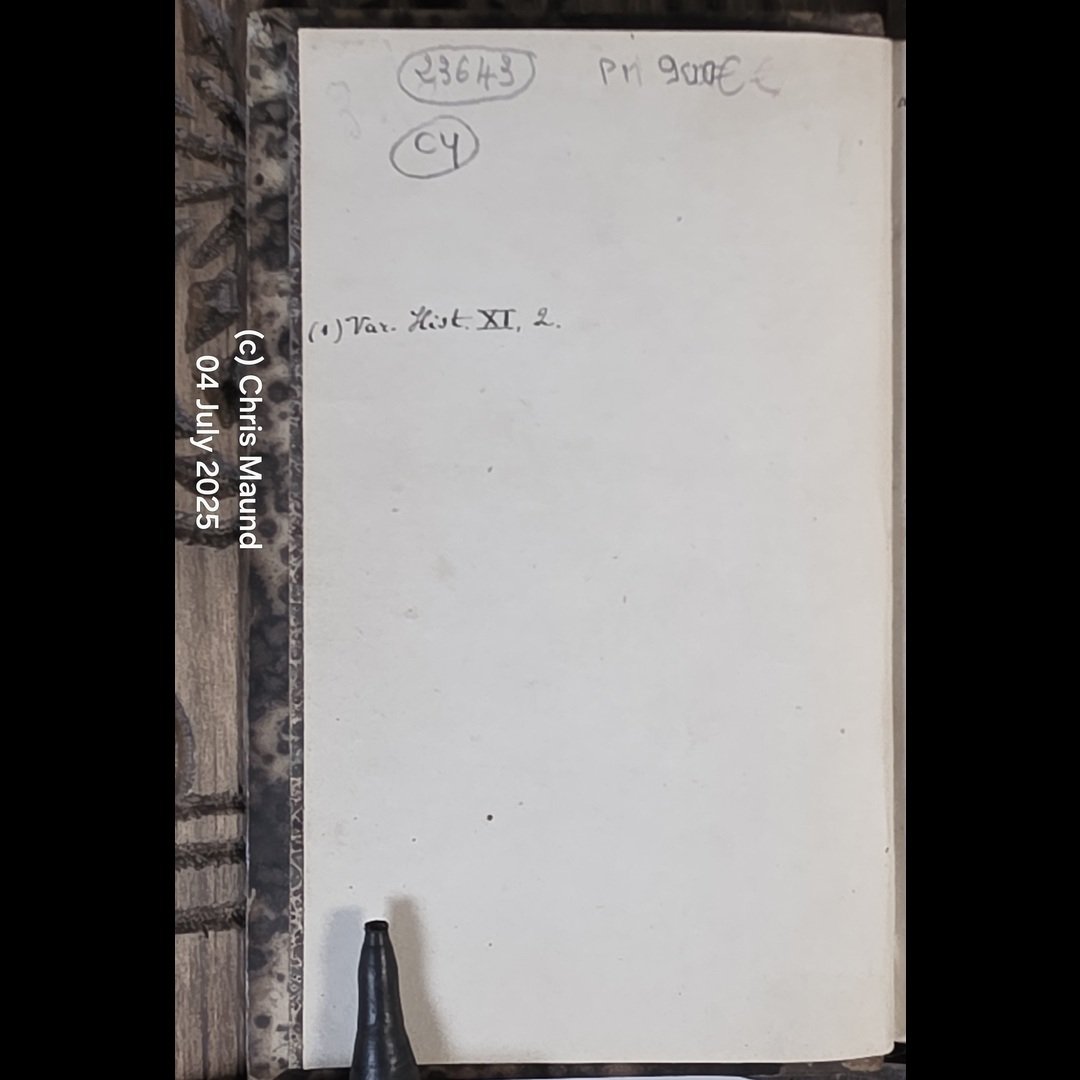
A single faint pencil ownership inscription occurs on the rear endpaper and has been cancelled with a single pencil stroke. The name is now too indistinct to identify reliably. Otherwise free from ownership inscriptions, marginalia and annotations.
Title page, dedication, contents, Introduction, all four chapters and Postscript present. The Postscript begins at p. 499.
Complete through p. 531. Five blank pages follow the printed text. The first corresponds with the terminal blank following p. 531, with further blank endleaves retained in this copy.
Please see Photos as part of condition report.
REFERENCES
ESTC T100161 — second edition, London and Edinburgh, 1797. A comparable bibliographical description records [4], 531, [1] blank, and identifies the edition as the second edition with additional Postscript.
ESTC T100164 — first edition, Edinburgh and London, 1797; [8], 496 pp.
Wellcome Collection — Postscript to the second edition of Mr. Robison's Proofs of a Conspiracy, London, T. Cadell jun. and W. Davies; Edinburgh, W. Creech, 1797.
George Washington Papers, Library of Congress — Washington to Reverend G. W. Snyder, Mount Vernon, 25 September 1798, acknowledging receipt of Robison's Proofs of a Conspiracy.
SYNOPSIS
Published during the political and intellectual upheaval following the French Revolution, Proofs of a Conspiracy was John Robison's attempt to demonstrate that revolutionary change in Europe was not simply spontaneous political unrest but had been encouraged and organised through interconnected secret societies.
Robison begins with Freemasonry, examining the proliferation of continental Masonic systems and what he regarded as their departure from the comparatively apolitical traditions of British Masonry. His argument therefore goes beyond a straightforward attack upon Freemasonry itself: he claims that existing Masonic structures provided secrecy, hierarchy and international connections that could be appropriated for more radical purposes.
The centre of the book is devoted to the Bavarian Illuminati, founded by Adam Weishaupt. Robison reconstructs its hierarchy, terminology, methods of recruitment and programme of progressive initiation, arguing that beneath the organisation's outward language of moral and intellectual improvement lay an intention to undermine established religion and civil government.
He next turns to the German Union and Reading Societies, treating apparently literary and educational associations as further mechanisms through which radical philosophy might circulate. For Robison, intellectual networks, publishing, private clubs and secret societies formed overlapping channels by which Enlightenment ideas could become revolutionary political action.
The final major section applies this interpretation to the French Revolution. Robison attempts to connect continental secret societies with Jacobinism and the revolutionary destruction of traditional political and ecclesiastical institutions.
The newly added Postscript is particularly significant to the present second edition. It allowed Robison to respond to the extraordinarily rapid reception of the first printing, revisit aspects of his evidence and answer objections while the controversy was still unfolding.
Modern readers need not accept Robison's proposed conspiracy to recognise the book's historical importance. Proofs of a Conspiracy is an exceptional primary document for the political anxieties of the 1790s and for the development of later conspiracy narratives involving secret societies, hidden hierarchies, revolutionary ideology and the Illuminati.
Its continuing fascination lies precisely at that intersection of Freemasonry, the historical Illuminati, the French Revolution, Enlightenment thought and the history of conspiracy theory.
AUTHOR BIO
John Robison (1739–1805) was a Scottish physicist, mathematician and natural philosopher and one of the more remarkable scientific figures of the Scottish Enlightenment.
Educated at the University of Glasgow, Robison went to sea as a young man and accompanied the British expedition associated with General Wolfe's campaign against Quebec. He subsequently returned to academic life, succeeding Joseph Black as Lecturer in Chemistry at Glasgow before travelling to Russia with Admiral Sir Charles Knowles and working on the reorganisation of the Imperial Russian fleet. He later held a mathematical appointment connected with the naval cadet establishment at Kronstadt.
Returning to Scotland, Robison was appointed to the Chair of Natural Philosophy at the University of Edinburgh, where his teaching encompassed mechanics, hydrodynamics, astronomy, optics, electricity and magnetism. He was closely associated with figures including Joseph Black and James Watt.
When the Royal Society of Edinburgh was founded in 1783, Robison became a founder member and its first General Secretary, serving from 1783 until 1798.
His scientific career makes Proofs of a Conspiracy particularly unusual. Rather than being the production of an anonymous political pamphleteer, it was written by an established professor and Fellow of the Scottish intellectual establishment attempting to apply what he considered an evidential and systematic approach to the political upheavals of his own age.
1797 Second Edition Illuminati Freemasonry
PROOFS OF A CONSPIRACY
By John Robison
KEY DETAILS
Condition: Good
Format: Hardcover, Octavo (Standard) (8vo 6 × 9 in 152 × 229 mm )
Note: Binding/size selection follows standard bibliographic conventions and is approximate; exact measurements may vary.
Published By: T. Cadell jun and W. Davies and W. Creech, London, 1797
Language: English
Collation: [4], 531, [1] blank pp.
Dust Jacket: None, as issued, No Jacket
SKU: BTETM0002680
Shipping Info: Approximate Package Dimensions H: 12.5, L: 30, W: 25 (Units: cm), W: 2Kg
Tracked Shipping, Insurance Coverage as per Customer Request
DESCRIPTION
Proofs of a Conspiracy
Against all the Religions and Governments of Europe, Carried on in the Secret Meetings of Free Masons, Illuminati, and Reading Societies
The scarce second edition, corrected, with the newly added Postscript, of John Robison's celebrated Proofs of a Conspiracy — one of the best-known British works of late eighteenth-century anti-Illuminati and anti-revolutionary literature, published at the height of European anxiety over the French Revolution, Freemasonry and secret political societies.
Issued in the same year as the first edition, this second edition is bibliographically significant. The first edition comprised [8], 496 pages; the present corrected edition extends to 531 pages and adds Robison's substantial Postscript, beginning here at p. 499. Contemporary bibliographical records identify this second edition as ESTC T100161.
Robison himself explains in the Postscript that the first impression had been exhausted within only a few days and that the publisher was already calling for another edition, accounting for the unusually rapid appearance of this corrected second edition during 1797.
The work is divided into an Introduction and four substantial chapters — Schisms in Free Masonry; The Illuminati; The German Union; and The French Revolution — followed by the Postscript. Robison attempts to trace a network of secret intellectual and political organisations through continental Freemasonry, Adam Weishaupt's Bavarian Illuminati, German reading societies and the revolutionary clubs of France.
Particularly attractive from a collecting perspective is the appearance of “ILLUMINATI” prominently on the title page of a book printed in 1797, only twelve years after the Bavarian authorities had suppressed Weishaupt's organisation.
The book rapidly became part of the international debate surrounding the Illuminati. In 1798 the Reverend G. W. Snyder sent a copy to George Washington. Washington's surviving reply acknowledges receipt of Robison's book, states that he had heard much about the Illuminati but had not yet had time to read it, and importantly adds that he did not believe American Masonic lodges had been contaminated by the principles attributed to the Illuminati. The correspondence survives among the George Washington Papers at the Library of Congress.
An appealing and internally notably clean copy in an unrestored-looking period binding, preserving considerably more historical character than the frequently rebacked or rebound copies encountered in the trade.
CONDITION, COLLATION & COPY NOTES
Contemporary half calf over blue marbled paper-covered boards, with calf corners, smooth spine ruled and decorated in gilt and retaining the original-style red morocco lettering-piece.
Binding considerably rubbed and worn from age and use, with abrasion and surface loss to the marbled paper, rubbing to the calf and wear to the corners and extremities. The red morocco spine label remains present, although rubbed and chipped. The leather backstrip has a long vertical crack, with further wear and small losses at head and foot. Despite the external wear, both boards remain attached and the text block is firm.
Internally much stronger than the exterior condition might suggest. Pages are notably clean for a late eighteenth-century copy, with light general age-toning and occasional minor spotting or handling marks but no significant staining or intrusive annotation apparent. Margins remain generous and the printing is clear throughout.
A single faint pencil ownership inscription occurs on the rear endpaper and has been cancelled with a single pencil stroke. The name is now too indistinct to identify reliably. Otherwise free from ownership inscriptions, marginalia and annotations.
Title page, dedication, contents, Introduction, all four chapters and Postscript present. The Postscript begins at p. 499.
Complete through p. 531. Five blank pages follow the printed text. The first corresponds with the terminal blank following p. 531, with further blank endleaves retained in this copy.
Please see Photos as part of condition report.
REFERENCES
ESTC T100161 — second edition, London and Edinburgh, 1797. A comparable bibliographical description records [4], 531, [1] blank, and identifies the edition as the second edition with additional Postscript.
ESTC T100164 — first edition, Edinburgh and London, 1797; [8], 496 pp.
Wellcome Collection — Postscript to the second edition of Mr. Robison's Proofs of a Conspiracy, London, T. Cadell jun. and W. Davies; Edinburgh, W. Creech, 1797.
George Washington Papers, Library of Congress — Washington to Reverend G. W. Snyder, Mount Vernon, 25 September 1798, acknowledging receipt of Robison's Proofs of a Conspiracy.
SYNOPSIS
Published during the political and intellectual upheaval following the French Revolution, Proofs of a Conspiracy was John Robison's attempt to demonstrate that revolutionary change in Europe was not simply spontaneous political unrest but had been encouraged and organised through interconnected secret societies.
Robison begins with Freemasonry, examining the proliferation of continental Masonic systems and what he regarded as their departure from the comparatively apolitical traditions of British Masonry. His argument therefore goes beyond a straightforward attack upon Freemasonry itself: he claims that existing Masonic structures provided secrecy, hierarchy and international connections that could be appropriated for more radical purposes.
The centre of the book is devoted to the Bavarian Illuminati, founded by Adam Weishaupt. Robison reconstructs its hierarchy, terminology, methods of recruitment and programme of progressive initiation, arguing that beneath the organisation's outward language of moral and intellectual improvement lay an intention to undermine established religion and civil government.
He next turns to the German Union and Reading Societies, treating apparently literary and educational associations as further mechanisms through which radical philosophy might circulate. For Robison, intellectual networks, publishing, private clubs and secret societies formed overlapping channels by which Enlightenment ideas could become revolutionary political action.
The final major section applies this interpretation to the French Revolution. Robison attempts to connect continental secret societies with Jacobinism and the revolutionary destruction of traditional political and ecclesiastical institutions.
The newly added Postscript is particularly significant to the present second edition. It allowed Robison to respond to the extraordinarily rapid reception of the first printing, revisit aspects of his evidence and answer objections while the controversy was still unfolding.
Modern readers need not accept Robison's proposed conspiracy to recognise the book's historical importance. Proofs of a Conspiracy is an exceptional primary document for the political anxieties of the 1790s and for the development of later conspiracy narratives involving secret societies, hidden hierarchies, revolutionary ideology and the Illuminati.
Its continuing fascination lies precisely at that intersection of Freemasonry, the historical Illuminati, the French Revolution, Enlightenment thought and the history of conspiracy theory.
AUTHOR BIO
John Robison (1739–1805) was a Scottish physicist, mathematician and natural philosopher and one of the more remarkable scientific figures of the Scottish Enlightenment.
Educated at the University of Glasgow, Robison went to sea as a young man and accompanied the British expedition associated with General Wolfe's campaign against Quebec. He subsequently returned to academic life, succeeding Joseph Black as Lecturer in Chemistry at Glasgow before travelling to Russia with Admiral Sir Charles Knowles and working on the reorganisation of the Imperial Russian fleet. He later held a mathematical appointment connected with the naval cadet establishment at Kronstadt.
Returning to Scotland, Robison was appointed to the Chair of Natural Philosophy at the University of Edinburgh, where his teaching encompassed mechanics, hydrodynamics, astronomy, optics, electricity and magnetism. He was closely associated with figures including Joseph Black and James Watt.
When the Royal Society of Edinburgh was founded in 1783, Robison became a founder member and its first General Secretary, serving from 1783 until 1798.
His scientific career makes Proofs of a Conspiracy particularly unusual. Rather than being the production of an anonymous political pamphleteer, it was written by an established professor and Fellow of the Scottish intellectual establishment attempting to apply what he considered an evidential and systematic approach to the political upheavals of his own age.

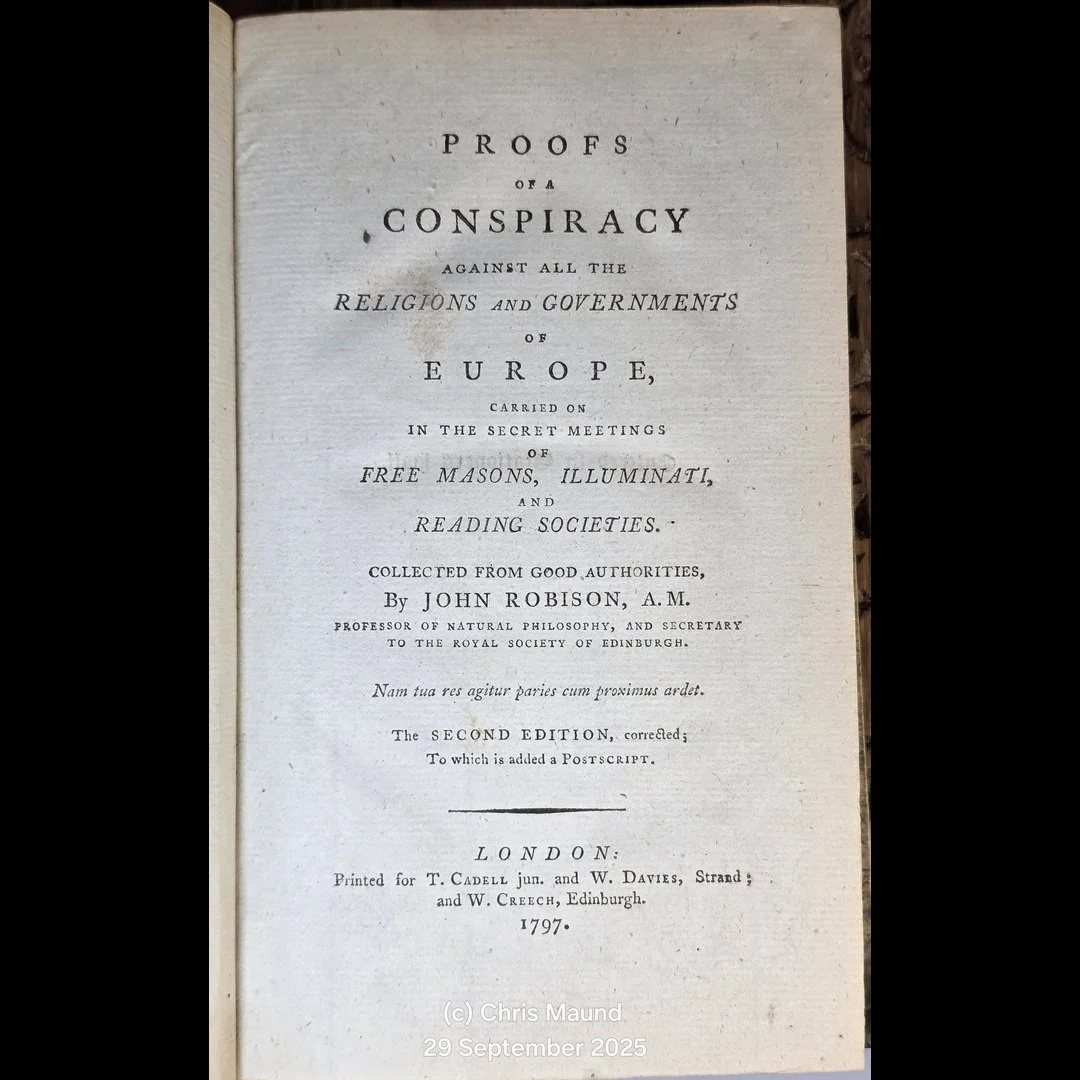 Image 1 of 15
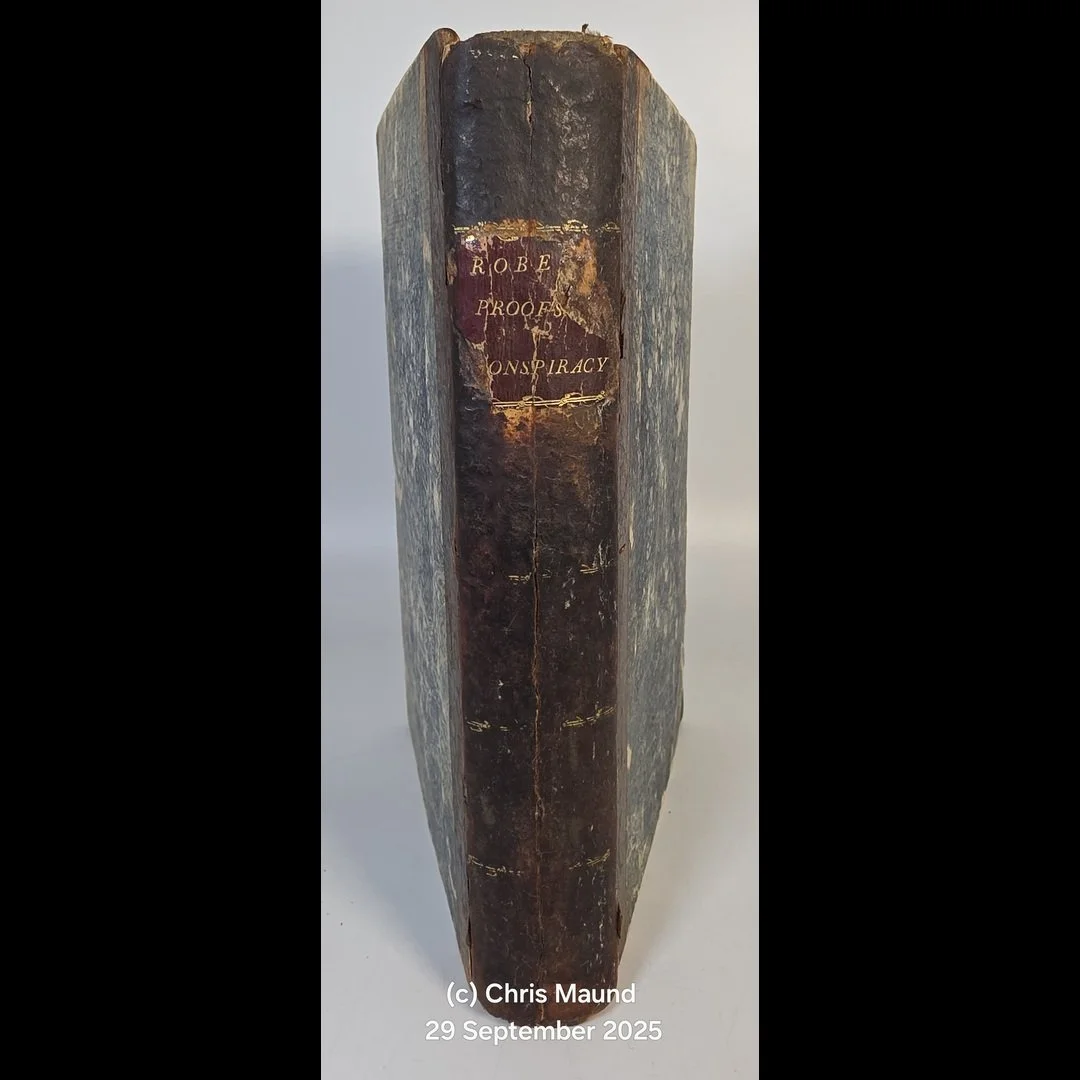 Image 2 of 15
 Image 3 of 15
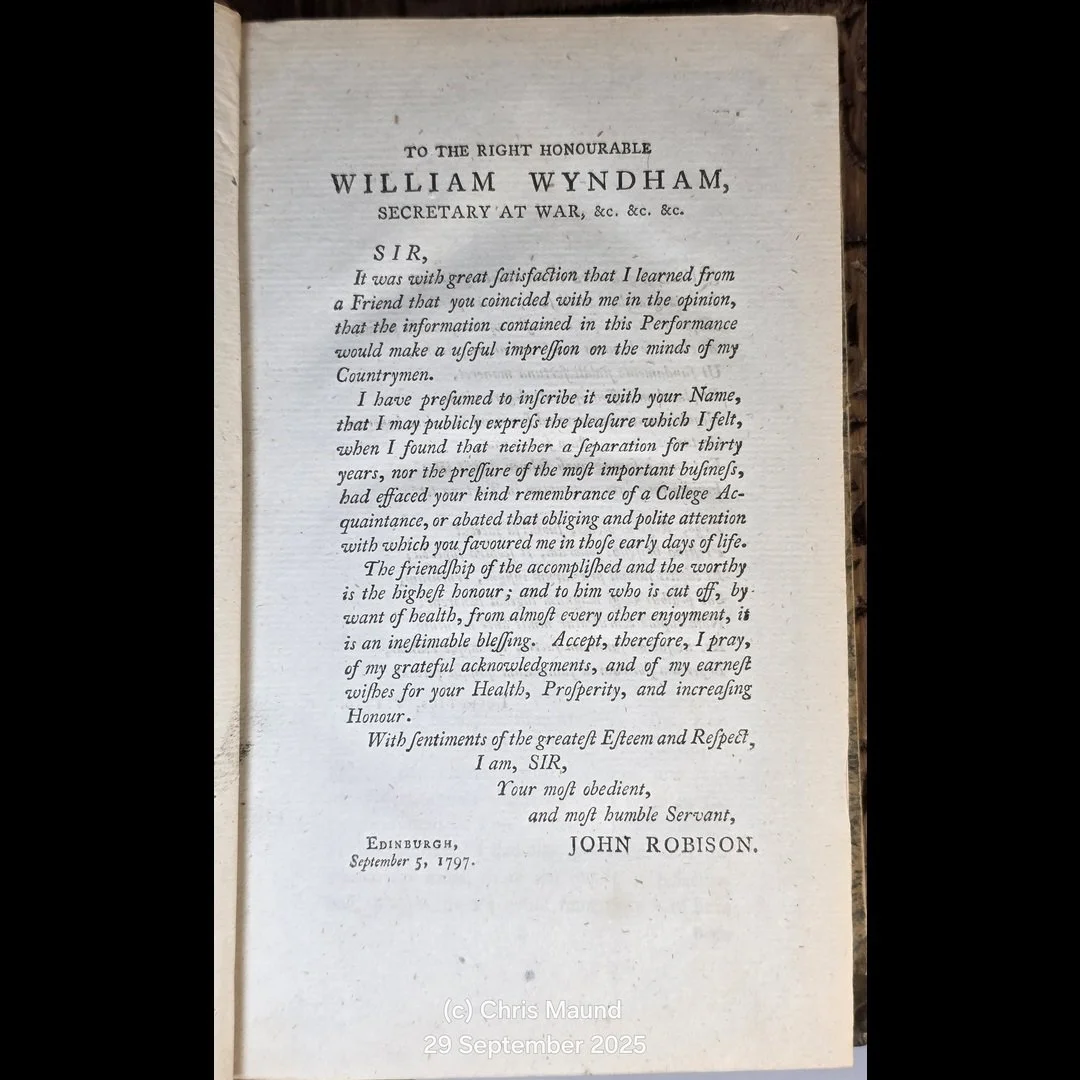 Image 4 of 15
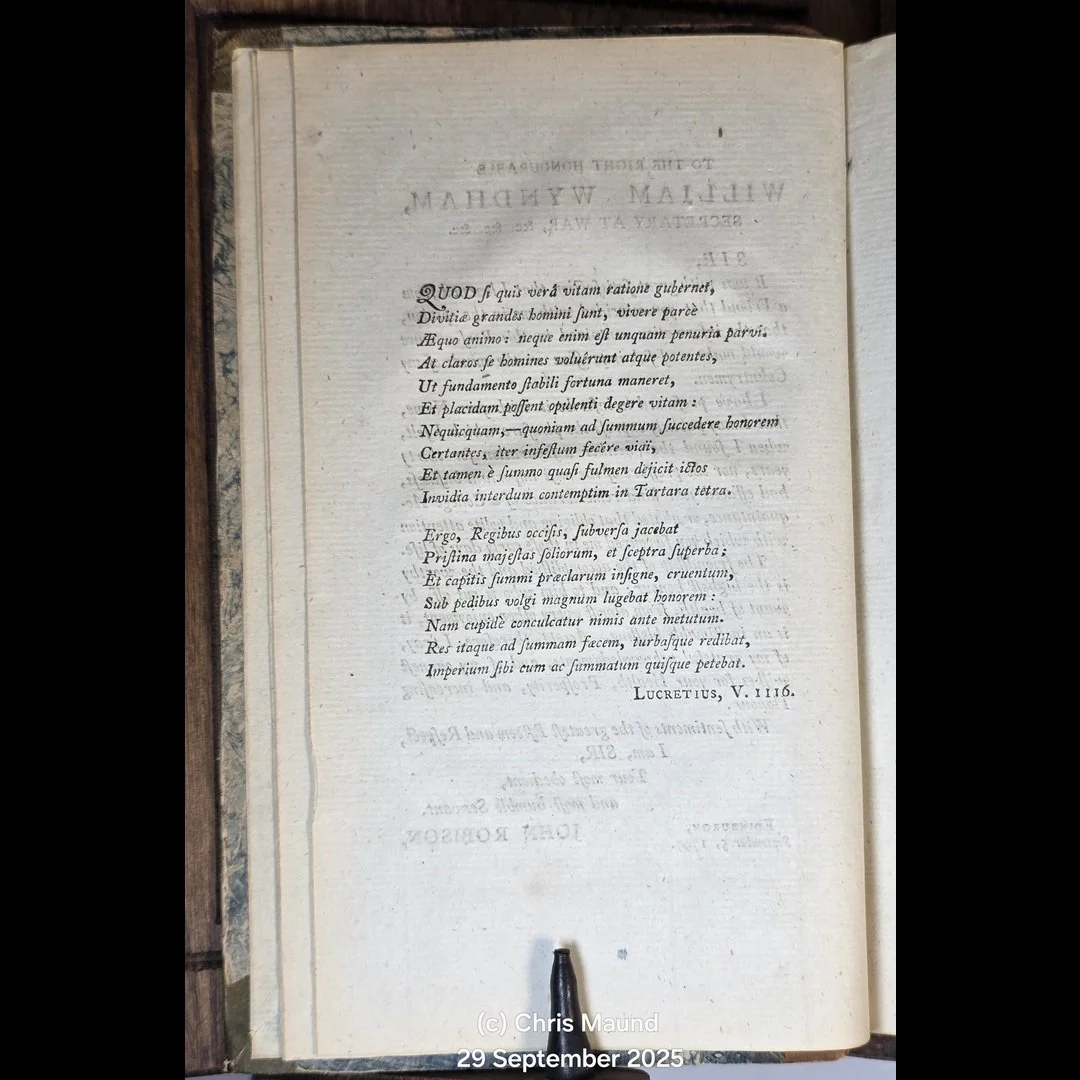 Image 5 of 15
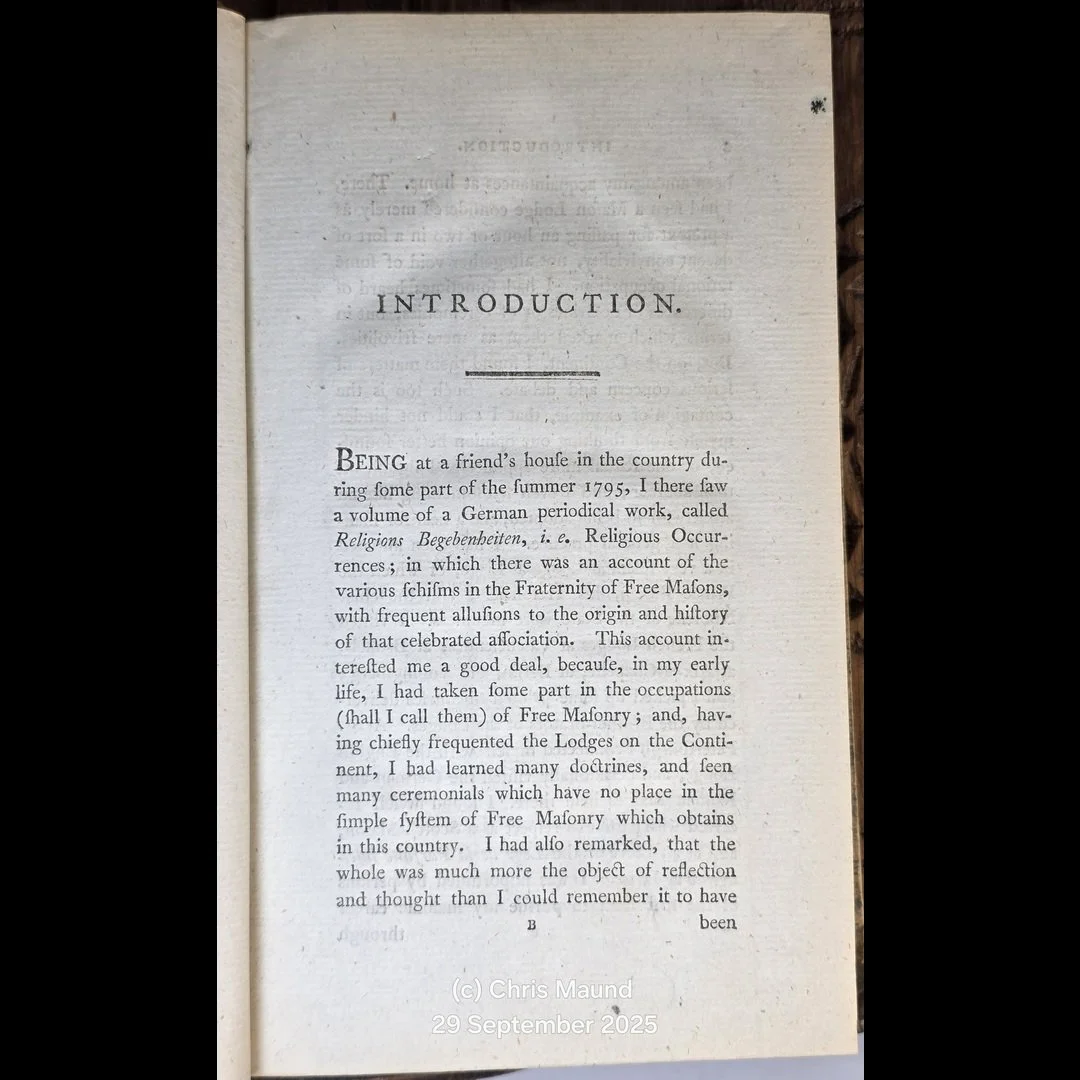 Image 6 of 15
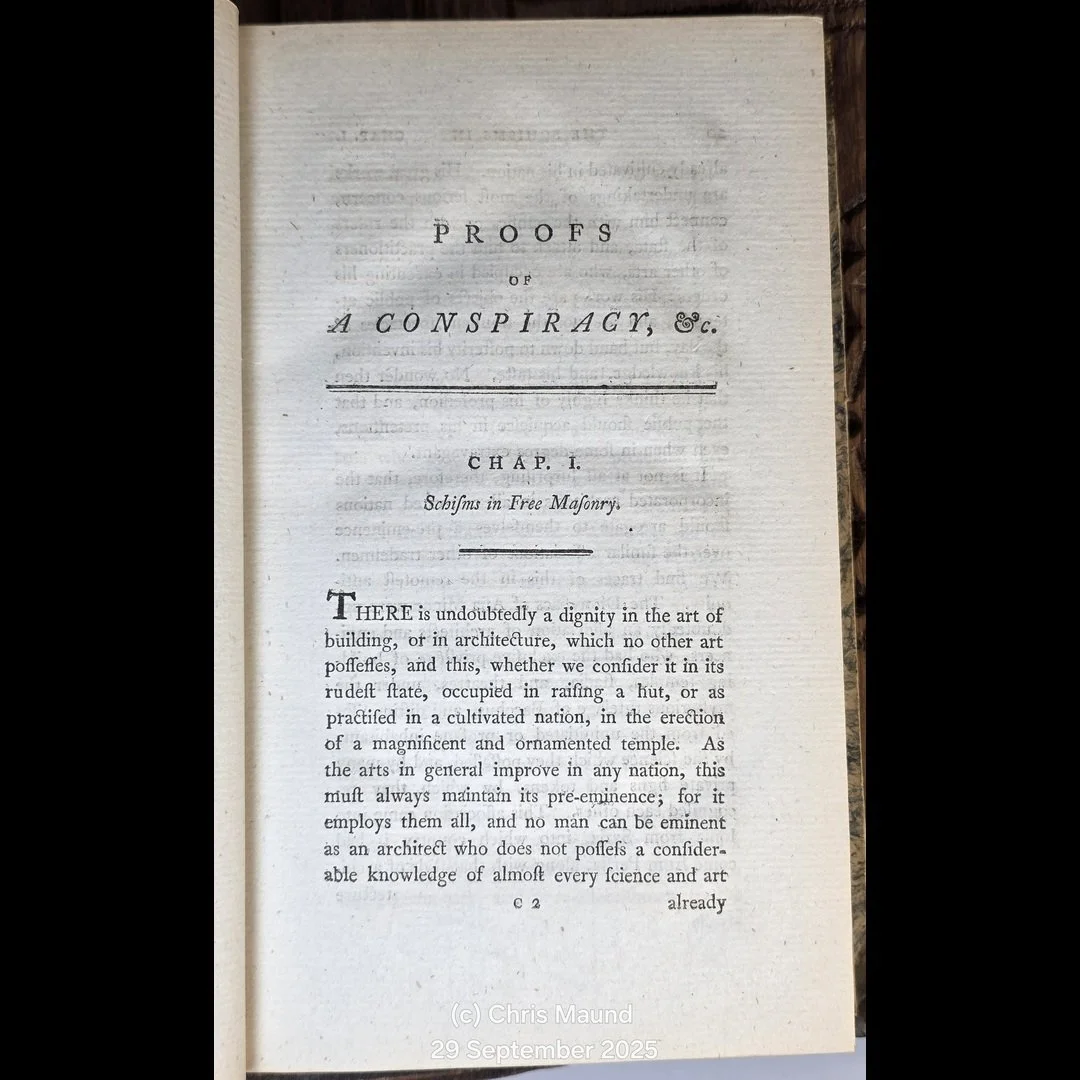 Image 7 of 15
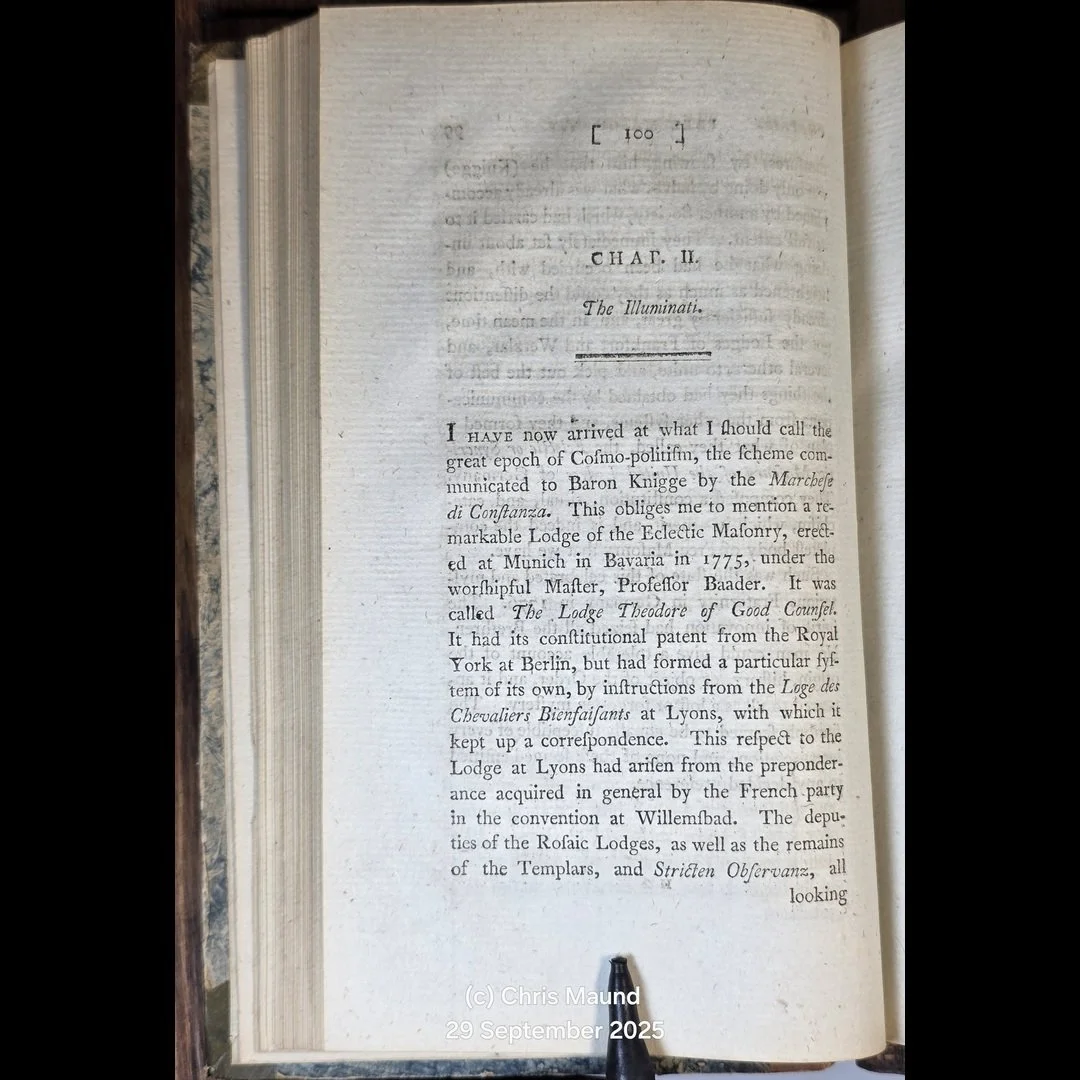 Image 8 of 15
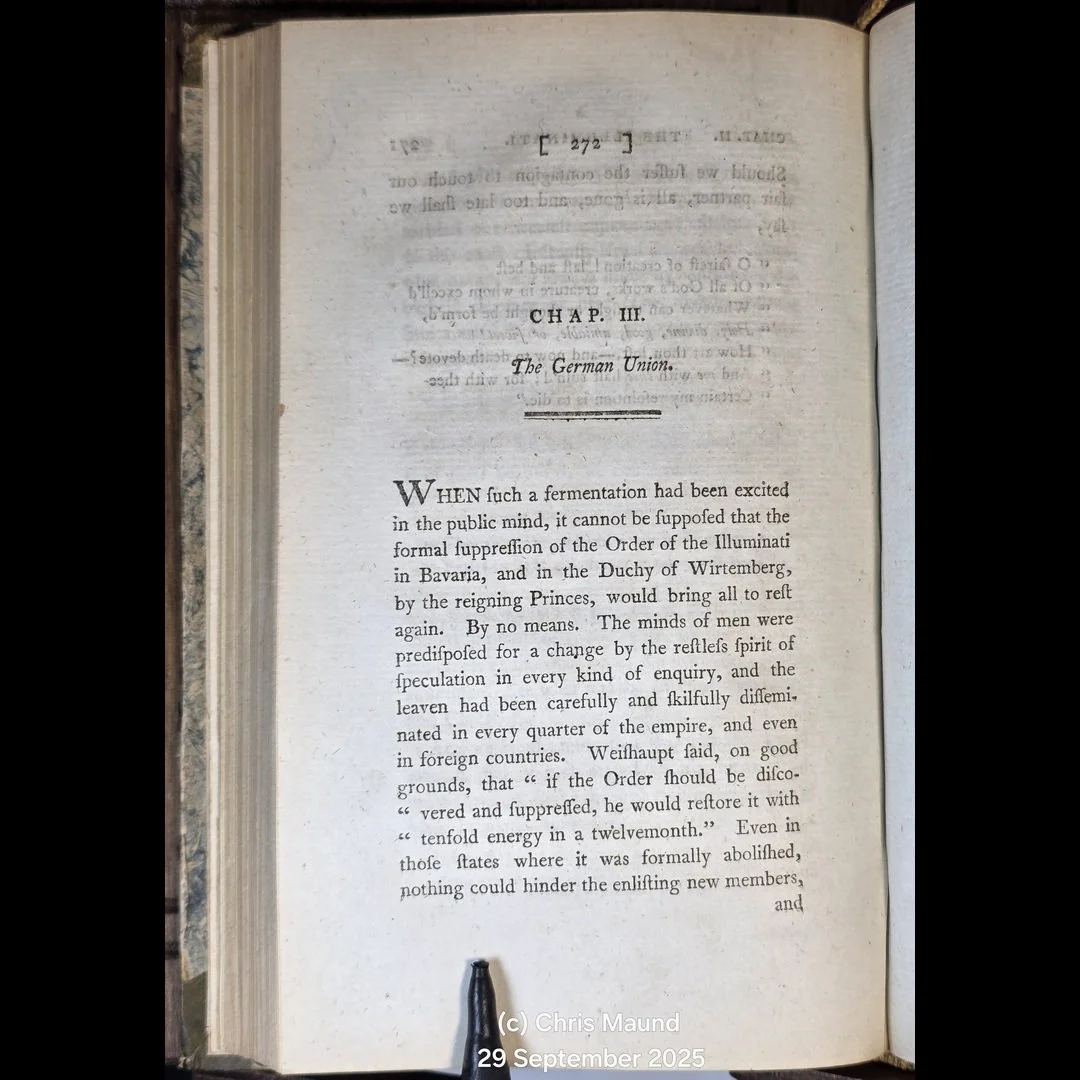 Image 9 of 15
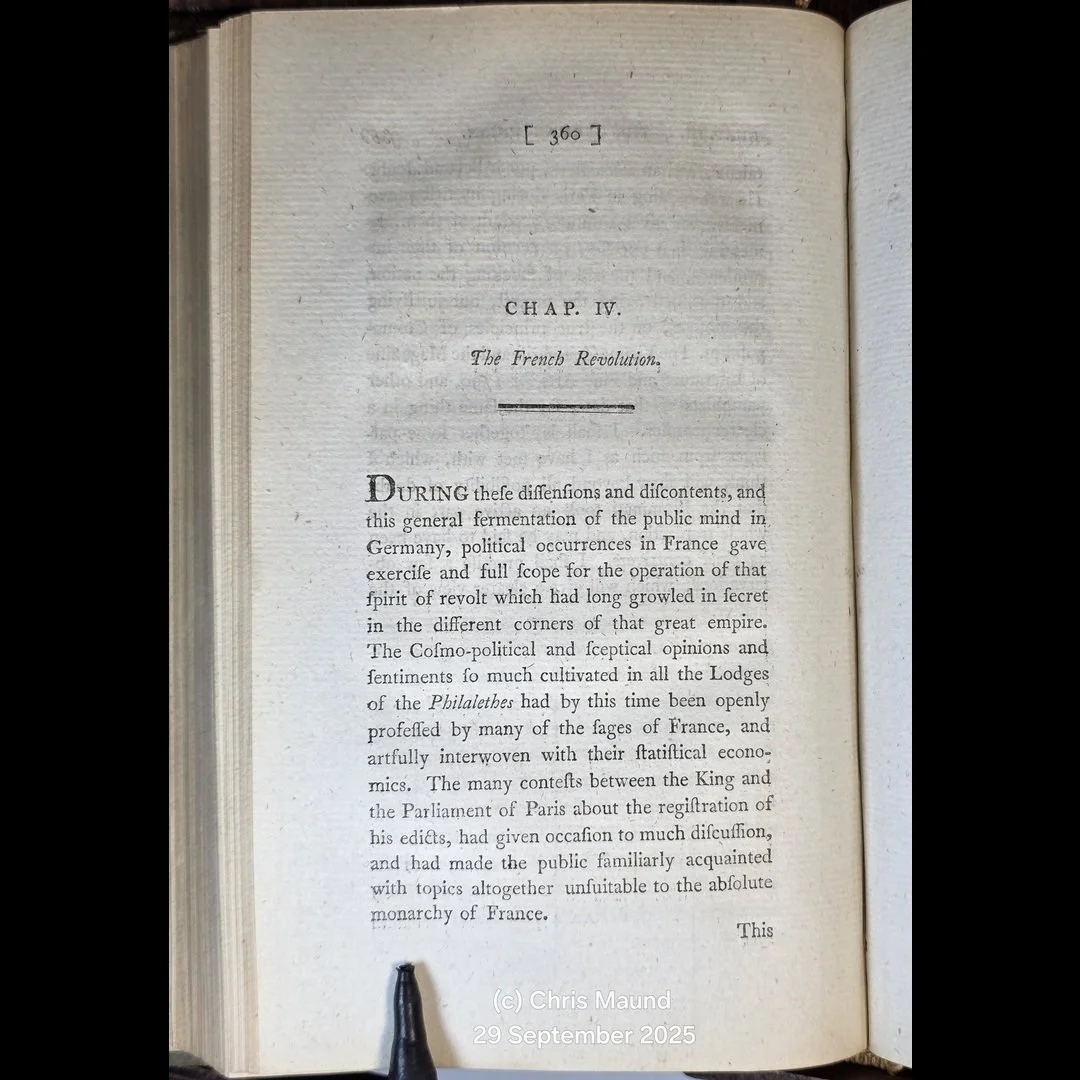 Image 10 of 15
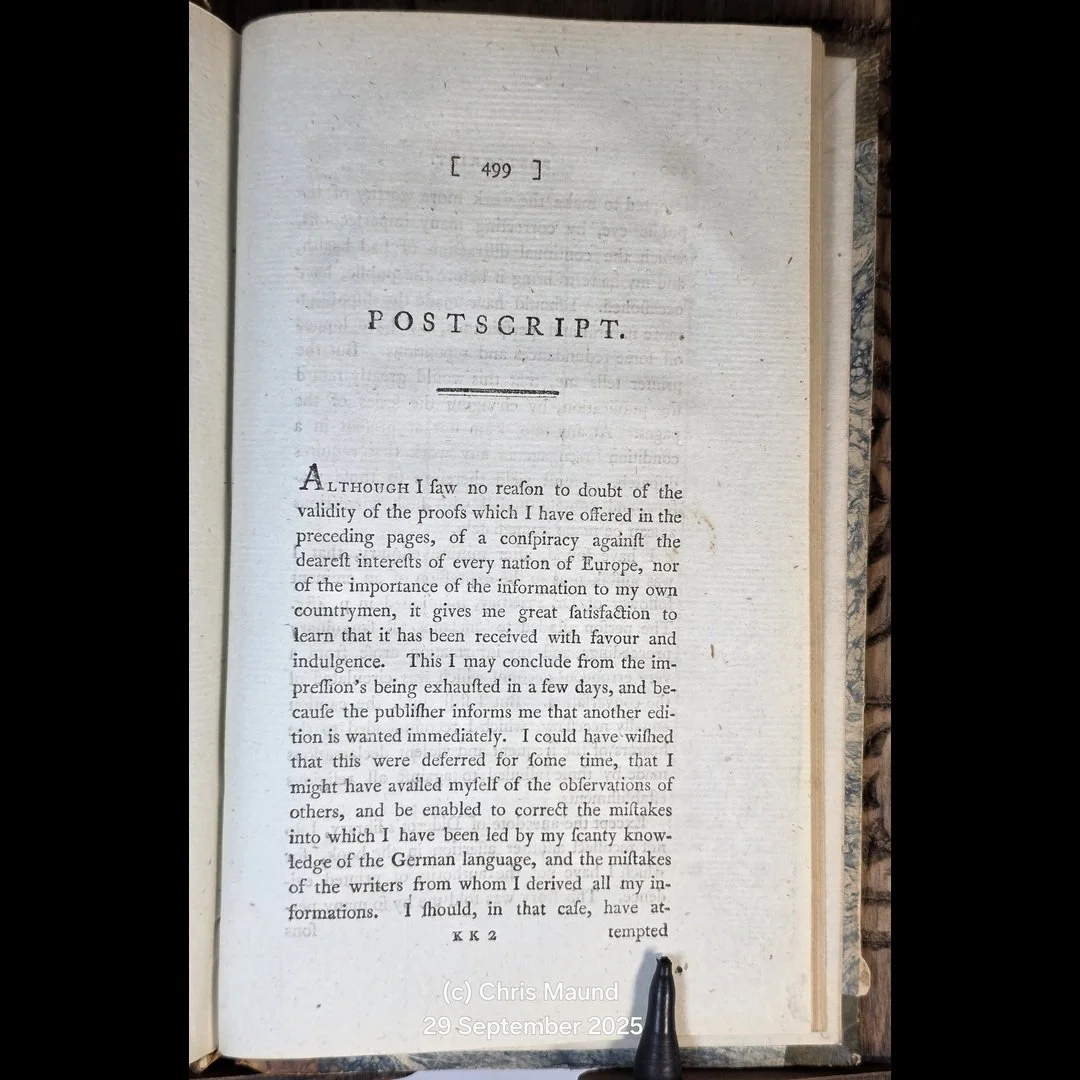 Image 11 of 15
 Image 12 of 15
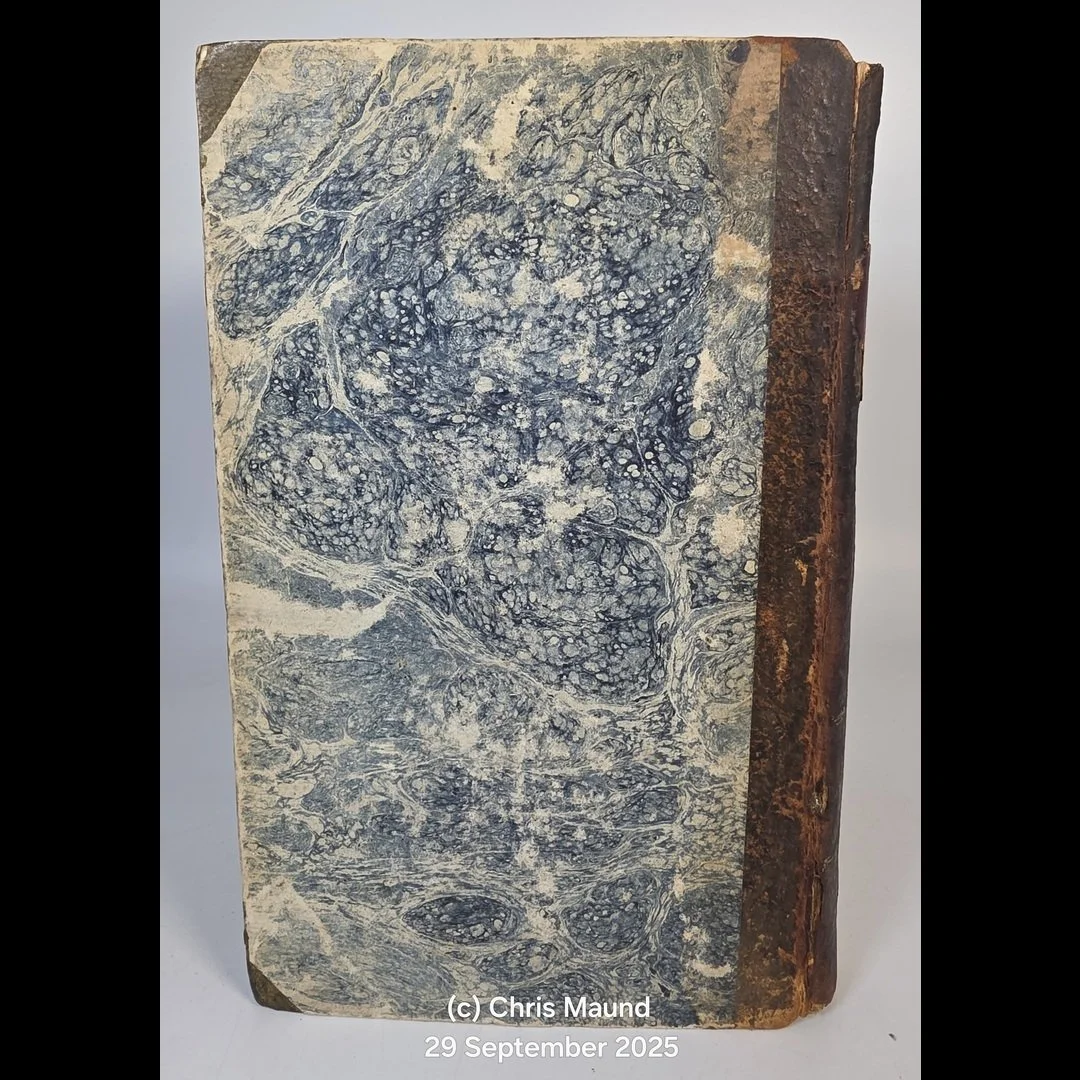 Image 13 of 15
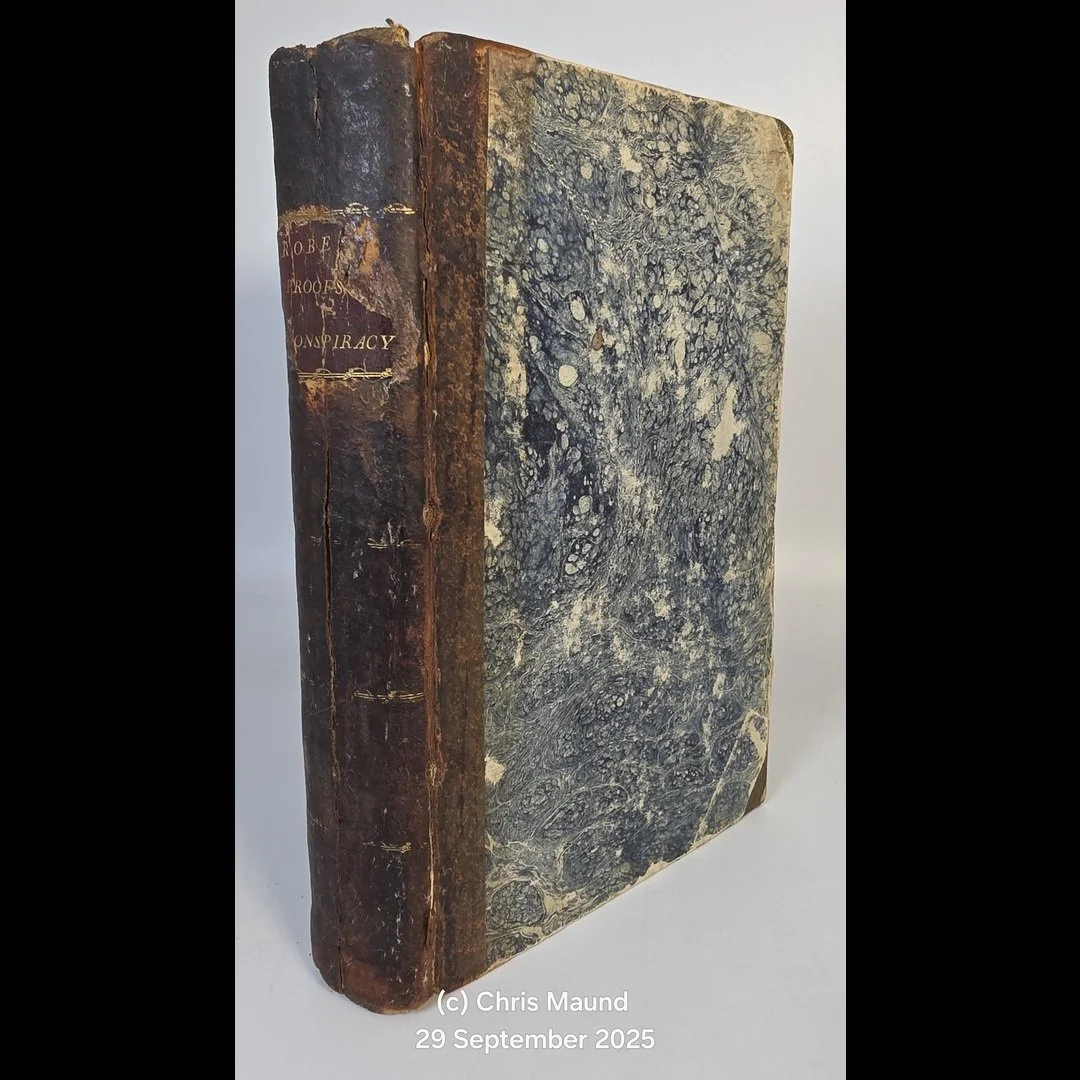 Image 14 of 15
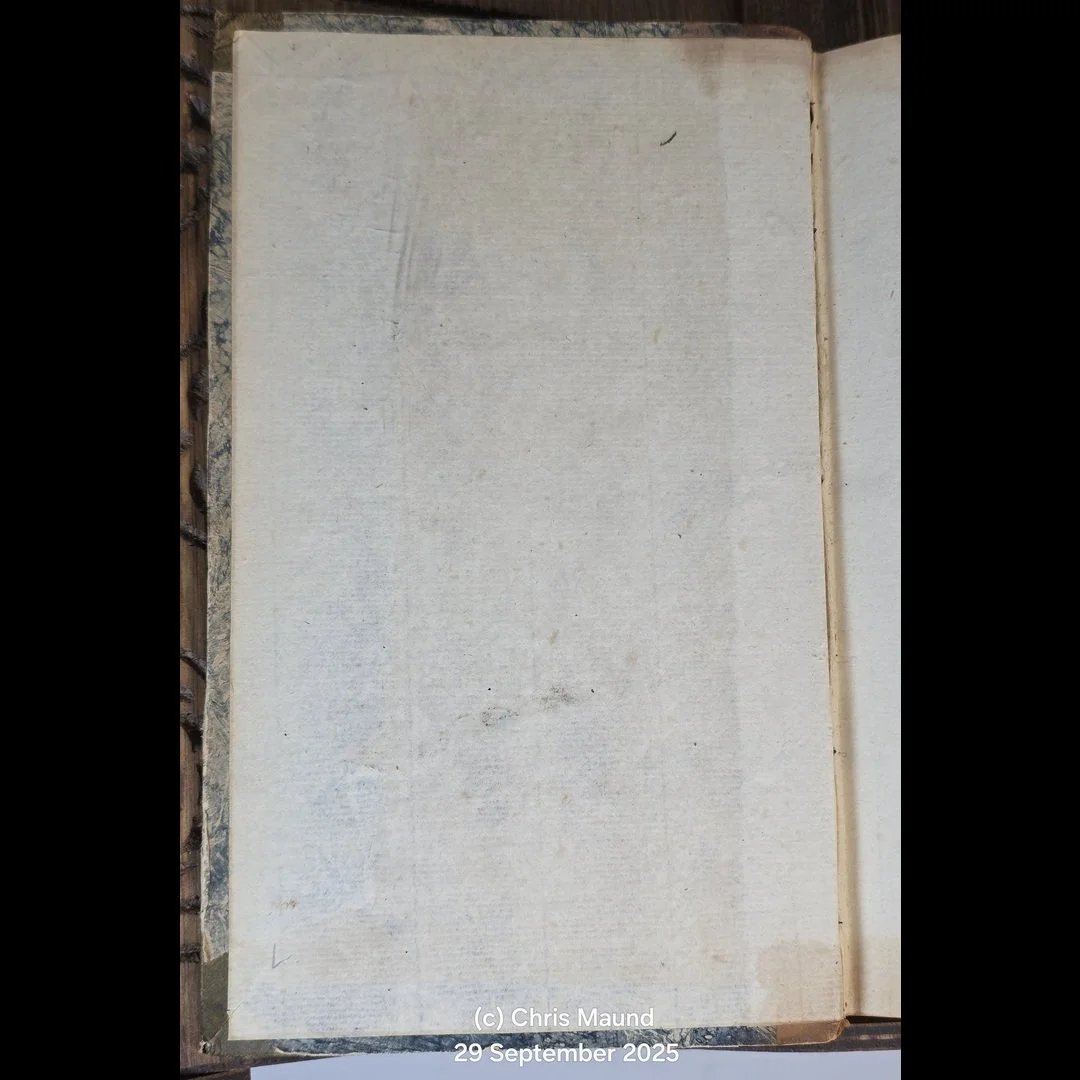 Image 15 of 15